What is Digital Marketing? Complete Beginner’s Guide (2026)
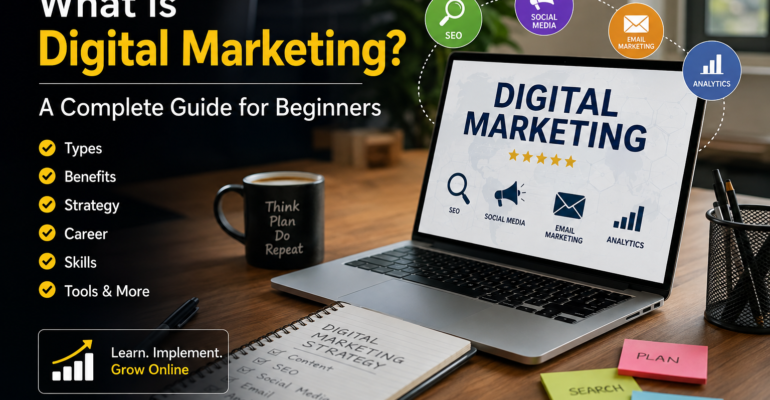

Think about the last time you searched on Google, watched a YouTube video, scrolled through Instagram, or clicked on an online advertisement. Every one of those interactions is part of Digital Marketing. Today, businesses no longer rely only on newspapers, television, or radio to reach customers. Instead, they use websites, search engines, social media platforms, email campaigns, and online advertisements to connect with people where they spend most of their time—on the internet.
In simple words, Digital Marketing is the process of promoting products, services, or brands through digital channels such as Google, Facebook, Instagram, YouTube, email, websites, and mobile applications. It helps businesses reach the right audience, generate leads, increase sales, and build long-term relationships with customers.
Whether you own a small local shop, manage a growing business, or want to build a career in online marketing, understanding Digital Marketing has become an essential skill in today’s digital world. From startups to multinational companies, organisations of every size use digital strategies to improve their online presence and stay competitive.
In this beginner-friendly guide, you’ll learn what Digital Marketing is, how it works, the different types of Digital Marketing, its benefits, career opportunities, essential skills, and why it has become one of the fastest-growing industries in India. We’ll also share practical examples to help you understand how businesses use Digital Marketing every day.
If you’re planning to build a career in this field, we’ll also introduce our Digital Marketing Course in Shimla, where you can gain practical experience through live projects, AI-powered tools, and industry-focused training.
What is Digital Marketing?
Digital Marketing is the practice of promoting products, services, or brands using digital channels such as search engines, websites, social media, email, mobile apps, and online advertising. Its primary goal is to attract the right audience, generate leads, build customer relationships, and increase sales through measurable online strategies.
Unlike traditional marketing, where businesses rely on newspapers, magazines, radio, television, or billboards, Digital Marketing enables companies to connect with potential customers in real time. It allows marketers to understand user behaviour, measure campaign performance, and make improvements based on data, making it one of the most effective marketing methods available today.
For example, if someone searches “best laptop under ₹50,000” on Google and clicks a website to compare products, they are interacting with Search Engine Optimization (SEO) and Google Ads. Similarly, when you see a sponsored post on Instagram or receive a promotional email from an online store, you are experiencing different forms of Digital Marketing in action.
The biggest advantage of Digital Marketing is that it allows businesses to target specific audiences based on factors such as age, location, interests, online behaviour, and purchasing habits. This targeted approach helps businesses achieve better results while using their marketing budget more efficiently.
Today, Digital Marketing is used by businesses of every size—from local shops and educational institutes to e-commerce brands and global corporations. As more people spend time online, Digital Marketing has become one of the most valuable skills for entrepreneurs, students, freelancers, and working professionals.
How Does Digital Marketing Work?
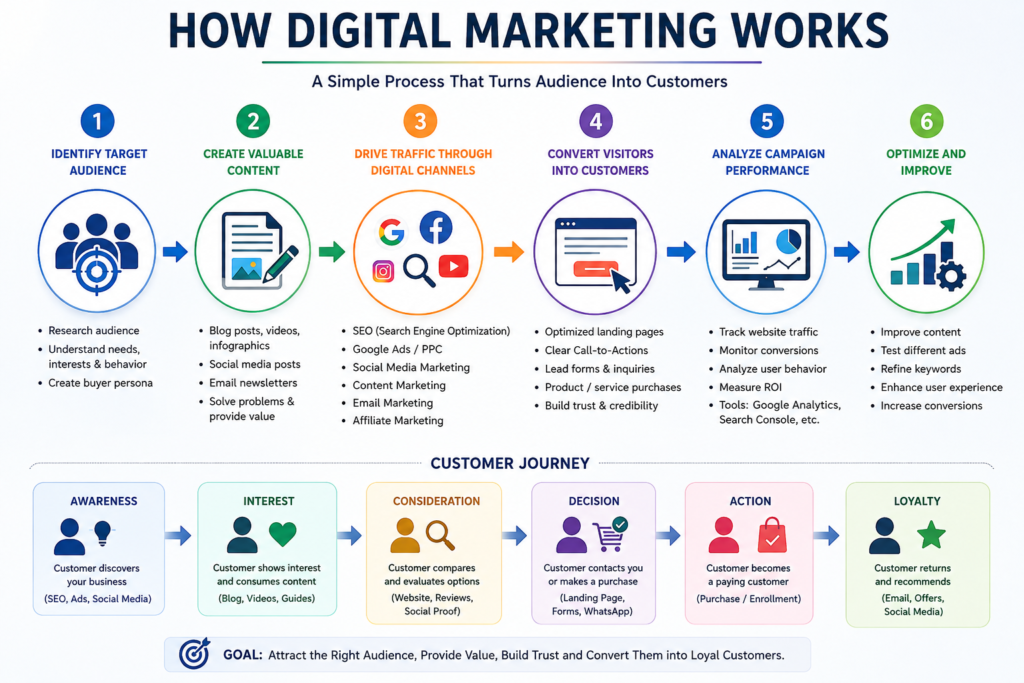
Digital Marketing works by connecting businesses with potential customers through online platforms. Instead of promoting products to everyone, it helps businesses reach people who are most likely to be interested in their products or services. Every digital marketing campaign follows a simple process—from attracting visitors to converting them into paying customers and building long-term relationships.
Whether someone discovers a business through Google Search, a Facebook advertisement, an Instagram Reel, or an email newsletter, the goal remains the same: guide the customer from awareness to action.
The Digital Marketing Process
A successful digital marketing strategy usually follows these six steps:
1. Identify the Target Audience
Every campaign begins by understanding who the ideal customers are. Businesses research their audience based on factors such as age, location, interests, online behaviour, and buying habits. This ensures that marketing messages reach people who are genuinely interested.
For example, a computer training institute may target students, graduates, job seekers, and working professionals looking to upgrade their digital skills.
2. Create Valuable Content
After identifying the audience, businesses create content that solves problems or answers questions. This may include:
- Blog articles
- Videos
- Social media posts
- Infographics
- Email newsletters
- Landing pages
Useful and informative content builds trust and encourages users to interact with the brand.
3. Drive Traffic Through Digital Channels
Once the content is ready, businesses promote it through different digital marketing channels, including:
- Search Engine Optimization (SEO)
- Google Ads
- Social Media Marketing
- Email Marketing
- Content Marketing
- Affiliate Marketing
- YouTube Marketing
Using multiple channels helps attract both organic and paid traffic to a website.
4. Convert Visitors into Customers
Getting visitors is only the beginning. The next step is encouraging them to take action, such as:
- Filling out a contact form
- Calling the business
- Purchasing a product
- Registering for a course
- Downloading a brochure
- Subscribing to a newsletter
Well-designed landing pages, clear calls-to-action (CTAs), and a smooth user experience improve conversion rates.
5. Analyse Campaign Performance
One of the biggest advantages of Digital Marketing is that every campaign can be measured.
Businesses track important metrics such as:
- Website traffic
- Click-through rate (CTR)
- Conversion rate
- Cost per Lead (CPL)
- Return on Investment (ROI)
- Bounce Rate
- User Behaviour
Tools like Google Analytics and Google Search Console help marketers understand what’s working and what needs improvement.
6. Optimise and Improve
Digital Marketing is an ongoing process. After analysing campaign performance, marketers make improvements by:
- Updating content
- Improving SEO
- Testing different advertisements
- Refining keywords
- Enhancing landing pages
- Improving website speed
- Creating better user experiences
Continuous optimisation leads to better rankings, higher conversions, and stronger business growth over time.
Simple Example of How Digital Marketing Works
Imagine a student wants to learn Digital Marketing.
- The student searches “What is Digital Marketing?” on Google.
- A well-optimised blog appears in the search results.
- The student reads the article and learns about Digital Marketing.
- The blog recommends a professional training course.
- The student visits the course page, fills out an enquiry form, and contacts the institute.
- The institute follows up with the student and completes the admission process.
This entire journey—from search to enrolment—is powered by Digital Marketing.
Customer Journey in Digital Marketing
| Stage | Customer Action | Digital Marketing Channel |
|---|---|---|
| Awareness | Searches for information | SEO, Blog, Google Ads |
| Interest | Reads articles and watches videos | Content Marketing, YouTube |
| Consideration | Compares courses or services | Website, Reviews, Social Media |
| Decision | Contacts the business | Landing Page, Contact Form, WhatsApp |
| Action | Makes a purchase or enrols | Website, Payment Gateway |
| Loyalty | Receives updates and offers | Email Marketing, Social Media |
Why Measuring Results Makes Digital Marketing Different
Unlike traditional marketing, Digital Marketing provides real-time insights into campaign performance. Businesses can see how many people visited their website, clicked an advertisement, filled out a form, or completed a purchase. This data helps marketers improve future campaigns and achieve better results with their marketing budget.
This ability to measure, analyse, and optimise is one of the biggest reasons Digital Marketing has become the preferred marketing approach for businesses of all sizes.
Why is Digital Marketing Important?
The way people discover, compare, and buy products has changed dramatically over the last decade. Before making a purchase, most customers search online, read reviews, compare prices, watch videos, or check social media. This shift in consumer behaviour has made Digital Marketing one of the most important business strategies in the modern world.
Whether you’re running a local shop, a coaching institute, a startup, or a large company, having a strong online presence is no longer optional—it’s essential. Digital Marketing helps businesses connect with the right audience, build trust, and generate measurable results without the high costs of traditional advertising.
Unlike traditional marketing, Digital Marketing allows businesses to understand customer behaviour in real time. You can see how many people visited your website, clicked an advertisement, filled out a contact form, or completed a purchase. These insights make it easier to improve campaigns and achieve better results.
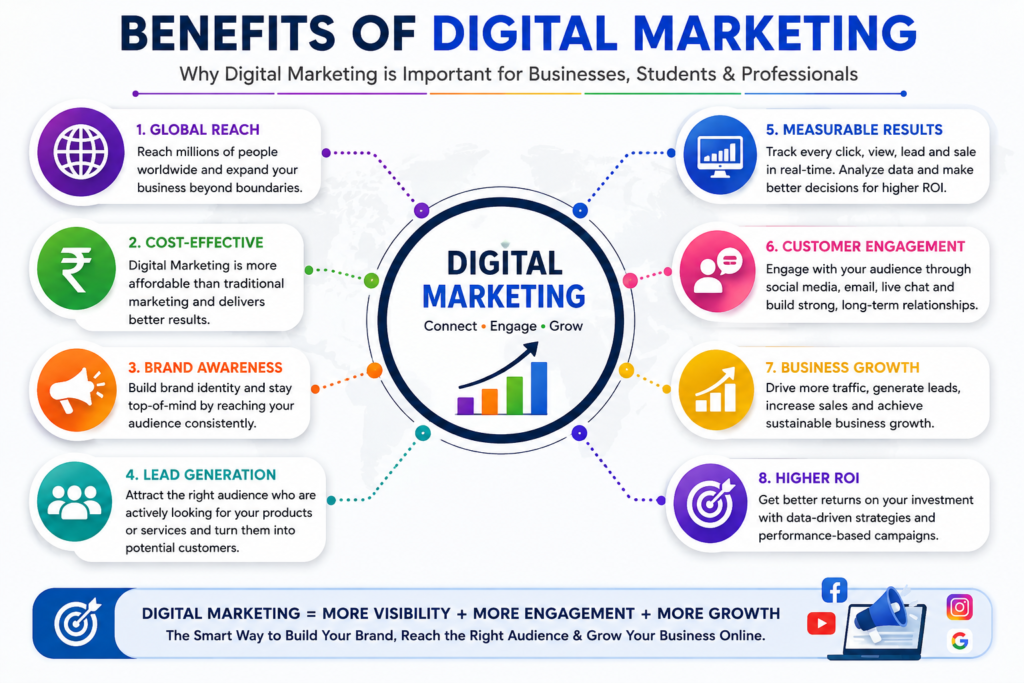
Benefits of Digital Marketing
Here are some of the biggest reasons why businesses invest in Digital Marketing:
Reach the Right Audience
Instead of advertising to everyone, Digital Marketing helps you target people based on their:
- Location
- Age
- Interests
- Online behaviour
- Search intent
- Device usage
This targeted approach increases the chances of attracting potential customers who are genuinely interested in your products or services.
Cost-Effective Marketing
Digital Marketing is often more affordable than traditional advertising methods such as newspapers, television, or billboards.
Even small businesses can start with a limited budget and gradually increase their investment as they see positive results.
Build Brand Awareness
Consistent content, social media activity, and search engine visibility help businesses become more recognisable. When customers repeatedly see your brand online, they are more likely to trust your business and choose your products or services.
Generate High-Quality Leads
Digital Marketing attracts people who are already searching for solutions online.
For example:
- Someone searching for “best laptop for students” is more likely to purchase a laptop.
- Someone searching for “Digital Marketing Course in Shimla” is already interested in learning Digital Marketing.
This intent-driven approach generates better-quality leads compared to traditional advertising.
Measure Everything
One of the biggest advantages of Digital Marketing is that every campaign can be measured.
Businesses can monitor:
- Website visitors
- Keyword rankings
- Advertisement clicks
- Conversion rates
- Sales
- Customer enquiries
- Return on Investment (ROI)
This data helps marketers make informed decisions and continuously improve performance.
Improve Customer Engagement
Digital Marketing enables businesses to communicate directly with customers through:
- Social media
- Email campaigns
- Live chat
- Online communities
This interaction strengthens customer relationships and increases brand loyalty over time.
Increase Sales and Business Growth
By combining SEO, content marketing, paid advertising, social media, and email campaigns, businesses can attract more visitors, generate more enquiries, and convert those leads into loyal customers.
A well-planned Digital Marketing strategy supports long-term business growth by increasing visibility, improving customer trust, and driving consistent revenue.
Why Digital Marketing is Growing Rapidly in India
India has become one of the world’s fastest-growing digital economies. Millions of people use Google, YouTube, Instagram, Facebook, LinkedIn, and online shopping platforms every day. At the same time, businesses of all sizes are investing more in their online presence to reach these digital consumers.
Several factors have accelerated the growth of Digital Marketing in India:
- Widespread internet access across urban and rural areas
- Increasing smartphone usage
- Growth of e-commerce and online services
- Rise of digital payments
- Expansion of startups and small businesses
- Greater demand for online education and remote learning
As more organisations shift their marketing budgets to digital channels, the demand for skilled digital marketers continues to grow across industries.
Real-Life Examples of Digital Marketing
Digital Marketing is part of everyday life, even if you don’t always notice it.
Here are a few familiar examples:
| Activity | Digital Marketing Channel |
|---|---|
| Searching for “best restaurant near me” on Google | Search Engine Optimization (SEO) |
| Seeing a sponsored product while browsing | Google Ads / PPC |
| Watching a brand’s Instagram Reel | Social Media Marketing |
| Receiving a discount offer in your inbox | Email Marketing |
| Reading a helpful blog before making a purchase | Content Marketing |
| Recommending a product through a referral link | Affiliate Marketing |
| Watching a product review on YouTube | Video Marketing |
These examples show how businesses use different digital channels to connect with customers at every stage of their buying journey.
Quick Summary
Digital Marketing is important because it helps businesses reach the right audience, build brand awareness, generate qualified leads, improve customer engagement, measure campaign performance, and grow more efficiently than traditional marketing methods. As internet usage continues to rise, Digital Marketing has become an essential skill for businesses, entrepreneurs, students, and professionals alike.
Types of Digital Marketing
Search Engine Optimization (SEO) is the process of improving a website so it appears higher in search engine results like Google and Bing without paying for advertisements.
When someone searches for information online, Google ranks websites based on their relevance, quality, and user experience. SEO helps businesses optimize their websites to attract more organic traffic, making it one of the most cost-effective digital marketing strategies.
SEO includes several important activities, such as:
- Keyword Research
- On-Page SEO
- Technical SEO
- Off-Page SEO
- Local SEO
- Link Building
- Content Optimization
For example, if a user searches for “best Digital Marketing Course in Shimla”, a well-optimized website has a better chance of appearing on the first page of Google.
Learn more: Digital Marketing course with AI in Shimla and SEO Course in Shimla | IICE Computer Education Shimla
Search Engine Marketing (SEM) & Google Ads
Search Engine Marketing (SEM) involves promoting websites through paid advertisements on search engines. The most popular SEM platform is Google Ads, where businesses bid on keywords to display ads above the organic search results.
Google Ads helps businesses:
- Reach customers instantly
- Generate qualified leads
- Increase website traffic
- Promote products and services
- Improve online sales
Unlike SEO, which takes time to build rankings, Google Ads can generate traffic almost immediately after launching a campaign.
Businesses only pay when someone clicks on their advertisement, making it a performance-based advertising model known as Pay-Per-Click (PPC).
Learn more: Google Ads (PPC)
Social Media Marketing (SMM)
Social Media Marketing uses platforms like Facebook, Instagram, LinkedIn, YouTube, X (formerly Twitter), and Pinterest to connect with customers, build brand awareness, and promote products or services.
Businesses use social media to:
- Publish engaging content
- Build communities
- Respond to customer queries
- Run paid advertising campaigns
- Increase website traffic
- Improve customer engagement
Short-form videos, live sessions, and educational posts have become powerful ways to attract and retain audiences.
Learn more: Social Media Marketing Course in Shimla
Content Marketing
Content Marketing focuses on creating valuable, informative, and engaging content that helps customers solve problems and make informed decisions.
Instead of directly selling products, businesses educate their audience through:
- Blog articles
- Videos
- E-books
- Infographics
- Case studies
- Podcasts
- Guides
High-quality content improves SEO, builds trust, increases website traffic, and encourages visitors to return.
A well-written blog like this is an excellent example of Content Marketing.
Learn more: Content Marketing
Email Marketing
Email Marketing is one of the most effective ways to communicate directly with customers.
Businesses use email campaigns to:
- Share newsletters
- Promote new products
- Send special offers
- Follow up with leads
- Build customer loyalty
- Recover abandoned carts
Because emails reach users directly in their inbox, Email Marketing continues to deliver one of the highest returns on investment (ROI) among digital marketing channels.
Learn more:Email Marketing
Affiliate Marketing
Affiliate Marketing is a performance-based marketing model where individuals or businesses earn a commission by promoting another company’s products or services.
Affiliates share referral links through websites, blogs, YouTube channels, or social media. When someone makes a purchase using that link, the affiliate receives a commission.
This model benefits both businesses and content creators because businesses pay only for successful results.
Learn more: Affiliate Marketing Course in Shimla
Google Analytics
Google Analytics helps businesses understand how visitors interact with their website.
It provides valuable insights such as:
- Number of website visitors
- Traffic sources
- User behaviour
- Most popular pages
- Conversion tracking
- Audience demographics
These insights enable marketers to make data-driven decisions and improve their digital marketing strategies.
Learn more: Google Analytics 4
Google Search Console
Google Search Console is a free tool that helps website owners monitor their website’s performance in Google Search.
It allows marketers to:
- Track keyword rankings
- Submit XML sitemaps
- Fix indexing issues
- Monitor website health
- Improve search visibility
- Identify technical SEO problems
Using Google Search Console alongside Google Analytics provides a complete picture of website performance.
Learn more: Google Search Console
Comparison of Digital Marketing Channels
Different digital marketing channels serve different purposes. While some focus on increasing website traffic, others help businesses generate leads, improve customer engagement, or measure marketing performance. The table below explains the primary goal and best use case for each channel.
| Digital Marketing Channel | Primary Goal | Best For |
|---|---|---|
| Search Engine Optimization (SEO) | Increase organic website traffic through higher search rankings | Long-term business growth |
| Google Ads (PPC) | Drive instant traffic using paid advertisements | Lead generation and quick sales |
| Social Media Marketing | Build brand awareness and engage with customers | Community building and customer interaction |
| Content Marketing | Educate, inform, and build trust with valuable content | Improving organic visibility and authority |
| Email Marketing | Communicate directly with customers and nurture leads | Customer retention and repeat business |
| Affiliate Marketing | Generate sales through referral partners | Performance-based marketing and revenue growth |
| Google Analytics | Measure website traffic and user behaviour | Data-driven marketing decisions |
| Google Search Console | Monitor search performance and technical SEO | Improving search visibility and website health |
How These Channels Work Together
Successful businesses rarely rely on a single marketing channel. Instead, they combine multiple digital marketing strategies to create a complete customer journey.
For example:
- A customer discovers your website through SEO or Google Ads.
- They read your blog and learn about your services through Content Marketing.
- They start following your brand on social media, increasing trust through Social Media Marketing.
- They subscribe to your newsletter and receive updates using Email Marketing.
- An affiliate or influencer recommends your business through Affiliate Marketing.
- Meanwhile, Google Analytics measures user behaviour, and Google Search Console helps improve your website’s visibility in Google Search.
When these channels work together, they create a seamless experience that attracts new visitors, builds trust, converts leads into customers, and encourages repeat business.
Key Takeaway
Every type of Digital Marketing has a specific purpose, but the best results come from using them together. SEO helps your website rank organically, Google Ads delivers immediate traffic, Social Media Marketing builds relationships, Content Marketing establishes authority, Email Marketing keeps customers engaged, and Affiliate Marketing expands your reach through trusted partners. At the same time, Google Analytics and Google Search Console provide valuable insights that help you measure performance and continuously improve your strategy.
Whether you’re a business owner looking to grow online or a beginner planning a career in Digital Marketing, understanding how these channels work together is the foundation of a successful digital marketing strategy.
Traditional Marketing vs Digital Marketing
Marketing has always been about connecting businesses with potential customers. However, the way companies reach their audience has changed significantly over the years. Traditional Marketing uses offline channels such as newspapers, television, radio, magazines, billboards, and brochures, whereas Digital Marketing uses online platforms like search engines, websites, social media, email, and mobile applications.
Both methods aim to promote products and services, but they differ in terms of reach, cost, targeting, and measurable results. Today, many businesses combine both approaches to create a balanced marketing strategy. Understanding the differences between them helps businesses choose the right marketing channels based on their goals, audience, and budget.
Traditional Marketing vs Digital Marketing: Comparison Table
| Feature | Traditional Marketing | Digital Marketing |
|---|---|---|
| Marketing Channels | Newspapers, TV, Radio, Billboards, Flyers | Google, Websites, Social Media, Email, Mobile Apps |
| Audience Reach | Mostly local or regional | Local, national, and global |
| Targeting | Broad audience | Highly targeted based on age, location, interests, and behaviour |
| Cost | Generally expensive | Flexible for every budget |
| Performance Tracking | Difficult to measure accurately | Real-time analytics and reporting |
| Customer Interaction | One-way communication | Two-way communication through comments, messages, and reviews |
| Campaign Changes | Time-consuming and costly | Can be updated instantly |
| Speed of Results | Slower to evaluate | Immediate insights and faster optimisation |
| Return on Investment (ROI) | Hard to calculate | Easy to measure using analytics tools |
What is Traditional Marketing?
Traditional Marketing refers to promoting products or services using offline communication channels. Before the rise of the internet, businesses depended on newspapers, television commercials, radio advertisements, magazines, posters, banners, and direct mail to reach customers.
Although traditional marketing is still effective for building local brand awareness and reaching audiences who consume offline media, it offers limited targeting options and makes it difficult to measure campaign performance accurately.
Common Examples of Traditional Marketing
- Newspaper advertisements
- Television commercials
- Radio promotions
- Billboards and hoardings
- Flyers and brochures
- Event sponsorships
- Print magazines
Traditional marketing remains valuable for businesses targeting local communities or audiences that respond well to offline advertising.
What is Digital Marketing?
Digital Marketing is the promotion of products, services, or brands through online channels such as search engines, websites, social media platforms, email, and paid advertisements. It allows businesses to connect with their target audience wherever they spend time online.
Unlike traditional marketing, Digital Marketing provides detailed performance data, enabling businesses to measure website traffic, advertisement clicks, conversions, and customer engagement in real time. This makes it easier to improve campaigns and achieve better results.
Common Examples of Digital Marketing
- Ranking a website on Google using SEO
- Running Google Ads campaigns
- Promoting products on Instagram and Facebook
- Publishing educational blog articles
- Sending promotional email campaigns
- Collaborating with affiliate marketers
- Creating YouTube videos to educate customers
Advantages of Traditional Marketing
Traditional Marketing still offers several benefits, especially for businesses with a strong local presence.
Some of its advantages include:
- Builds credibility through established media channels
- Effective for reaching local audiences
- Suitable for offline events and exhibitions
- Helps create strong brand recognition through television and print advertising
- Works well for products targeting audiences with limited internet access
However, businesses often need a larger marketing budget, and measuring campaign performance can be challenging.
Advantages of Digital Marketing
Digital Marketing has become the preferred marketing method because it offers greater flexibility, wider reach, and measurable results.
Some key advantages include:
- Reach customers anywhere in the world
- Target specific audiences based on demographics and interests
- Start campaigns with a small budget
- Measure every click, visitor, and conversion
- Optimise campaigns in real time
- Generate high-quality leads
- Build long-term customer relationships
- Improve return on investment (ROI)
These advantages make Digital Marketing suitable for businesses of all sizes, from startups and local shops to multinational companies.
Can Businesses Use Both Together?
Yes. In fact, many successful businesses combine Traditional Marketing and Digital Marketing to maximise their results.
For example, a company may advertise a new product through television or newspapers while directing customers to its website or social media pages for more information. Similarly, a coaching institute can distribute brochures in local areas while also running Google Ads and publishing educational blogs to attract online enquiries.
By integrating both approaches, businesses can increase brand visibility, reach different audience segments, and create a consistent customer experience across online and offline channels.
Real-Life Example
Imagine a coaching institute launching a new Digital Marketing course.
Using Traditional Marketing, it prints banners, distributes pamphlets, and places advertisements in local newspapers to attract students from nearby areas.
Using Digital Marketing, the same institute publishes informative blogs, ranks its website on Google through SEO, runs Google Ads, creates Instagram Reels, shares student success stories on Facebook, and sends email updates to interested learners.
While traditional marketing creates awareness in the local community, Digital Marketing reaches a much larger audience, generates measurable enquiries, and helps the institute improve its campaigns based on real-time data.
Key Takeaway
Traditional Marketing and Digital Marketing both have their strengths, but they serve different purposes. Traditional Marketing is useful for offline branding and local visibility, while Digital Marketing provides targeted reach, measurable results, and greater flexibility. Businesses that combine both approaches can create stronger marketing campaigns and connect with customers through multiple channels.
How Can You Become a Digital Marketer?
Becoming a Digital Marketer is easier than ever because you don’t need a specific degree or technical background to get started. What matters most is your willingness to learn, practise, and stay updated with the latest marketing trends. Whether you’re a student, graduate, business owner, freelancer, or working professional, Digital Marketing offers opportunities for everyone.
The journey begins with learning the fundamentals of online marketing and gradually building practical experience through real-world projects. As you gain confidence, you can specialise in areas such as Search Engine Optimization (SEO), Google Ads, Social Media Marketing, Content Marketing, Email Marketing, or Web Analytics.
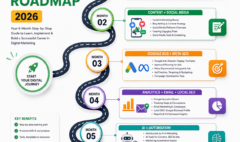
Step-by-Step Roadmap to Become a Digital Marketer
Step 1: Learn the Fundamentals
Start by understanding the core concepts of Digital Marketing, including SEO, Google Ads, Social Media Marketing, Content Marketing, Email Marketing, Affiliate Marketing, and Analytics.
Step 2: Build Practical Skills
Knowledge becomes valuable only when you apply it. Create your own website or blog, optimise it for search engines, publish content regularly, and experiment with different digital marketing techniques.
Step 3: Learn Digital Marketing Tools
Get hands-on experience with industry-standard tools such as:
- Google Analytics
- Google Search Console
- Google Ads
- Meta Ads Manager
- Canva
- ChatGPT and other AI tools
- WordPress
- Keyword research tools
These tools are widely used by businesses and agencies worldwide.
Step 4: Work on Live Projects
The best way to gain confidence is by working on real projects. Practical experience helps you understand customer behaviour, campaign optimisation, and performance measurement while building a professional portfolio.
Step 5: Earn Certifications
Recognised certifications demonstrate your knowledge and commitment to learning. Platforms such as Google Skillshop, HubSpot Academy, and Meta Blueprint offer valuable certifications that can strengthen your resume.
Step 6: Build Your Portfolio
Employers and clients often value practical work more than theoretical knowledge. Showcase your blogs, SEO projects, advertising campaigns, social media strategies, and analytics reports to demonstrate your skills.
Step 7: Apply for Jobs or Start Freelancing
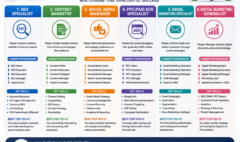
Once you’ve developed practical skills and built a portfolio, you can explore opportunities as a Digital Marketing Executive, SEO Specialist, PPC Expert, Social Media Manager, Content Marketer, Freelancer, or Digital Marketing Consultant.
Learn Digital Marketing with Practical Training
If you’re looking for structured learning with hands-on experience, enrolling in a professional training program can help you build job-ready skills faster.
At IICE Computer Education, our Digital Marketing Course in Shimla is designed for beginners, students, entrepreneurs, and working professionals. The course includes practical training in SEO, Google Ads, Social Media Marketing, Content Marketing, Email Marketing, Affiliate Marketing, Google Analytics, Google Search Console, AI-powered marketing tools, and live projects to help you gain real-world experience.
You can also explore our specialised training programs:
- Digital Marketing Course in Shimla
- SEO Course in Shimla
- Google Ads Course in Shimla
- Social Media Marketing Course in Shimla
- Content Marketing Course in Shimla
- Email Marketing Course in Shimla
- Affiliate Marketing Course in Shimla
- Google Analytics Course in Shimla
- Google Search Console Course in Shimla
Whether your goal is to secure a job, grow your business, or become a freelancer, practical training combined with continuous learning can help you build a successful career in Digital Marketing.
Frequently Asked Questions (FAQs)
1. What is Digital Marketing in simple words?
Digital Marketing is the process of promoting products or services through online platforms such as Google, websites, social media, email, and mobile applications to reach potential customers and increase sales.
2. How does Digital Marketing work?
Digital Marketing works by attracting potential customers through channels like SEO, Google Ads, social media, and content marketing, then converting them into leads or customers while measuring performance using analytics tools.
3. What are the main types of Digital Marketing?
The major types include Search Engine Optimization (SEO), Google Ads (PPC), Social Media Marketing, Content Marketing, Email Marketing, Affiliate Marketing, Video Marketing, and Web Analytics.
4. Is Digital Marketing a good career?
Yes. Digital Marketing is one of the fastest-growing career fields in India, offering excellent job opportunities, competitive salaries, freelancing options, and long-term career growth.
5. Who can learn Digital Marketing?
Anyone can learn Digital Marketing, including students, graduates, entrepreneurs, business owners, freelancers, and working professionals. No prior technical experience is required.
6. What skills are required for Digital Marketing?
A Digital Marketer should understand SEO, Google Ads, Content Marketing, Social Media Marketing, Email Marketing, Analytics, AI tools, communication, and problem-solving skills.
7. Can I learn Digital Marketing after 12th?
Yes. Students can begin learning Digital Marketing after completing the 12th standard and build valuable skills for jobs, freelancing, or entrepreneurship.
8. What is the salary of a Digital Marketer in India?
Entry-level Digital Marketing professionals typically earn around ₹2.5–₹4.5 lakh per year, while experienced specialists and managers can earn significantly higher depending on their skills, role, and location.
9. Is Digital Marketing easy for beginners?
Yes. With consistent learning and practical practice, beginners can gradually develop the skills needed to build a successful career in Digital Marketing.
10. Where can I learn Digital Marketing in Shimla?
If you’re looking for practical training, live projects, AI-powered tools, and industry-focused learning, you can enrol in the Digital Marketing Course in Shimla offered by IICE Computer Education.
Conclusion
Digital Marketing has transformed the way businesses connect with customers in today’s digital world. From Search Engine Optimization and Google Ads to Social Media Marketing, Content Marketing, Email Marketing, and Analytics, every digital marketing channel plays an important role in helping businesses grow online.
Whether you’re planning to start a new career, grow your business, or develop in-demand digital skills, learning Digital Marketing can open the door to exciting opportunities. The key to success is combining strong theoretical knowledge with practical experience, continuous learning, and hands-on projects.
If you’re ready to build a successful career in Digital Marketing, explore the Digital Marketing Course in Shimla at IICE Computer Education. Our industry-focused training, experienced mentors, live projects, internship opportunities, and AI-powered marketing modules are designed to help you become job-ready and confident in today’s competitive digital landscape.
Start your Digital Marketing journey today and take the first step toward building a rewarding career in one of the world’s fastest-growing industries.