Digital Marketing Roadmap 2026: Step-by-Step Guide for Beginners

Digital marketing has become one of the most important skills for businesses, professionals, freelancers, and entrepreneurs. But for a beginner, learning digital marketing can feel confusing because there are so many areas to explore—SEO, content marketing, social media, Google Ads, email marketing, analytics, AI, websites, and more.
The biggest question is not simply “What is digital marketing?” but “What should I learn first, and what should I learn next?”
That is where a digital marketing roadmap can help.
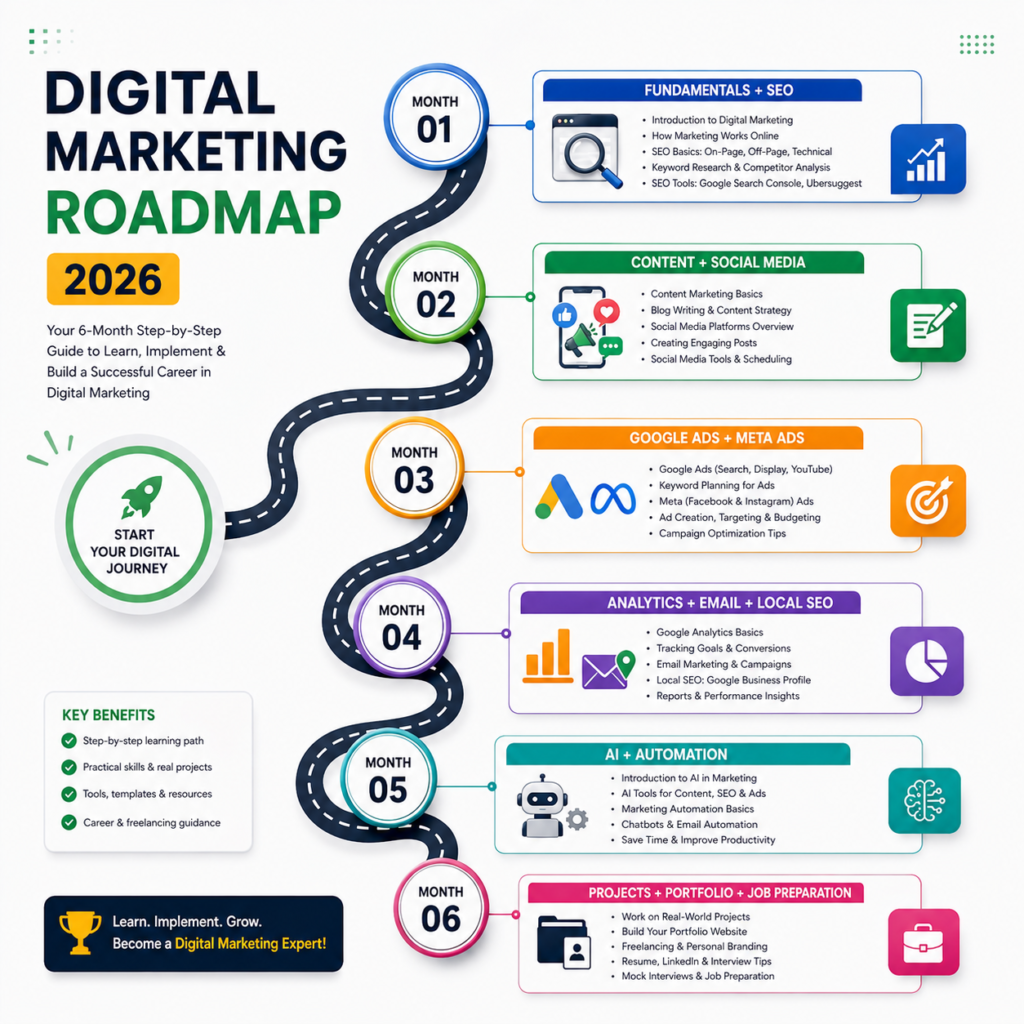
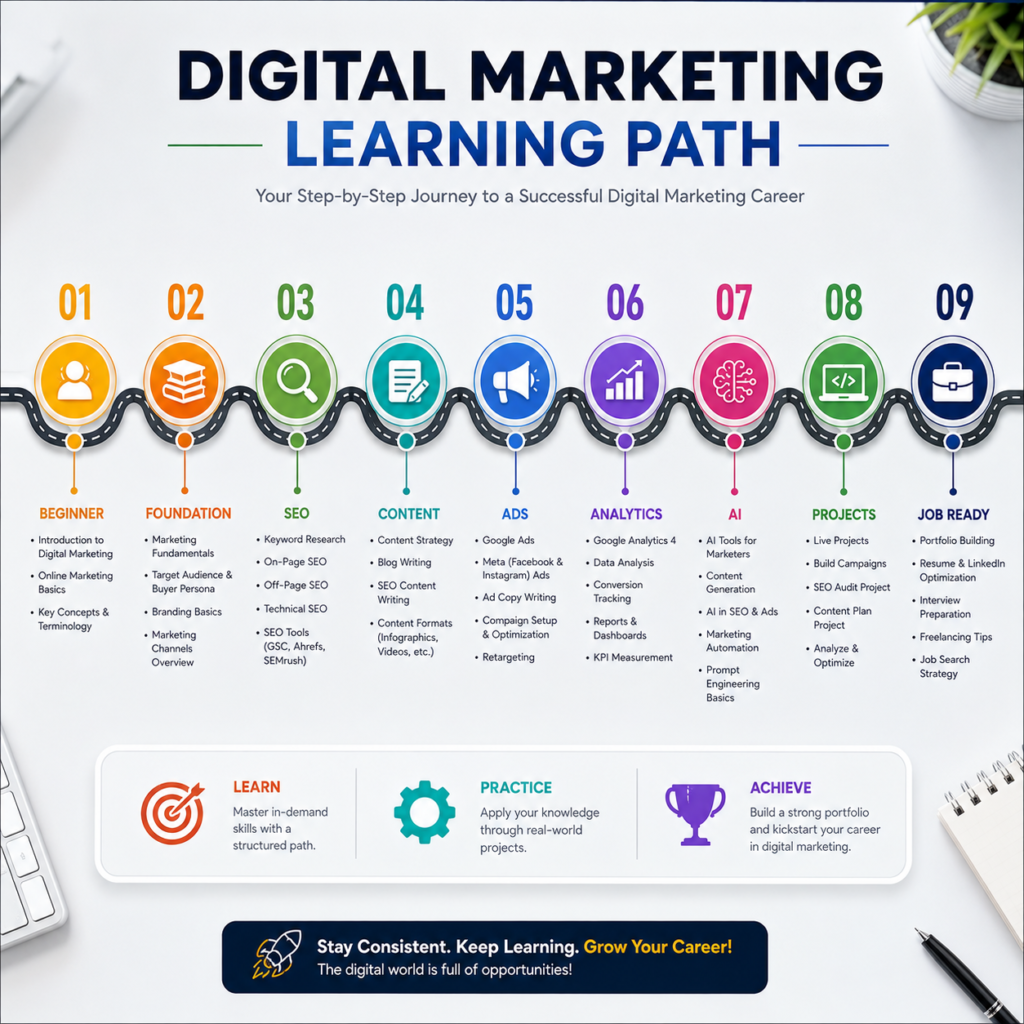
A roadmap gives you a clear learning path so you can develop your skills step by step instead of trying to learn everything at once. You can start with marketing fundamentals, move into SEO and content, learn social media and paid advertising, understand analytics, explore AI-powered marketing, and finally apply your knowledge through practical projects.
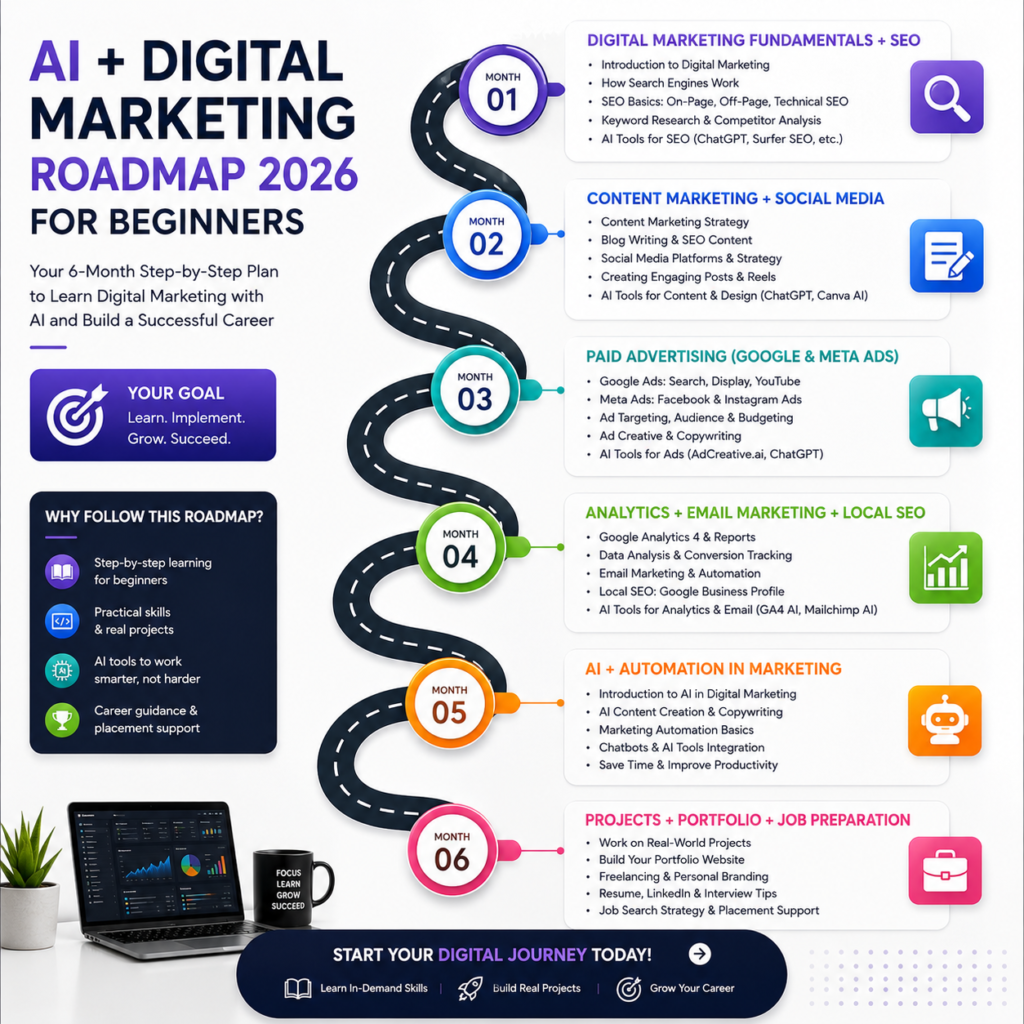
This Digital Marketing Roadmap 2026 is designed for beginners who want to learn digital marketing from scratch and gradually become job-ready. Whether you are a student, job seeker, business owner, freelancer, or someone planning a career change, this guide will help you understand what to learn, in what order, and how to practice each skill.
You do not need to master every digital marketing channel immediately. The better approach is to build a strong foundation first and then develop specialized skills according to your career goals.
Digital Marketing Roadmap 2026
What Is a Digital Marketing Roadmap?
A digital marketing roadmap is a structured learning plan that explains the skills, tools, concepts, and practical experience you can develop to become a digital marketer.
Instead of randomly watching tutorials about SEO one day, Google Ads the next day, and social media the day after, a roadmap gives your learning a logical sequence.
A beginner can follow a path such as:
Marketing Fundamentals → Website Basics → SEO → Content Marketing → Social Media → Paid Advertising → Analytics → Email Marketing → AI → Practical Projects → Portfolio → Career
This does not mean every learner has to follow exactly the same timeline. Someone interested in SEO may spend more time on search optimization, while someone interested in performance marketing may focus more heavily on Google Ads, Meta Ads, analytics, and conversion tracking.
The purpose of a roadmap is to give you direction and structure.
A good learning roadmap should answer five important questions:
- What should I learn first?
- What should I learn after that?
- Which tools should I practice?
- How can I gain practical experience?
- How can I become ready for a job, freelance work, or business?
For beginners, following a structured digital marketing learning roadmap can prevent information overload and make the learning process easier to manage.
Why Do Beginners Need a Digital Marketing Roadmap?
Digital marketing is a broad field. A beginner searching online for digital marketing courses or tutorials can quickly find thousands of resources covering different topics.
One course may begin with SEO. Another may focus on social media. Another may start with Google Ads, while another may focus on content creation or analytics.
This can create a common problem: learning without direction.
You may know many individual terms but still not understand how they connect.
For example, you might know what a keyword is but not understand search intent. You might know how to create a social media post but not know how social media contributes to a business objective. You might know how to create an advertisement but not know how to measure whether the campaign generated profitable results.
A roadmap connects these concepts.
A roadmap helps you build skills in the right order
You can begin with basic marketing concepts before moving into specialized areas. Once you understand the fundamentals, topics such as SEO, paid advertising, content marketing, and analytics become easier to understand.
A roadmap reduces information overload
You don’t need to learn ten different tools in your first week. Focus on one skill, practice it, and then move to the next stage.
A roadmap encourages practical learning
Digital marketing is not a subject that should be learned only through theory. You need to create websites, research keywords, write content, plan campaigns, analyze data, and work on realistic projects.
A roadmap helps with career planning
Once you understand the major areas of digital marketing, you can decide whether you want to specialize in SEO, PPC, social media, content, email marketing, analytics, AI marketing, or another area.
Step 1: Learn Marketing Fundamentals
Before learning individual digital marketing tools, start with basic marketing concepts.
This is the foundation of your entire digital marketing journey.
You should understand who the customer is, what problem the business solves, why someone would choose a particular product or service, and what action the business wants the customer to take.
Start With the Target Audience
A target audience is the specific group of people a business wants to reach.
For example, an institute offering digital marketing training may target:
- Students
- Job seekers
- Graduates
- Working professionals
- Business owners
- Freelancers
- People looking for career changes
Understanding the audience helps determine what content to create, which platforms to use, what keywords to target, and what type of advertising message to develop.
Learn About Buyer Personas
A buyer persona is a simplified representation of an ideal customer.
For example:
Name: Rahul
Age: 22
Background: Graduate
Goal: Wants a digital marketing job
Problem: Has limited practical experience
Need: Practical training and portfolio projects
You don’t need to create complicated personas at the beginning. The important thing is to understand the customer’s goals, problems, questions, and decision-making process.
Understand the Marketing Funnel
The marketing funnel explains how people can move from first discovering a business to eventually becoming customers.
A simple funnel looks like:
Awareness → Interest → Consideration → Conversion → Retention
At the awareness stage, a person may discover a brand through Google Search, social media, YouTube, or an advertisement.
During consideration, they may compare services, read reviews, visit websites, or look at pricing.
At the conversion stage, they may purchase a product, submit a form, call a business, or register for a service.
After conversion, the business can continue building the relationship through email marketing, social media, customer support, useful content, and other retention activities.
Understanding this journey makes it easier to understand why different digital marketing channels exist.
Learn About Leads and Conversions
A lead is a potential customer who has shown interest in a business.
For example, someone who fills out a course inquiry form may become a lead.
A conversion is a desired action completed by a user. Depending on the business, a conversion could be:
- Making a purchase
- Filling out a form
- Calling a business
- Registering for a course
- Downloading a resource
- Booking an appointment
- Subscribing to a newsletter
These concepts are important because digital marketing is ultimately about achieving measurable business outcomes, not simply generating website visits or social media followers.
Learn Search Intent
Search intent is the reason behind a user’s search query.
For example:
“What is SEO?” has an informational intent.
“Best SEO course in Shimla” has a stronger commercial or investigation-oriented intent.
“IICE digital marketing course” is more navigational.
Understanding search intent becomes particularly important when you start learning SEO and content marketing.
Internal Link Opportunity: In this section, naturally link the phrase “digital marketing training” to your relevant IICE Digital Marketing Course page.
Step 2: Learn Website Fundamentals
A website is often the central platform connecting different digital marketing channels.
Social media can send visitors to a website. Search engines can send organic traffic. Paid advertisements can send potential customers to landing pages. Email campaigns can direct subscribers to specific pages.
Therefore, a beginner should understand basic website concepts.
You do not need to become a professional web developer, but you should know how websites work at a basic level.
Learn Domain and Hosting Basics
Understand what a domain name is and what web hosting does.
You should also understand basic concepts such as:
- Domain name
- Hosting
- SSL/HTTPS
- URLs
- Web pages
- Website navigation
- Landing pages
Learn WordPress
WordPress is widely used for creating and managing websites.
A beginner should learn how to:
- Install and configure WordPress
- Create pages and posts
- Use categories
- Add images
- Create menus
- Install plugins
- Edit basic website settings
- Manage basic SEO elements
You don’t have to become an advanced WordPress developer. The objective is to become comfortable enough to manage a marketing website.
Learn Basic HTML and CSS
Digital marketers can benefit from understanding basic HTML.
You should know what common elements such as these do:
<title><h1><h2><p><a><img>
This knowledge becomes particularly useful when working with SEO, landing pages, website content, and technical issues.
Understand Landing Pages
A landing page is designed to encourage visitors to take a specific action.
For example, a landing page for a digital marketing course may focus on:
- Course benefits
- Curriculum
- Practical training
- Testimonials
- Certification
- Career support
- Enquiry form
- Call to action
Learning how landing pages work will help you understand the connection between traffic and conversions.
Understand Basic Website SEO
Before moving deeply into SEO, learn basic concepts such as:
- Page titles
- Meta descriptions
- Headings
- URLs
- Internal links
- Image ALT text
- Mobile responsiveness
- Page speed
- Website structure
These fundamentals will make the next stage of your digital marketing roadmap much easier.
Step 3: Learn Search Engine Optimization (SEO)
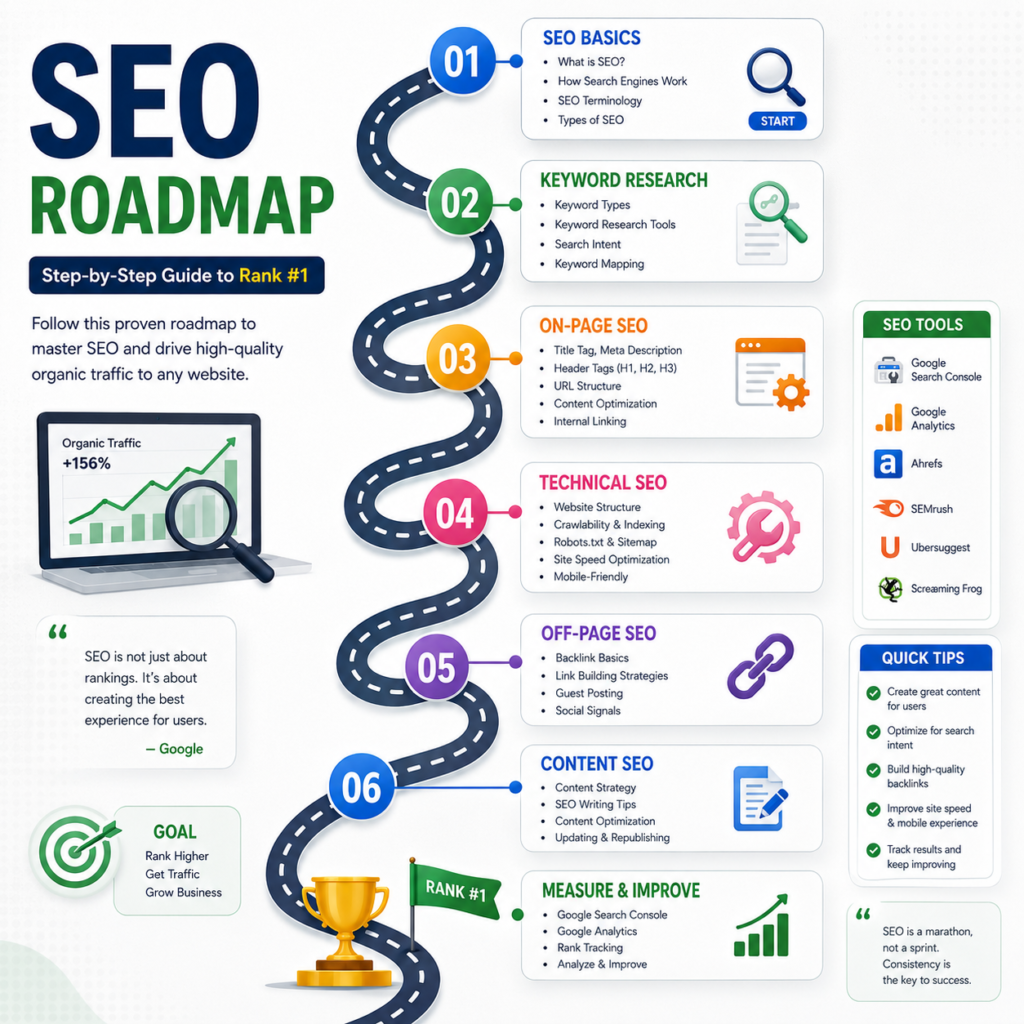
SEO should be one of the major skills in your digital marketing learning journey because search engines can connect businesses with people actively looking for information, products, or services.
The goal of SEO is not simply to put keywords on a webpage. You need to understand how users search, what information they need, how websites are structured, and how content can provide a better answer.
or additional guidance on how Google Search works and how websites can improve their visibility, beginners can refer to Google Search Central.
Start With Keyword Research
Keyword research helps you discover the words and phrases people use when searching online.
For example:
- Digital marketing course
- Digital marketing course in Shimla
- SEO course in Shimla
- Learn digital marketing
- Digital marketing jobs
Learn how to evaluate keywords based on factors such as:
- Search intent
- Relevance
- Search volume
- Competition
- Business value
Learn Search Intent
Don’t target a keyword simply because it has high search volume.
Ask:
What does the person actually want?
Someone searching for “digital marketing roadmap” wants a structured learning path.
Someone searching for “digital marketing course in Shimla” may be looking for a training institute.
Someone searching for “digital marketing salary” is probably researching career opportunities.
Matching content with intent is an important SEO skill.
Learn On-Page SEO
On-page SEO involves optimizing elements on your website.
Learn about:
- Title tags
- Meta descriptions
- Headings
- Keyword placement
- Content structure
- Internal linking
- Image optimization
- URLs
- Search intent
Learn Technical SEO Basics
You don’t need to become a technical SEO expert immediately, but you should understand:
- Crawling
- Indexing
- XML sitemaps
- Robots.txt
- Canonical URLs
- HTTPS
- Mobile usability
- Page speed
- Core Web Vitals
Learn Off-Page SEO
Off-page SEO includes activities that happen outside your website and can contribute to its authority and visibility.
Learn about:
- Backlinks
- Digital PR
- Brand mentions
- Link-building strategies
- Local citations
Avoid thinking of SEO as simply “getting backlinks.” Quality, relevance, and overall website value matter.
Learn Local SEO
Local SEO is especially important for businesses serving a particular city or geographical area.
Learn about:
- Google Business Profile
- Local keywords
- Reviews
- Local citations
- Location pages
- NAP consistency
- Local content
Step 4: Learn Content Marketing
Once you understand marketing fundamentals, websites, and SEO, the next stage in your digital marketing roadmap is content marketing.
Content is one of the main ways businesses communicate with their audiences online. It can educate potential customers, answer their questions, build trust, support SEO, and encourage people to take action.
Content marketing is much more than writing blog posts. It includes creating the right content for the right audience and distributing it through suitable channels.
Understand Different Types of Content
As a beginner, learn how different content formats work:
- Blog posts
- Website pages
- Social media posts
- Short-form videos
- Infographics
- Case studies
- E-books
- Email newsletters
- Product descriptions
- Landing page copy
- Videos and tutorials
Different formats serve different purposes. A detailed blog may be useful for explaining a complex topic, while a short video may be better for attracting attention on social media.
Learn SEO Content Writing
SEO content writing combines useful information with search optimization.
A good SEO article should:
- Match search intent
- Answer the reader’s questions
- Use relevant keywords naturally
- Have clear headings
- Be easy to read
- Include useful examples
- Use internal links where appropriate
- Include relevant images
- Provide genuine value
Avoid writing content simply to increase word count or repeat keywords. Search engines and readers both benefit from content that is useful, clear, and focused.
Learn Copywriting
Copywriting is different from informational content writing. Its primary purpose is often to encourage an action.
You should learn basic copywriting frameworks such as:
- AIDA — Attention, Interest, Desire, Action
- PAS — Problem, Agitate, Solution
- FAB — Features, Advantages, Benefits
Practice writing headlines, advertisements, landing pages, calls to action, product descriptions, and promotional messages.
Create a Content Calendar
A content calendar helps you organize what you will publish, where you will publish it, and when it will be published.
For example, a beginner managing a business website could create a weekly plan:
| Day | Content |
|---|---|
| Monday | Educational blog |
| Tuesday | Instagram carousel |
| Wednesday | Short video |
| Thursday | SEO-focused post |
| Friday | Customer story |
| Saturday | Promotional content |
The exact schedule will depend on the business and audience. The goal is to maintain consistency rather than publishing content randomly.
Learn Content Distribution
Creating content is only one part of content marketing. You also need to understand how people will discover it.
Content can be distributed through:
- Search engines
- Social media
- Online communities
- Video platforms
- Paid advertising
- Business websites
A single piece of content can also be repurposed. For example, a detailed blog post can become several social media posts, a video script, an infographic, and an email newsletter.
Use AI Carefully for Content
AI tools can help generate ideas, outlines, headlines, content variations, and research questions. However, you should review AI-generated content for accuracy, originality, relevance, and quality.
The goal is to use AI to improve your workflow rather than publish unedited machine-generated content.
Step 5: Learn Social Media Marketing
After learning content marketing, move into social media marketing.
Social media allows businesses to reach audiences, communicate directly with customers, distribute content, build communities, and support lead generation.
However, every platform works differently. A strategy that works on Instagram may not work in exactly the same way on LinkedIn or YouTube.
Understand Major Social Media Platforms
Start by understanding the purpose and audience of major platforms such as:
- YouTube
- X
You don’t need to become an expert on every platform.
Instead, understand which platforms are most relevant to different audiences and business models.
For example, LinkedIn may be useful for B2B marketing and professional audiences, while Instagram can be effective for visual content and consumer-focused brands.
Learn Social Media Content Planning
A social media marketer needs to plan content rather than simply post whenever they have an idea.
Create content categories such as:
Educational: Tips, tutorials, explanations
Engagement: Questions, polls, discussions
Promotional: Products, services, offers
Trust-building: Reviews, testimonials, behind-the-scenes content
Entertainment: Relevant trends, stories, short videos
This gives the audience variety while keeping the content connected to business objectives.
Learn Short-Form Video
Short-form video has become an important content format across social platforms.
Learn basic concepts such as:
- Strong opening hooks
- Clear messaging
- Storytelling
- Captions
- Basic editing
- Visual consistency
- Calls to action
You do not need expensive equipment to start practicing. A smartphone, good lighting, clear audio, and useful content can be enough for beginner projects.
Learn Community Engagement
Social media is not only about publishing posts.
You should also learn how to:
- Respond to comments
- Answer questions
- Handle basic customer queries
- Monitor brand mentions
- Encourage discussions
- Build relationships with followers
This helps turn social media from a publishing channel into a communication channel.
Learn Social Media Analytics
Understand basic metrics such as:
- Reach
- Impressions
- Engagement
- Video views
- Clicks
- Followers
- Engagement rate
- Website traffic
- Leads
Don’t judge success only by follower growth. A smaller but relevant audience can sometimes generate more business value than a large audience with little engagement or buying intent.
Step 6: Learn Google Ads and Paid Advertising
For beginners who want to understand Google’s advertising platform in more detail, the official Google Ads Help resources provide useful information about campaigns, keywords, bidding, and measurement.
Paid advertising allows businesses to reach specific audiences and generate traffic, leads, sales, or other actions.
Google Ads is an important platform to understand because it can place businesses in front of people who are actively searching for relevant products or services.
Learn How Search Ads Work
Start with the basic relationship:
Keyword → Search Query → Advertisement → Landing Page → Conversion
For example, someone searches for:
“digital marketing course in Shimla”
A relevant business can create a Google Search campaign targeting appropriate search terms.
The user clicks the advertisement and reaches a landing page containing course information and an enquiry or registration option.
Learn Keyword Match Types
Understand the basic concepts behind:
- Broad match
- Phrase match
- Exact match
You should also understand negative keywords because they can help prevent advertisements from appearing for irrelevant searches.
Learn Ad Copy
A good advertisement should communicate:
- What is being offered
- Why it is useful
- What makes the offer different
- What action the user should take
Practice creating multiple versions of headlines and descriptions instead of assuming that the first advertisement will perform best.
Learn Campaign Budgeting
Understand:
- Daily budgets
- Bidding
- Cost per click
- Cost per conversion
- Conversion value
- Return on ad spend
You don’t need a large budget to learn the concepts. For practice, you can first create campaign plans and mock campaigns before running real advertisements.
Learn Landing Page Optimization
Sending paid traffic to a poorly designed page can waste advertising money.
A good landing page should have:
- Clear headline
- Relevant information
- Strong value proposition
- Trust signals
- Easy navigation
- Clear call to action
- Mobile-friendly design
The advertisement and landing page should match the user’s intent.
Learn Meta Ads
After understanding Google Ads fundamentals, explore paid advertising on platforms such as Facebook and Instagram through Meta Ads.
Learn concepts such as:
- Campaign objectives
- Audience targeting
- Ad creatives
- Placements
- Budgets
- Retargeting
- Conversion tracking
The important goal is not simply learning how to click buttons inside an advertising platform. You should understand why a campaign is being created, who it is targeting, what action you want users to take, and how its results will be measured.
Step 7: Learn Analytics and Reporting
Analytics is an important part of a digital marketing roadmap because it helps you understand whether your marketing activities are actually producing results.
Start by understanding the basic concepts of Google Analytics and website measurement. Beginners can also explore Google’s official Google Analytics documentation to understand how website data is collected and reported.
Analytics helps you answer questions such as:
- How many people visited the website?
- Where did visitors come from?
- Which pages received the most traffic?
- Which keywords generated visitors?
- How many people clicked an advertisement?
- How many visitors became leads or customers?
- Which marketing channel produced the best results?
Instead of making decisions based only on assumptions, digital marketers can use data to identify what is working and what needs improvement.
Learn Google Analytics
Start by understanding the basic concepts of Google Analytics and website measurement.
You should learn about:
- Users and sessions
- Traffic sources
- Landing pages
- Engagement
- Events
- Conversions
- Reports
- Acquisition
- User behavior
For example, if a website receives 10,000 visitors but generates very few enquiries, simply increasing traffic may not solve the problem. You may need to investigate the landing page, user experience, offer, targeting, or conversion process.
Learn Google Search Console
Google Search Console is particularly useful for SEO.
Learn how to use it to understand:
- Search queries
- Website impressions
- Clicks
- Click-through rate
- Average position
- Indexed pages
- Sitemap status
- Search-related issues
You can use this information to identify pages that receive impressions but few clicks and then improve their titles, descriptions, content, or search intent alignment.
Understand Important Marketing Metrics
A beginner should become comfortable with common digital marketing metrics.
Click-Through Rate (CTR)
CTR measures the percentage of people who click after seeing a search result, advertisement, or other clickable element.
Conversion Rate
Conversion rate shows the percentage of visitors who complete a desired action.
Cost Per Click (CPC)
CPC measures how much an advertiser pays for a click in a paid advertising campaign.
Cost Per Lead (CPL)
CPL helps businesses understand how much they spend to generate a lead.
Return on Ad Spend (ROAS)
ROAS compares advertising revenue with advertising expenditure and is particularly useful for businesses running campaigns designed to generate sales.
Bounce and Engagement Metrics
Depending on the analytics platform and reporting setup, you may also examine engagement-related metrics to understand whether visitors are interacting meaningfully with your website.
The important lesson is that metrics should always be connected to a business objective.
A high number of impressions may look impressive, but if the campaign is designed to generate qualified leads, impressions alone do not indicate success.
Learn How to Create Marketing Reports
A digital marketer should be able to turn raw data into a simple and useful report.
A basic monthly report could include:
- Website traffic
- Organic traffic
- Top-performing pages
- Search performance
- Social media performance
- Advertising results
- Leads generated
- Conversion rate
- Key improvements
- Recommendations for the next month
A good report should not simply show numbers. It should explain what happened, why it happened, and what should be done next.
This is one of the skills that can help you move from simply executing marketing tasks to making strategic marketing decisions.
Step 8: Learn Email Marketing
Email marketing is another important stage in a digital marketing roadmap because it helps businesses build direct relationships with potential and existing customers.
Unlike social media platforms, where businesses depend heavily on platform algorithms and changing reach patterns, email allows businesses to communicate directly with people who have chosen to receive their messages.
Email can be used for:
- Lead nurturing
- Newsletters
- Product promotions
- Course updates
- Customer communication
- Event invitations
- Abandoned-cart campaigns
- Follow-up sequences
- Customer retention
Understand Email Lists
Start by understanding how email lists work.
A business can collect subscribers through:
- Website forms
- Lead magnets
- Course registrations
- Purchases
- Events
- Newsletter subscriptions
Always collect and manage email addresses responsibly and follow applicable privacy and consent requirements.
Learn Email Segmentation
Not every subscriber has the same needs.
For example, an education business could have separate groups for:
- New enquiries
- Existing students
- Previous students
- Course-specific leads
- Newsletter subscribers
Segmentation allows businesses to send more relevant messages instead of sending exactly the same email to everyone.
Learn Email Copywriting
A good email should have a clear purpose.
Learn how to create:
- Subject lines
- Opening lines
- Body copy
- Benefits
- Calls to action
- Follow-up messages
For example, instead of writing a vague promotional email, you could structure it around a specific problem:
Problem → Solution → Benefits → Proof → Call to Action
Practice writing emails for different stages of the customer journey.
Learn Email Automation
Email automation allows predefined messages to be sent based on user actions or timing.
A basic sequence could look like:
Sign-up → Welcome Email → Educational Email → Case Study → Offer → Follow-up
Automation can save time while maintaining consistent communication.
Track Email Performance
Learn to monitor metrics such as:
- Delivery rate
- Open rate
- Click-through rate
- Conversion rate
- Unsubscribe rate
Again, don’t focus on a single metric. Look at the complete customer journey and the objective of the campaign.
Step 9: Learn AI for Digital Marketing
AI has become an important part of the modern digital marketing workflow. For someone following a digital marketing roadmap in 2026, learning how to use AI effectively can improve research, content creation, analysis, personalization, and automation.
However, AI should be treated as a tool that supports marketing skills—not as a replacement for understanding marketing fundamentals.
Learn AI for Content Research
AI tools can help marketers brainstorm:
- Blog topics
- Content ideas
- Audience questions
- Content outlines
- Social media ideas
- Video concepts
- Email topics
The marketer should still verify information and make the final content relevant to the target audience.
Learn AI-Assisted SEO
AI can support several parts of an SEO workflow, including:
- Keyword clustering
- Search intent analysis
- Content outlines
- Topic research
- Content optimization ideas
- Internal-link suggestions
- SEO brief creation
For example, you could provide a list of related keywords and ask an AI tool to organize them into topical groups. You would then review the results before using them in your SEO strategy.
Learn AI for Social Media
AI can help generate:
- Caption ideas
- Content calendars
- Post variations
- Video scripts
- Hook ideas
- Content repurposing suggestions
The final content should still reflect the brand’s tone and audience rather than becoming generic AI-generated material.
Learn AI for Advertising
AI can assist with:
- Ad headline variations
- Description ideas
- Audience research
- Creative concepts
- Campaign analysis
- Testing ideas
A skilled marketer still needs to understand the audience, offer, campaign objective, budget, and performance data.
Learn AI for Email Marketing
AI can help marketers develop:
- Subject-line variations
- Email drafts
- Personalized messages
- Follow-up sequences
- Segmentation ideas
- Content variations
You should always review AI-generated emails before sending them, especially when they contain business claims, pricing, statistics, or customer-specific information.
Learn Prompt Engineering
Prompting is becoming a useful supporting skill for marketers who work with generative AI.
Learn how to provide:
- Clear objectives
- Audience information
- Context
- Tone
- Format
- Constraints
- Examples
- Expected output
Instead of asking:
“Write a social media post.”
A better prompt explains the audience, platform, objective, tone, offer, key information, and desired format.
This generally produces more useful results and teaches you to think more strategically about what you actually need from an AI tool.
Step 10: Build Practical Digital Marketing Projects
Learning concepts and watching tutorials is not enough to become job-ready.
One of the most important stages in a digital marketing roadmap for beginners is practical implementation.
You need to demonstrate that you can actually apply what you have learned.
You don’t necessarily need a real company’s marketing budget to begin. You can create realistic practice projects using a personal website, demo business, educational project, or a hypothetical brand.
Project 1: Create an SEO Blog
Choose a topic and create a complete SEO-focused article.
Practice:
- Keyword research
- Search intent
- Content structure
- On-page SEO
- Internal linking
- Image optimization
- Meta title
- Meta description
Then monitor its performance using available analytics and search tools.
Project 2: Create a Keyword Research Report
Choose a business and research relevant keywords.
Your report can include:
- Primary keywords
- Secondary keywords
- Long-tail keywords
- Search intent
- Competition
- Keyword clusters
- Content ideas
This is a useful project for demonstrating SEO research skills.
Project 3: Create a Social Media Calendar
Choose a sample business and create a 30-day content calendar.
Include:
- Date
- Platform
- Content type
- Topic
- Caption idea
- Creative format
- Call to action
This demonstrates planning rather than simply designing individual posts.
Project 4: Create a Google Ads Campaign Plan
Build a mock campaign containing:
- Campaign objective
- Target audience
- Keywords
- Negative keywords
- Ad groups
- Headlines
- Descriptions
- Landing page
- Budget
- Conversion goal
You can present this as a portfolio case study.
Project 5: Create an Email Marketing Sequence
Develop a short email sequence for a fictional or real business.
For example:
Welcome → Education → Problem/Solution → Offer → Follow-up
Explain the purpose of each email and the action you want the subscriber to take.
Project 6: Create a Monthly Analytics Report
Take a sample website or project and create a report containing:
- Traffic
- Traffic sources
- Top pages
- Search performance
- Conversions
- Social performance
- Advertising performance
- Key findings
- Recommendations
These projects give you evidence of your skills when applying for jobs, internships, or freelance opportunities.
Build Your Digital Marketing Portfolio
After completing practical projects in your digital marketing roadmap, document your work in a simple digital marketing portfolio.
Your portfolio can include:
- SEO and keyword research projects
- Blog content
- Social media campaigns
- Google Ads campaign plans
- Email marketing campaigns
- Analytics reports
- AI-assisted marketing projects
- Website optimization work
For each project, explain the objective, strategy, tools used, work completed, and results or key learnings.
A strong portfolio can help demonstrate your practical abilities when applying for internships, jobs, or freelance projects.

Choose Your Digital Marketing Specialization
Once you understand the major areas, you can choose a specialization based on your interests and strengths.
SEO can be suitable if you enjoy research, websites, keywords, and content.
Paid Advertising can be a good choice if you enjoy data, testing, budgets, and performance.
Social Media Marketing may suit people interested in content, communication, creativity, and audience engagement.
Content Marketing is useful for people who enjoy writing, storytelling, and research.
Analytics can suit people who enjoy working with data and identifying patterns.
AI-powered Marketing is an emerging area for marketers interested in combining marketing with artificial intelligence and automation.
You do not have to choose a specialization immediately. Build your fundamentals first and then identify the area you enjoy most.
Frequently Asked Questions
What should I learn first in digital marketing?
Start with marketing fundamentals, target audiences, customer journeys, conversions, and basic website concepts. Then move into SEO, content, social media, paid advertising, analytics, and AI.
How long does it take to learn digital marketing?
The timeline depends on your goals and consistency. A beginner can learn the fundamentals within a few months, while becoming job-ready generally requires continuous practice and project experience.
Is digital marketing difficult for beginners?
Digital marketing can seem complicated because it includes many areas, but a structured digital marketing roadmap makes the learning process easier. Focus on one skill at a time and practice regularly.
Can I learn digital marketing without coding?
Yes. Advanced coding is not required for most digital marketing roles. However, basic HTML, CSS, WordPress, and website knowledge can be useful, particularly for SEO and website optimization.
Can I get a digital marketing job after completing this roadmap?
A roadmap can give you the knowledge and direction you need, but practical experience is essential. Build projects, create a portfolio, improve your communication skills, and apply for internships or entry-level positions.
Can I become a freelancer after learning digital marketing?
Yes. After developing practical skills, you can offer services such as SEO, content writing, social media management, paid advertising, email marketing, or website optimization.
Start Your Digital Marketing Journey in 2026
Learning digital marketing does not require you to master everything at once. The right approach is to build your knowledge step by step, practice every skill through real projects, analyze your results, and gradually develop a specialization.
This Digital Marketing Roadmap 2026 gives you a structured path from basic marketing concepts to SEO, content, social media, paid advertising, analytics, email marketing, AI, practical projects, and career preparation.
If you want to develop these skills through structured and practical training, you can explore the Digital Marketing Course at IICE Computer Education Shimla, where learners can work on important areas of modern digital marketing and gain practical exposure.
Start with the fundamentals, build real projects, create your portfolio, and keep improving your skills. Your digital marketing career starts with the first step.