How to Start a Digital Marketing Career: Complete Roadmap for Beginners

Starting a digital marketing career can be an exciting opportunity for students, freshers, career changers and anyone interested in marketing, technology and online business. However, getting started can also feel confusing because digital marketing includes many different areas, including search engine optimisation (SEO), content marketing, social media marketing, Google Ads, email marketing, marketing analytics, conversion optimisation and AI-powered marketing.
The biggest challenge for beginners is usually not finding information. There are thousands of courses, tutorials, videos, blogs and tools available online. The real challenge is knowing what to learn first, what skills to practise, how to gain experience, how to build a portfolio and how to turn your knowledge into a real career opportunity.
The good news is that you do not need to master every area of digital marketing before applying for your first opportunity.
A better approach is to build your skills step by step. Start by understanding marketing fundamentals, learn how the major digital channels work, practise through projects, measure your work, build a portfolio and then look for internships, entry-level jobs, freelance projects or other opportunities where you can gain practical experience.
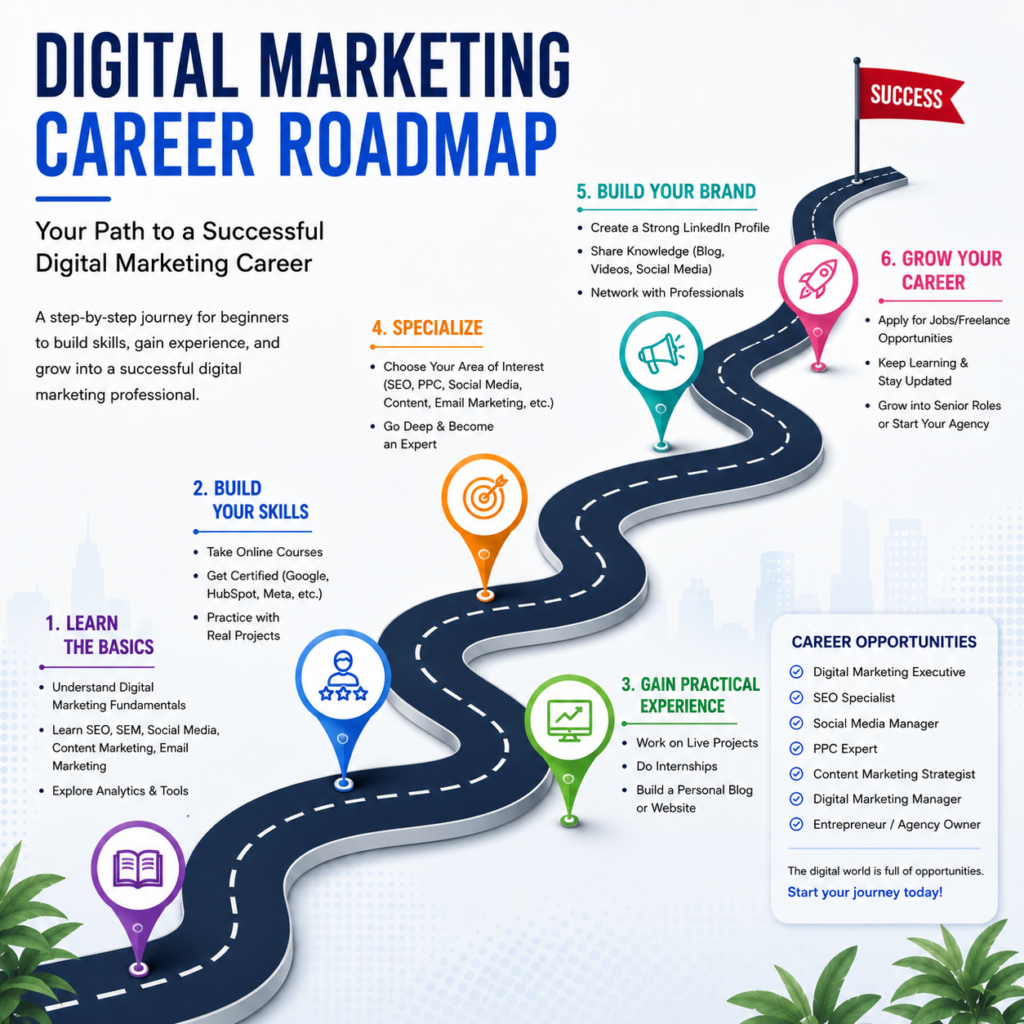
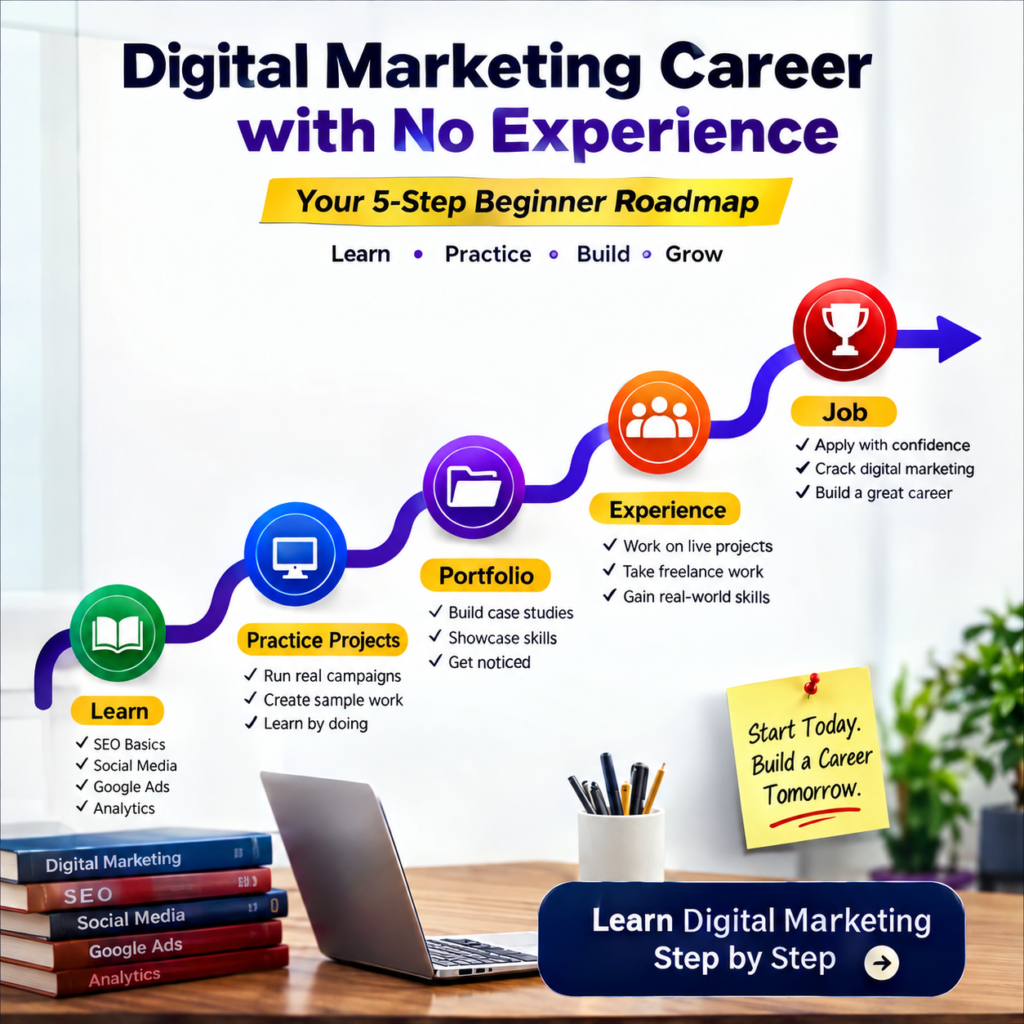
A simple digital marketing career roadmap looks like this:
Learn → Practise → Measure → Build a Portfolio → Gain Experience → Apply → Improve → Grow
This roadmap can work whether you are a college student, a fresher looking for your first job, a working professional planning a career change or someone interested in freelancing.
The objective is not to learn every digital marketing tool available. Instead, focus on developing a combination of marketing knowledge, practical skills, analytical thinking, communication and problem-solving ability.
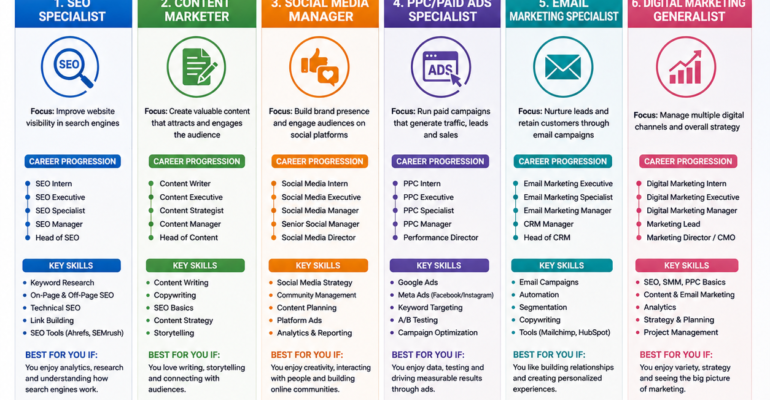
As you progress, you can explore different career paths such as SEO, content marketing, social media marketing, performance marketing, email marketing, marketing analytics or broader digital marketing roles.
This guide explains how to start a digital marketing career from the ground up. It covers the skills you need, what to learn first, how to choose a specialisation, how to build a digital marketing portfolio without professional experience, how to gain practical experience and how to prepare for your first digital marketing job.
Most importantly, remember that digital marketing is not a subject that you simply finish learning.
It is an ongoing process:
Learn → Apply → Analyse → Improve → Repeat
That mindset will help you move from beginner-level knowledge toward practical digital marketing experience and, eventually, a sustainable career.
What Is Digital Marketing?
Digital marketing is the process of using digital channels, platforms and technologies to promote a business, product, service or organisation, reach the right audience and encourage actions that support a business goal.
These actions can include visiting a website, submitting an enquiry, making a purchase, booking a service, downloading a resource, subscribing to an email list or contacting a business.
Unlike traditional marketing, digital marketing allows businesses to communicate with audiences across multiple online channels and use data to understand how people interact with their marketing activities.
The major areas of digital marketing include:
- Search Engine Optimisation (SEO): Improving a website and its content so that relevant pages can appear more prominently in organic search results.
- Content Marketing: Creating useful, relevant and valuable content to attract, educate and engage a target audience.
- Social Media Marketing: Using social media platforms to build awareness, communicate with audiences, encourage engagement and support business objectives.
- Paid Advertising: Using online advertising platforms to reach specific audiences through paid campaigns.
- Google Ads: Creating and managing search, display, video and other advertising campaigns to reach potential customers at relevant stages of their journey.
- Email Marketing: Using email campaigns, newsletters and automated communication to nurture subscribers and customers.
- Marketing Analytics: Collecting and interpreting marketing data to understand traffic, engagement, leads, conversions and campaign performance.
- Conversion Optimisation: Improving websites, landing pages and customer journeys to encourage more visitors to complete a desired action.
- AI-Powered Marketing: Using artificial intelligence to support research, content development, analysis, automation and other marketing workflows.
A digital marketer may specialise in one of these areas or work across several channels. The responsibilities depend on the organisation, business objectives and level of the role.
How Does Digital Marketing Work?
At its simplest, digital marketing follows a continuous process:
Understand the audience → Choose the right channel → Create the right message → Encourage an action → Measure the result → Improve the strategy
Consider a simple example.
Suppose a training institute wants to generate more enquiries for its digital marketing course.
The first step is understanding the target audience. The institute may want to reach college students, fresh graduates, working professionals or people planning a career change.
Next, the marketer researches what these audiences are looking for online. This may include topics such as digital marketing courses, digital marketing careers, SEO training, Google Ads training or digital marketing skills for beginners.
The marketer can then create useful website content, optimise relevant pages for search engines, publish social media content, run paid advertising campaigns and develop landing pages designed to generate enquiries.
Once people reach the website, the marketer needs to make the next step clear.
That could be:
Read an article → Explore a course → Submit an enquiry → Speak with the institute
The process does not end when someone clicks an advertisement or visits a website.
The marketer must also measure what happened.
Important questions include:
- How many people visited the website?
- Which channels brought visitors?
- Which pages received the most engagement?
- How many visitors became leads?
- Which campaigns generated relevant enquiries?
- What was the cost of generating those leads?
- Where are potential customers leaving the journey?
- What should be improved?
This combination of strategy, execution and measurement is what makes digital marketing different from simply publishing content online.
Digital Marketing Is More Than Social Media
One of the most common misconceptions among beginners is that digital marketing is mainly about managing social media accounts.
Social media is an important part of digital marketing, but it is only one channel.
A complete digital marketing strategy may involve:
SEO + Content + Social Media + Paid Advertising + Email + Website Optimisation + Analytics
Each channel can support a different stage of the customer journey.
For example, SEO can help people discover a business when they are searching for information. Content can educate them and answer their questions. Social media can help build awareness and engagement. Paid advertising can reach targeted audiences quickly. Email marketing can help nurture existing leads and customers.
Analytics connects these activities by helping marketers understand what is working and where improvements are required.
This is why someone starting a digital marketing career should learn how the channels work together instead of treating each platform as a completely separate skill.
The Role of a Digital Marketer
A digital marketer’s job is ultimately connected to a business objective.
Depending on the role, a marketer may be responsible for objectives such as:
- Increasing relevant website traffic
- Generating qualified leads
- Increasing online sales
- Improving search visibility
- Building brand awareness
- Increasing engagement
- Improving conversion rates
- Retaining customers
- Supporting product or service launches
The specific tactics may change, but the underlying thinking remains similar:
Business Goal → Audience → Strategy → Channel → Execution → Measurement → Optimisation
This framework is useful for beginners because it prevents them from focusing too heavily on individual tools.
Five Questions Every Beginner Should Ask
Before creating a campaign, writing content or learning a new marketing platform, develop the habit of asking five basic questions.
1. Who is the target audience?
Understand who the business wants to reach and what characteristics, needs or behaviours make that audience relevant.
2. What problem does the audience have?
Identify their questions, challenges, needs and motivations.
3. Where does the audience search or spend time online?
The answer could involve search engines, social media, websites, email or other digital platforms.
4. What action should the audience take?
The desired action could be reading an article, submitting an enquiry, making a purchase, booking an appointment, downloading a resource or subscribing to an email list.
5. How will success be measured?
Choose metrics that relate to the objective. Depending on the campaign, these could include traffic, clicks, engagement, leads, conversions, conversion rate or cost per acquisition.
These questions form the foundation of a practical digital marketing strategy.
Why Digital Marketing Is a Growing Career Area
Businesses of different sizes and industries need people who understand how to reach audiences online, create useful digital experiences and evaluate marketing performance.
Digital marketers can work in:
- Digital marketing agencies
- In-house marketing teams
- E-commerce companies
- Startups
- Education and training organisations
- Hospitality businesses
- Tourism companies
- Retail businesses
- Technology companies
- Media organisations
- Local businesses
- Freelance and consulting environments
The responsibilities can vary significantly.
An SEO professional may focus on keyword research, content optimisation, technical issues and search performance. A social media specialist may work on content planning, audience engagement and platform analytics. A performance marketer may manage paid campaigns, budgets, landing pages and conversion data.
A marketing analyst may spend more time interpreting data, preparing reports and identifying opportunities for improvement.
This variety gives beginners several potential directions when building a digital marketing career.
Digital Marketing Requires Both Creativity and Analysis
Digital marketing is often described as either a creative field or a data-driven field.
In reality, successful marketers usually need both.
Creativity can help you develop:
- Content ideas
- Campaign concepts
- Advertising messages
- Social media posts
- Visual communication
- Customer experiences
Analytical thinking helps you:
- Research audiences
- Interpret data
- Identify problems
- Compare performance
- Test ideas
- Measure results
- Make better decisions
For example, a marketer may create an attractive advertisement, but if the campaign attracts the wrong audience, the creative work may not generate meaningful business results.
Similarly, a campaign may generate excellent data, but without relevant messaging and a useful customer experience, those numbers may not translate into conversions.
The strongest digital marketers learn to combine both sides:
Creativity to attract attention + Strategy to guide it + Data to improve it
Digital Marketing and Traditional Marketing
Digital marketing follows many of the same fundamental principles as traditional marketing.
Both require an understanding of:
- Target audiences
- Customer needs
- Value propositions
- Positioning
- Communication
- Customer journeys
- Business objectives
The major advantage of digital channels is that marketers can often measure interactions in much greater detail.
For example, a digital campaign can be evaluated through a journey such as:
Impressions → Clicks → Website Visits → Leads → Conversions
This allows marketers to investigate where people are losing interest and identify opportunities for improvement.
However, having access to data does not automatically create a successful marketing campaign.
A marketer still needs to understand people, communicate clearly, provide value and create a relevant customer experience.
That combination of marketing fundamentals, digital skills, practical execution and analytical thinking provides the foundation for a successful digital marketing career.
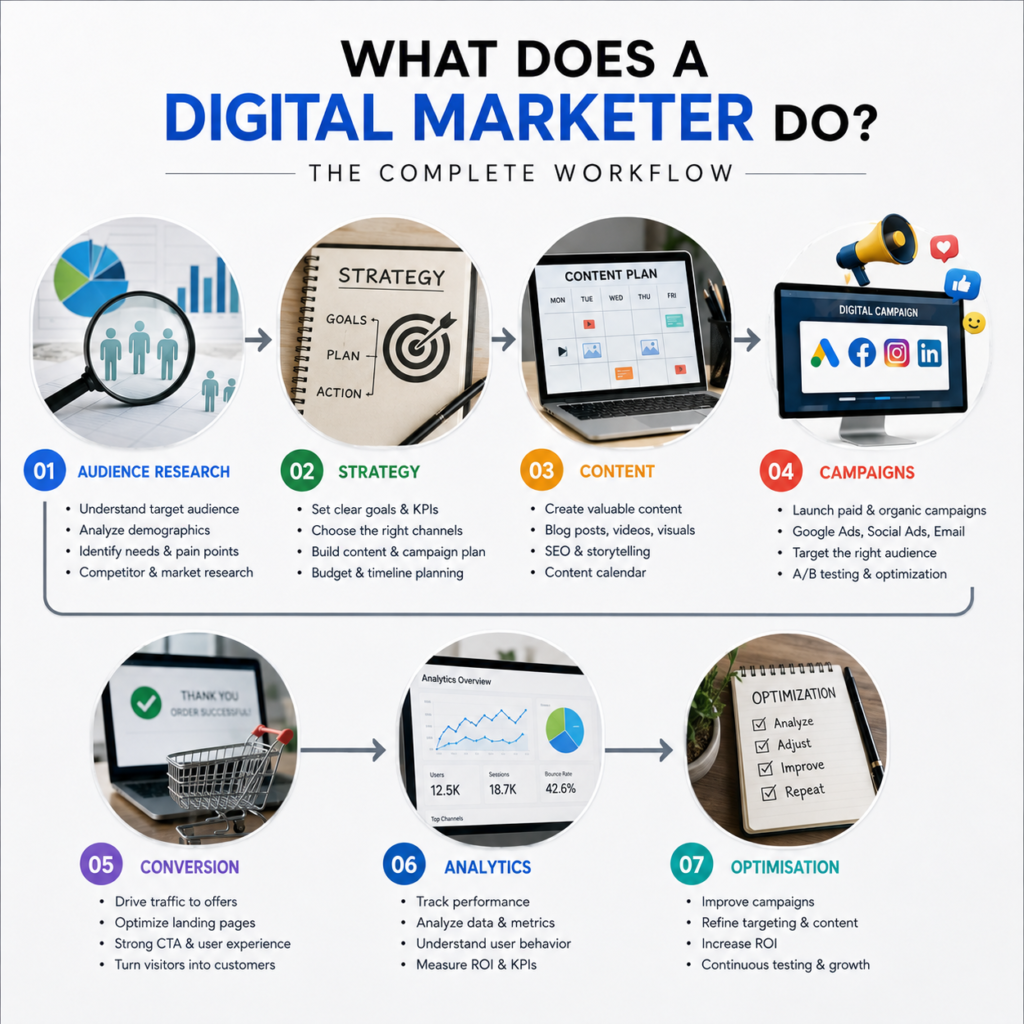
What Does a Digital Marketer Actually Do?
A digital marketer helps a business reach the right audience, communicate its value, generate leads or sales and improve marketing performance through digital channels.
The exact responsibilities depend on the job role and the organisation. An SEO specialist may spend most of their time working on search visibility and website content, while a performance marketer may focus on advertising campaigns, budgets and conversions. A social media marketer may concentrate on content and audience engagement, while an analytics specialist may focus on data, reporting and performance insights.
However, most digital marketing work can be understood through three core objectives:
Attract the right audience → Encourage action → Measure and improve performance
1. Understanding the Target Audience
Before creating content or launching a campaign, a digital marketer needs to understand who the business is trying to reach.
This may involve researching:
- Customer needs
- Search behaviour
- Interests
- Problems and challenges
- Buying behaviour
- Demographics
- Customer questions
- Competitor offerings
For example, a company selling professional training courses may have several potential audience groups, including college students, fresh graduates, working professionals and people planning a career change.
Each group may have different needs and motivations.
A student may be looking for practical skills and career opportunities. A working professional may be more interested in flexibility and career advancement.
Understanding these differences helps marketers create more relevant messages and campaigns.
2. Attracting the Right Audience
Once the target audience is understood, the next step is to reach people who may genuinely be interested in the product or service.
A digital marketer can use several channels to attract relevant audiences, including:
- SEO
- Content marketing
- Social media
- Google Ads
- Email marketing
- Online advertising
- Website content
- Local search
For example, an SEO professional may conduct keyword research to identify the terms and questions potential customers use when searching online.
The marketer can then use this information to plan relevant website pages, articles and other content.
The objective is not simply to generate large amounts of traffic.
The objective is to attract relevant traffic.
A website receiving 10,000 visitors who have no interest in the product may generate less business value than a website receiving 1,000 visitors who are genuinely interested in the offer.
This is why audience research and search intent are important parts of digital marketing.
3. Creating Useful Content
Digital marketers often create, manage or plan content designed to attract and educate an audience.
Depending on the organisation, this may include:
- Blog posts
- Website pages
- Social media posts
- Videos
- Infographics
- Email campaigns
- Guides
- Case studies
- Advertising copy
- Landing-page content
Good content should have a clear purpose.
Before creating something, a marketer should understand:
Who is this for? → What problem does it solve? → What information does the audience need? → What should they do next?
For example, an article explaining how to start a digital marketing career has an educational purpose.
A course page explaining fees, curriculum and admission information has a stronger commercial purpose.
The content should match the user’s needs and stage in the customer journey.
4. Managing Digital Campaigns
Digital marketers may also plan and manage campaigns across different platforms.
A campaign could be designed to:
- Increase brand awareness
- Generate leads
- Increase website traffic
- Promote a product
- Increase sales
- Generate course enquiries
- Promote an event
- Encourage registrations
A typical campaign may involve:
Objective → Audience → Message → Channel → Creative → Landing Page → Conversion → Measurement
The marketer needs to ensure that these elements work together.
For example, if an advertisement promises a particular offer but the landing page does not clearly explain that offer, users may leave without converting.
This is why digital marketing requires more than simply creating advertisements.
5. Turning Attention Into Action
Getting people to visit a website is only one part of the process.
A digital marketer also needs to consider what happens after someone arrives.
The desired action could be:
- Submit an enquiry
- Make a purchase
- Book an appointment
- Register for a course
- Download a guide
- Call the business
- Subscribe to an email list
- Request more information
This is where landing pages, calls to action and conversion optimisation become important.
For example, a course landing page might include:
Course information → Benefits → Curriculum → Projects → Testimonials → Fee information → Enquiry form
The marketer can then analyse how visitors interact with the page and identify possible improvements.
6. Measuring Marketing Performance
One of the biggest advantages of digital marketing is the ability to collect and analyse performance data.
A digital marketer may monitor metrics such as:
- Website traffic
- Impressions
- Clicks
- Engagement
- Leads
- Conversions
- Conversion rate
- Cost per lead
- Cost per acquisition
- Return on advertising spend
- Search performance
The exact metrics depend on the marketing objective.
For example, a brand-awareness campaign may focus heavily on reach and impressions, while a lead-generation campaign may focus more on qualified leads and cost per lead.
The important point is that marketers should not measure metrics simply because they are available.
They should measure metrics that help answer a business question.
7. Finding Problems and Opportunities
Digital marketers spend a significant amount of time investigating why something is or is not working.
Imagine a business receives:
50,000 ad impressions → 5,000 clicks → 0 enquiries
A marketer should not immediately conclude that the advertising platform is the problem.
They should investigate the entire journey.
Possible questions include:
- Is the audience relevant?
- Is the advertisement communicating the right message?
- Is the landing page working correctly?
- Is the offer attractive?
- Is the enquiry form too complicated?
- Is conversion tracking configured correctly?
- Is the website providing enough information?
- Are visitors being sent to the right page?
This type of investigation is an important digital marketing skill.
8. Testing and Optimising
Digital marketing is rarely a one-time activity.
Marketers often test different approaches and compare the results.
For example, they might test:
- Two headlines
- Different calls to action
- Different landing pages
- Different audience segments
- Different advertisement copy
- Different content formats
- Different email subject lines
The purpose of testing is not to change things randomly.
It is to learn what works better for a particular audience and business objective.
A simple optimisation cycle is:
Plan → Launch → Measure → Analyse → Improve → Test Again
Over time, this process can help improve campaign performance.
9. Working With Marketing Tools
Digital marketers use different tools depending on their responsibilities.
These may include tools for:
- Keyword research
- SEO analysis
- Website analytics
- Search performance
- Social media management
- Email marketing
- Advertising
- Content creation
- Reporting
- Project management
- AI-assisted workflows
However, learning tools should not become the main objective.
A beginner who knows how to operate ten marketing platforms but cannot explain why a campaign is being run is still developing their marketing ability.
The better approach is:
Learn the marketing concept → Learn the relevant tool → Apply it → Analyse the result
This makes tools a means of solving marketing problems rather than an end in themselves.
10. Using AI to Improve Marketing Work
AI is becoming increasingly useful across digital marketing workflows.
Depending on the task, marketers can use AI to support:
- Research
- Brainstorming
- Content ideation
- Content variations
- Data organisation
- Reporting
- Workflow automation
- Customer communication
- Campaign analysis
However, AI-generated output still requires human judgement.
A marketer needs to check whether the information is accurate, relevant, useful and appropriate for the target audience.
The best approach is to use AI as a productivity and decision-support tool while retaining responsibility for strategy, quality and final decisions.
11. Communicating Results
Digital marketers also need to communicate their work clearly.
A manager, client or business owner may ask:
“What did you do, why did you do it and what happened?”
A good marketer should be able to explain:
Objective → Strategy → Action → Result → Learning → Next Step
For example:
“Our objective was to increase relevant course enquiries. We created search-focused content around high-intent topics, improved the relevant landing page and monitored enquiry conversions. The data showed which topics generated the most relevant visitors, so the next step was to expand those content areas and improve conversion opportunities.”
The ability to explain marketing decisions is particularly valuable during interviews and client discussions.
12. What a Digital Marketer Does Changes by Role
Not every digital marketer performs the same tasks.
For example:
SEO Executive
May work on keyword research, on-page SEO, content optimisation, internal linking, technical SEO and search performance.
Content Marketer
May research topics, create content strategies, write or manage content and analyse content performance.
Social Media Executive
May plan content calendars, create posts, manage communities and analyse social performance.
Performance Marketer
May create advertising campaigns, manage budgets, analyse conversions and optimise campaigns.
Email Marketer
May manage email campaigns, segmentation, automation, personalisation and conversion performance.
Marketing Analyst
May work with dashboards, reports, campaign data, attribution and performance analysis.
Digital Marketing Executive
May work across several of these areas and support a broader marketing strategy.
This is why understanding the fundamentals of multiple digital marketing channels can be valuable even when you eventually specialise in one area.
The Core Role of a Digital Marketer
Regardless of the specific job title, the central responsibility remains similar:
Understand the audience → Identify the business objective → Choose the right strategy → Execute the activity → Measure the outcome → Improve the result
Once you understand this process, digital marketing becomes much easier to learn.
You are no longer simply learning SEO, social media, Google Ads or email marketing as separate subjects.
You are learning how different digital channels can work together to solve business and customer problems.
That is the foundation you need before moving into the specific digital marketing skills required to build a career.
Can You Start a Digital Marketing Career With No Experience?
Yes, you can start a digital marketing career with no professional experience.
One of the most important things for beginners to understand is the difference between having no professional experience and having no evidence of practical skills.
When you are starting out, you may not have worked for a digital marketing agency, company or client. That is completely normal. Most people beginning their careers need to build their professional experience over time.
However, you can still demonstrate that you understand digital marketing by completing relevant projects, creating campaigns for practice, analysing websites, developing content strategies and building a useful digital marketing portfolio.
The objective is to show potential employers what you can actually do.
Professional Experience vs Practical Experience
These two terms are related but not identical.
Professional experience usually means work performed for an employer, organisation or client in a professional environment.
Practical experience can also come from personal projects, practice assignments, volunteer work, academic projects or independent experiments where you actually apply your knowledge.
For example, saying:
“I know SEO.”
does not provide much evidence.
A stronger statement would be:
“I completed a practical SEO project involving keyword research, search-intent analysis, keyword mapping, on-page optimisation and internal-linking recommendations.”
The second statement demonstrates that you have applied specific concepts.
This distinction is particularly important when applying for entry-level digital marketing jobs.
What Can You Do If You Have No Experience?
There are several legitimate ways to start building evidence of your skills.
You can:
- Create a personal website or blog
- Complete digital marketing projects
- Develop a practice SEO strategy
- Create a social media content plan
- Build a hypothetical Google Ads campaign
- Create an email marketing sequence
- Analyse a business website
- Prepare a competitor analysis
- Volunteer for a legitimate organisation
- Work on a small business project
- Take a beginner-level freelance assignment when you are ready
- Create marketing case studies based on your own work
These activities will not automatically make you a professional with years of experience.
Their purpose is to help you develop practical ability and evidence of your work.
Build Your Own Digital Marketing Project
One of the easiest ways to start is by creating a project of your own.
For example, you could create:
- A personal blog
- A niche website
- A local information website
- A small e-commerce practice project
- A social media page
- A personal brand
- A content website
You can then practise different marketing activities.
For example:
Research → Keyword Selection → Content Creation → SEO → Promotion → Analytics → Improvement
You can document what you did at every stage.
This gives you something concrete to discuss during an interview.
Create Practice Projects
You do not need to wait for a real client before practising.
Choose a business category such as:
- Coaching institute
- Hotel
- Restaurant
- Café
- Salon
- Travel company
- Fitness centre
- Local retailer
- Real estate business
- Professional service provider
Then create a hypothetical marketing strategy.
For example, if you choose a local coaching institute, you could research:
- Target audience
- Competitors
- Relevant search terms
- Search intent
- Website content gaps
- Local SEO opportunities
- Social media content ideas
- Paid advertising opportunities
- Conversion opportunities
You can then present your work as a practice project.
Do not claim that the organisation hired you if it did not.
Being transparent about the nature of your project protects your credibility.
Volunteer to Gain Real-World Exposure
Volunteering can be another way to gain practical experience.
A small organisation, community group, educational organisation or local business may need help with activities such as:
- Website content
- Social media planning
- Search-friendly content
- Email communication
- Basic analytics
- Content calendars
- Marketing research
If you work on a genuine project, document your contribution.
For example, you could record:
Objective → Your Responsibility → Work Completed → Result → Learning
This can later become a portfolio case study.
Start With One Skill
Beginners sometimes make the mistake of offering every possible digital marketing service before they have developed sufficient skills.
You do not need to say:
“I provide SEO, Google Ads, social media, email marketing, content marketing, web development, branding and complete digital marketing services.”
Instead, begin with a skill you can genuinely deliver.
For example:
- Keyword research
- SEO content optimisation
- Competitor research
- Content calendar creation
- Website content audit
- Basic analytics reporting
- Social media content planning
Develop confidence in one area and gradually expand your capabilities.
Use Your Projects to Build a Portfolio
Your projects become much more valuable when they are documented properly.
A useful case-study structure is:
Objective → Research → Strategy → Execution → Measurement → Learning
For example:
Objective: Improve the search visibility of a practice website.
Research: Identify relevant keywords, competitors and search intent.
Strategy: Map keywords to relevant pages and identify content opportunities.
Execution: Create content recommendations, improve page structure and develop internal-linking suggestions.
Measurement: Define the metrics that could be used to evaluate organic search performance.
Learning: Identify what worked, what was difficult and what you would test next.
This demonstrates more than simply showing a screenshot.
It demonstrates your ability to think through a marketing problem.
You Do Not Need a Huge Portfolio
A common beginner mistake is believing that a portfolio needs dozens of projects.
It does not.
A small number of well-documented and relevant projects can be more useful than a large collection of unfinished work.
Start with approximately 2–4 strong projects that match the type of role you want.
For example, if you want an SEO role, your portfolio could include:
- Keyword research project
- SEO audit
- Content optimisation project
- SEO case study
If you want a social media role, your portfolio could include:
- Audience research
- Social media strategy
- Content calendar
- Campaign analysis
If you want a performance marketing role, you could demonstrate:
- Campaign structure
- Audience strategy
- Sample ad copy
- Landing-page strategy
- Conversion measurement plan
The projects should reflect the skills employers are likely to need for the role you are targeting.
Be Honest About Your Experience
Never present a hypothetical project as a real client project.
For example, if you created a practice SEO strategy for a fictional restaurant, describe it as:
“Practice SEO Strategy for a Local Restaurant”
not:
“SEO Campaign Managed for Restaurant Client”
unless you actually worked for that client.
Similarly, if you created a hypothetical Google Ads campaign, do not claim that you managed a real advertising budget.
Professional credibility is more valuable than making your resume appear more impressive than it really is.
What Employers Want to See From Beginners
Employers do not necessarily expect a fresher to know everything.
They may instead look for evidence that the candidate can:
- Understand basic marketing concepts
- Research information
- Follow a structured process
- Use relevant tools
- Complete practical tasks
- Analyse results
- Communicate clearly
- Learn from mistakes
- Solve problems
- Adapt to new situations
This means your portfolio should not simply answer:
“What tools do I know?”
It should answer:
“What can I do with the skills and tools I have learned?”
Your First Goal Is Evidence, Not Perfection
When you have no professional experience, your first objective should be to create evidence of your ability.
Think of the progression like this:
Learn → Practise → Create → Document → Improve → Present
Once you have evidence, you can begin applying for internships, entry-level positions, freelance opportunities and junior digital marketing roles.
Your first opportunity may not be your ideal job.
That is okay.
The first stage of a digital marketing career is about developing practical experience, learning from real situations and gradually increasing your level of responsibility.
You do not need to wait until you feel completely ready.
Start with what you know, identify what you do not know, practise the missing skills and continue improving.
That is how a beginner can move from no professional experience to credible digital marketing experience.
Digital Marketing course with AI
What Skills Do You Need to Start a Digital Marketing Career?
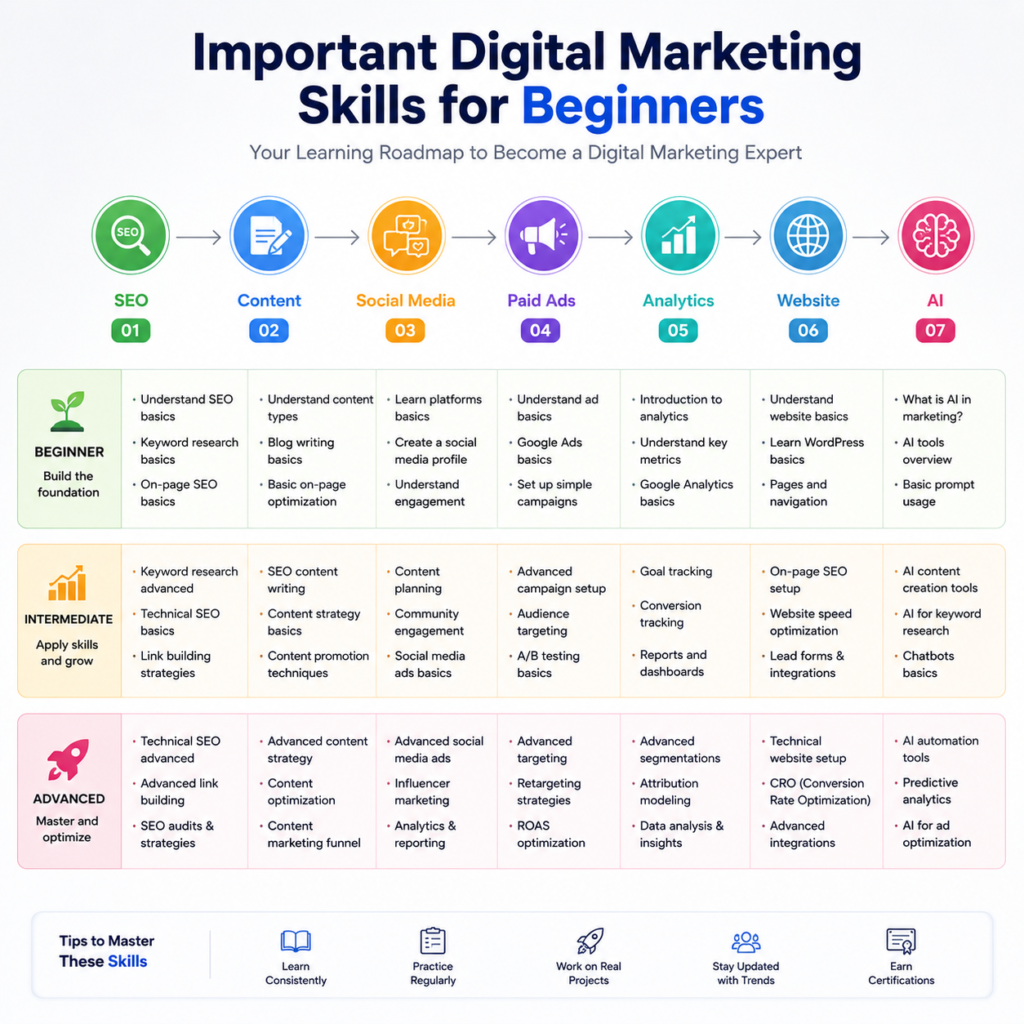
To start a digital marketing career, you do not need to master every marketing channel at an advanced level. A better approach is to build a strong combination of marketing fundamentals, practical digital skills, analytical thinking, communication and problem-solving.
Different digital marketing roles require different abilities. An SEO specialist needs strong research and website skills, while a performance marketer may need stronger analytical and advertising skills. A content marketer may focus more on writing and audience research, while a social media professional may need creativity and communication skills.
The good news is that you can develop these skills step by step while building practical projects.
1. Digital Marketing Fundamentals
Before learning individual platforms, understand the basic principles of marketing.
Learn concepts such as:
- Target audience
- Customer needs
- Buyer persona
- Customer journey
- Marketing funnel
- Value proposition
- Lead generation
- Conversion
- Brand awareness
- Customer retention
These concepts help you understand why a business is using a particular marketing channel.
For example, if a business wants more enquiries, simply increasing website traffic may not solve the problem. You may also need to understand whether the traffic is relevant, whether the offer is clear and whether the website makes it easy for visitors to enquire.
Strong marketing fundamentals help you ask the right questions before choosing a tactic.
2. Search Engine Optimisation
SEO is an important skill for beginners because it combines research, content, websites and analysis.
Start by learning:
- Keyword research
- Search intent
- Keyword mapping
- On-page SEO
- Title tags
- Meta descriptions
- Heading structure
- Internal linking
- Content optimisation
- Basic technical SEO
- Local SEO
- Search performance
A beginner does not need to memorise hundreds of SEO techniques.
Instead, understand the relationship between:
What people search for → What they expect → What your page provides
For example, keyword research can help you identify topics potential customers are searching for. Search-intent analysis then helps you understand what type of content should be created for those searches.
A good beginner SEO project is to choose a business, research relevant keywords, identify search intent and create a keyword map for potential website pages.
3. Content Marketing and Writing
Content is an important part of digital marketing because businesses need useful communication across websites, search engines, social media, email and advertising.
Learn how to create or plan:
- Blog posts
- Website pages
- Social media content
- Landing-page copy
- Email content
- Guides
- Case studies
- Video scripts
- Advertising copy
Good content is not simply well-written.
It should answer:
Who is this for? → What problem does it solve? → What information does the audience need? → What should they do next?
You should also learn how content relates to search intent and the customer journey.
Someone searching for an educational topic needs different content from someone actively comparing products or services.
4. Social Media Marketing
Social media marketing requires more than publishing posts.
A beginner should understand:
- Audience research
- Platform selection
- Content strategy
- Content pillars
- Content calendars
- Captions
- Visual content
- Engagement
- Social media analytics
A useful social media framework is:
Audience → Content → Platform → Objective → Action → Measurement
For example, if the objective is to generate enquiries, the content should not only create engagement. It should also guide relevant users toward an appropriate next step.
You can practise this skill by creating a one-month social media content calendar for a hypothetical or personal business.
5. Paid Advertising and Google Ads
Paid advertising can be a good specialisation for people who enjoy numbers, testing and measurable results.
Learn the fundamentals of:
- Campaign objectives
- Audience targeting
- Keywords
- Ad copy
- Creative
- Landing pages
- Budgets
- Bidding
- Click-through rate
- Conversion rate
- Cost per conversion
- Campaign optimisation
You do not need to immediately spend your own money to practise.
Instead, create a hypothetical campaign and document:
Objective → Audience → Campaign structure → Advertisement → Landing page → Conversion → Measurement
This helps you develop campaign strategy before working with real advertising budgets.
6. Email Marketing
Email marketing focuses on communicating with people who have already interacted with a business.
Important skills include:
- Email list management
- Segmentation
- Subject lines
- Email copywriting
- Calls to action
- Campaign planning
- Automation
- Personalisation
- Performance measurement
A simple beginner project could be a three-email sequence:
Welcome → Educational content → Relevant offer
The objective should be to provide useful information while moving the subscriber toward an appropriate next action.
7. Marketing Analytics
Analytics is one of the most valuable skills in digital marketing because it helps you understand whether your activities are producing meaningful results.
Learn how to:
- Understand marketing metrics
- Analyse traffic sources
- Monitor engagement
- Track conversions
- Compare performance
- Identify problems
- Prepare reports
- Turn data into decisions
A useful framework is:
Data → Observation → Question → Decision
For example, if an advertising campaign generates many clicks but very few enquiries, do not immediately assume that the campaign needs a larger budget.
Investigate:
- Is the audience relevant?
- Is the advertisement accurate?
- Is the landing page effective?
- Is the offer clear?
- Is conversion tracking working?
- Is the traffic quality good?
This type of thinking helps you become a marketer rather than simply a platform operator.
8. Basic Design Skills
Digital marketers frequently work with visual content.
Basic design knowledge can help you create:
- Social media graphics
- Presentations
- Advertisements
- Infographics
- Blog visuals
- Marketing materials
You do not need to become a professional graphic designer.
Instead, learn basic principles such as visual hierarchy, typography, spacing, consistency and clear communication.
The purpose of a marketing graphic is not simply to look attractive. It should communicate the intended message quickly and support the marketing objective.
9. AI and Digital Marketing Skills
AI is becoming an increasingly useful part of digital marketing workflows.
Beginners can learn how AI can support:
- Research
- Brainstorming
- Content ideas
- Content variations
- Data organisation
- Reporting
- Workflow automation
- Customer communication
- Campaign analysis
However, AI should support your marketing skills rather than replace them.
You still need to understand the audience, business objective, search intent, content quality and marketing metrics.
A useful principle is:
Use AI to improve your workflow, not to replace your marketing judgement.
10. Communication and Problem-Solving
Some of the most important digital marketing skills are not related to any particular platform.
Develop your ability to:
- Communicate clearly
- Research information
- Solve problems
- Think critically
- Manage your time
- Present ideas
- Explain decisions
- Learn independently
Digital marketing changes frequently, so the ability to investigate a new problem and learn a new concept is extremely valuable.
You may also need to explain your work to clients, managers or business owners.
Practise explaining:
What you did → Why you did it → What happened → What you would improve
The Most Important Skill Combination
You do not need to become an expert in everything.
A strong beginner foundation can be built around:
Marketing fundamentals + SEO + Content + Social Media + Paid Advertising + Analytics + Communication
You can then choose one area for deeper specialisation.
For example:
SEO + Content + Analytics
or
Google Ads + Landing Pages + Analytics
or
Social Media + Content + Analytics
This approach gives you broad digital marketing knowledge while allowing you to develop a clear professional strength.
The most valuable skill is ultimately the ability to connect your actions to a business objective:
Understand the audience → Choose the right strategy → Execute → Measure → Improve
That mindset will help you learn new digital marketing tools and channels much faster throughout your career.
What Should You Learn First in Digital Marketing?
One of the biggest challenges for beginners is deciding what to learn first in digital marketing.
There are hundreds of courses, tools, platforms and tutorials available online. Trying to learn everything at the same time can quickly become overwhelming.
A better approach is to follow a logical learning sequence:
Marketing Fundamentals → Audience & Search Intent → SEO & Content → Social Media → Paid Advertising → Analytics → Specialisation → Practical Projects → Portfolio
The objective is not to finish every digital marketing topic before gaining practical experience. Instead, learn a concept, apply it through a project and then identify what you need to learn next.
Step 1: Learn Marketing Fundamentals
Start with the basics of marketing before focusing heavily on individual platforms.
Understand:
- Target audience
- Customer needs
- Buyer journey
- Marketing funnel
- Value proposition
- Brand awareness
- Lead generation
- Conversion
- Customer retention
You should be able to answer:
Who are we trying to reach?
What problem do they have?
What does the business offer?
Why should the customer choose it?
What action do we want them to take?
These questions provide the foundation for almost every digital marketing activity.
Step 2: Understand Audience Research and Search Intent
Once you understand basic marketing concepts, learn how people search for information and make decisions online.
This is where keyword research and search intent become important.
For example:
“What is digital marketing?”
is primarily an informational search.
“Best digital marketing course for beginners”
shows stronger consideration.
“Digital marketing course in Shimla”
can indicate stronger local commercial intent.
Understanding this difference helps marketers create the right content for different stages of the customer journey.
Instead of simply collecting keywords, ask:
What does the person actually want when they search this phrase?
This question will improve your SEO, content and paid advertising decisions.
Step 3: Learn SEO and Content Together
After understanding search intent, learn the relationship between SEO and content.
Start with:
- Keyword research
- Search intent
- Keyword mapping
- On-page SEO
- Title tags
- Meta descriptions
- Headings
- Internal linking
- Content structure
- Basic technical SEO
- Local SEO
Then learn how to turn research into useful content.
A simple workflow is:
Research → Search Intent → Keyword Grouping → Content Planning → Writing → Optimisation → Publishing → Measurement
This is more useful than learning SEO as a list of isolated techniques.
For example, if you identify a keyword with informational intent, you may create an educational article.
If you identify a commercial keyword, you may need a service or product page instead.
This teaches you to connect SEO decisions with user needs.
Step 4: Learn Social Media Marketing
Once you understand basic SEO and content, learn how social media can support a marketing strategy.
Focus on:
- Audience research
- Platform selection
- Content pillars
- Content calendars
- Captions
- Visual content
- Engagement
- Social media analytics
Do not focus only on how to create posts.
Learn why a business should publish a particular piece of content.
For example:
Business objective: Generate enquiries
Audience: Students interested in professional training
Content: Educational tips, FAQs, demonstrations and career information
Action: Visit the website or submit an enquiry
Measurement: Relevant clicks, enquiries and conversions
This turns social media from random posting into strategic marketing.
Step 5: Learn Paid Advertising
After understanding organic channels, begin learning paid advertising.
You can start with the fundamentals of Google Ads, Meta advertising or another relevant advertising platform.
Learn:
- Campaign objectives
- Audience targeting
- Keywords
- Ad copy
- Creative
- Landing pages
- Budgets
- Bidding
- Click-through rate
- Conversion rate
- Cost per conversion
You do not need to immediately spend money on advertising.
Instead, create a practice campaign.
For example:
Objective: Generate course enquiries
Audience: People searching for digital marketing training
Campaign: Search campaign
Ad: Relevant search advertisement
Landing page: Course information page
Conversion: Enquiry form submission
Measurement: Cost per enquiry and conversion rate
This exercise helps you understand the complete advertising journey.
Step 6: Learn Analytics Alongside Everything Else
Do not leave analytics until the end of your learning journey.
Start developing analytical thinking while learning every channel.
Whenever you create something, ask:
How will I know whether it worked?
For SEO, you may examine search visibility, clicks and organic traffic.
For social media, you may analyse reach, engagement, clicks and conversions.
For paid advertising, you may examine impressions, clicks, conversion rate and cost per conversion.
For email marketing, you may examine delivery, engagement and conversions.
The basic process is:
Data → Observation → Question → Decision
This helps you move from simply reporting numbers to making marketing decisions.
Step 7: Choose One Area for Specialisation
Once you understand the major areas, choose one skill to develop more deeply.
Possible specialisations include:
- SEO
- Content marketing
- Social media marketing
- Performance marketing
- Google Ads
- Email marketing
- Marketing analytics
Your choice should be based on your interests and the type of work you enjoy.
If you enjoy research and websites, SEO may be worth exploring.
If you enjoy writing and explaining ideas, content marketing may be a good fit.
If you enjoy creativity and communication, social media may appeal to you.
If you enjoy numbers, experimentation and measurable results, performance marketing or analytics may suit you.
You do not have to make a permanent career decision immediately.
Start by completing small projects in different areas and observe which type of work you enjoy and perform well.
Step 8: Start Practical Projects Before You Feel Ready
Do not wait until you have completed every tutorial.
Start practising while you learn.
For example, create:
- An SEO audit
- A keyword research project
- A content calendar
- A social media strategy
- A sample Google Ads campaign
- An email sequence
- A website conversion analysis
Your projects should answer:
What was the objective?
What research did you conduct?
What strategy did you choose?
What did you create?
How would you measure success?
What did you learn?
These projects eventually become the foundation of your digital marketing portfolio.
Step 9: Learn Tools After Understanding the Concepts
Beginners often make the mistake of collecting tools instead of developing skills.
You do not need to learn every SEO, analytics, advertising or AI platform available.
Instead:
Learn the concept → Choose the relevant tool → Practise → Analyse → Improve
For example, first understand keyword research.
Then learn a keyword research tool.
First understand conversion tracking.
Then learn the relevant analytics or advertising platform.
First understand content strategy.
Then explore tools that help you research, organise or produce content.
This approach prevents you from becoming dependent on individual platforms.
Step 10: Build a Continuous Learning Habit
Digital marketing changes regularly.
Search algorithms evolve. Advertising platforms introduce new features. Social media platforms change their formats. AI tools develop rapidly.
You therefore do not need a learning plan that ends after a few months.
Instead, develop a continuous process:
Learn → Apply → Measure → Identify Gaps → Improve → Repeat
For example, if your first SEO project reveals that you do not understand technical SEO, study technical SEO next.
If a social media project shows that you struggle with analytics, improve your analytics skills.
If a paid advertising exercise reveals that you do not understand landing pages, learn conversion optimisation.
This creates a personalised learning roadmap based on actual gaps rather than random tutorials.
A Simple Learning Order for Beginners
If you are completely new to digital marketing, use this sequence:
1. Marketing fundamentals
↓
2. Audience research and search intent
↓
3. SEO and content
↓
4. Social media marketing
↓
5. Paid advertising
↓
6. Email marketing
↓
7. Analytics
↓
8. Choose a specialisation
↓
9. Build practical projects
↓
10. Create your portfolio
The most important point is that you do not need to become an expert before moving forward.
Learn enough to understand the concept, practise it, identify your weaknesses and continue improving.
That approach is more effective than spending months watching tutorials without creating anything.
The Best Learning Formula
A practical digital marketing learning formula is:
30% Learning + 50% Practical Work + 20% Review and Improvement
The exact percentage does not need to be rigid.
The principle is what matters.
Spend enough time understanding the theory, but make sure most of your learning eventually turns into practical work.
If you learn SEO, perform an SEO audit.
If you learn content marketing, create a content strategy.
If you learn social media, build a content calendar.
If you learn Google Ads, create a practice campaign.
If you learn analytics, analyse a sample dataset or campaign.
This is how theoretical knowledge becomes practical digital marketing ability.
Ultimately, the best digital marketing learning roadmap is not the one with the most topics.
It is the one that helps you consistently move from:
Learning → Practising → Measuring → Improving → Building Evidence
How to Build a Digital Marketing Portfolio and Gain Experience
Learning digital marketing is only one part of starting a career. You also need evidence that you can apply what you have learned.
This is where a digital marketing portfolio becomes important.
A portfolio allows you to demonstrate your skills through practical work instead of simply listing them on a resume.
You do not need years of professional experience or dozens of projects to create a useful portfolio.
Start with a few relevant projects and explain what you did, why you did it and what you learned.
What Should a Digital Marketing Portfolio Include?
A strong beginner portfolio can include:
- SEO projects
- Keyword research
- Content strategies
- Social media campaigns
- Content calendars
- Google Ads campaign plans
- Email marketing sequences
- Website audits
- Competitor analysis
- Analytics reports
- Conversion optimisation recommendations
- AI-assisted marketing workflows
You do not need to include every type of project.
Choose projects that match the role you want.
For example, if you are applying for an SEO position, your portfolio should make your SEO-related work easy to find.
If you want a social media role, focus more on content strategy, audience research, creative concepts and performance analysis.
Start With 2–4 Strong Projects
Beginners often assume that a portfolio needs twenty or thirty projects.
It does not.
A small number of well-documented projects can be more valuable than a large collection of incomplete work.
Start with 2–4 strong projects.
For example:
Project 1: SEO Audit
Analyse a website and identify opportunities involving on-page SEO, content, internal linking and technical factors.
Project 2: Content Strategy
Research a topic, identify relevant keywords and search intent, group related topics and create a content plan.
Project 3: Social Media Strategy
Develop an audience profile, content pillars, posting calendar and measurement plan for a practice business.
Project 4: Paid Advertising Strategy
Create a hypothetical Google Ads campaign including audience, keywords, ad copy, landing-page recommendations and conversion goals.
These projects can demonstrate different aspects of digital marketing without requiring you to claim professional client experience.
Build Projects Around Real Problems
A strong portfolio project should solve a problem rather than simply demonstrate that you watched a tutorial.
For example, instead of creating a random keyword list, create:
“Keyword Research and Content Strategy for a Local Training Business”
Instead of simply designing social media posts, create:
“30-Day Social Media Strategy for a Local Business”
Instead of showing an advertisement, create:
“Google Ads Campaign Plan for Generating Course Enquiries”
This gives your work a clear purpose.
Use a Case-Study Structure
For every major portfolio project, use a simple structure:
Objective → Research → Strategy → Execution → Measurement → Learning
Objective
Explain what you wanted to achieve.
For example:
Objective: Develop a search-focused content strategy designed to attract people interested in digital marketing training.
Research
Show the research you performed.
This might include:
- Keyword research
- Search intent
- Competitor analysis
- Audience research
- Content gaps
- Existing website analysis
Strategy
Explain the decisions you made and why.
For example:
You may decide to target informational content for beginners while creating separate commercial pages for people actively looking for training.
Execution
Show what you actually created.
This might include:
- Keyword map
- Content briefs
- SEO recommendations
- Social media calendar
- Advertisement copy
- Email sequence
- Landing-page structure
Measurement
Explain how success would be measured.
Depending on the project, this could include:
- Organic clicks
- Search visibility
- Website traffic
- Engagement
- Leads
- Conversion rate
- Cost per lead
If the project is hypothetical, clearly state that these are proposed measurement methods rather than real results.
Learning
Explain what you learned.
For example:
- What was difficult?
- What assumptions did you make?
- What would you change?
- What would you test next?
- Which skills do you need to improve?
This final section can demonstrate maturity and analytical thinking.
How to Build a Portfolio Without Client Experience
You may think:
“I don’t have clients, so I have nothing to show.”
That is not true.
You can create legitimate portfolio work through:
Personal projects
Build your own website, blog, social media account or online project.
Practice projects
Create marketing strategies for hypothetical businesses.
Academic projects
Use relevant college or training projects when they genuinely demonstrate your skills.
Volunteer projects
Help a legitimate organisation with a clearly defined marketing task.
Small business projects
Work with a business when you have permission and clearly document your contribution.
The important rule is simple:
Never present hypothetical work as professional client work.
If you created the project yourself, label it as a practice or personal project.
Honesty makes your portfolio more credible.
Build Your Own Project
A personal project is one of the best ways to practise digital marketing.
For example, you could create a small website around a topic you understand.
Then practise:
Keyword Research → Content → SEO → Promotion → Analytics → Improvement
Document the changes you make.
Record:
- What you changed
- Why you changed it
- What you expected to happen
- What actually happened
- What you learned
This creates a real learning record that you can discuss during interviews.
Gain Experience Through Small Real-World Opportunities
Once you have developed basic confidence, look for opportunities to work on genuine projects.
These may include:
- Volunteer work
- Small business assignments
- Freelance projects
- Student projects
- Community organisations
- Personal business projects
- Internships
You do not need to begin by offering every digital marketing service.
Start with one area you can genuinely handle.
For example:
- Keyword research
- Content optimisation
- Competitor analysis
- Social media planning
- Content calendars
- Basic analytics reporting
Clearly define the work you will provide and the expected outcome before starting.
Document Your Contribution
When working on a real project, keep track of your contribution.
For example:
Business objective: Generate more relevant enquiries.
Your role: Keyword research and content planning.
Work completed: Researched search terms, analysed intent, grouped keywords and created content recommendations.
Measurement: Organic traffic, relevant clicks and enquiry conversions.
Learning: Identified content opportunities and areas requiring further testing.
This makes your experience easier to explain on both your resume and in interviews.
Turn Portfolio Projects Into Resume Evidence
Your portfolio and resume should support each other.
Instead of writing:
“Knowledge of SEO and digital marketing.”
you can describe genuine project work such as:
“Completed a practical SEO project involving keyword research, search-intent analysis, keyword mapping and on-page optimisation recommendations.”
This is more specific and provides evidence of what you have actually done.
Similarly, instead of:
“Social media expert.”
you could describe:
“Created a practice social media strategy including audience research, content pillars, a 30-day content calendar and performance metrics.”
Always make sure the statement accurately represents your experience.
What Employers Should See When They Open Your Portfolio
Within a few minutes, an employer should be able to understand:
Who you are → What role you want → What skills you have → What projects you completed → How you think → What you learned
Keep the portfolio organised.
For each project, make the objective and your contribution easy to find.
Avoid filling the portfolio with unnecessary screenshots.
A screenshot is useful when it supports an explanation.
For example:
Screenshot → What it shows → Why it matters → What you learned
This is much stronger than simply uploading ten screenshots without context.
Your Portfolio Does Not Need to Be Perfect
Your first portfolio will probably not be your best portfolio.
That is normal.
As you gain more experience, replace weaker projects with stronger ones.
Your progression may look like:
Practice Project → Better Practice Project → Volunteer Project → Freelance Project → Professional Project
Over time, your portfolio can become a record of your career development.
The goal is not to make yourself appear more experienced than you are.
The goal is to demonstrate your genuine ability and show that you can learn, execute, analyse and improve.
The Portfolio-to-Career Process
A practical progression is:
Learn a Skill
↓
Create a Project
↓
Document the Process
↓
Build a Case Study
↓
Add It to Your Portfolio
↓
Gain Real-World Experience
↓
Improve the Portfolio
↓
Apply for Relevant Opportunities
This process allows you to move from learning digital marketing to demonstrating digital marketing ability.
For a beginner, that transition is extremely important.
Employers are not only interested in what you have studied. They also want to understand whether you can apply your knowledge to practical marketing problems.
Your portfolio gives you a way to demonstrate that.
How to Get Your First Digital Marketing Job
Once you have learned the fundamentals, developed practical digital marketing skills and created a few portfolio projects, the next step is to start looking for your first opportunity.
Many beginners make the mistake of waiting until they feel completely ready before applying for jobs.
You do not need to know everything before applying.
Instead, focus on having a strong foundation, relevant projects and the ability to explain what you have learned and applied.
A practical process is:
Choose a Target Role → Build Relevant Skills → Create Projects → Prepare Your Resume → Apply → Prepare for Interviews → Learn From Feedback
Choose the Right Entry-Level Digital Marketing Role
Digital marketing is a broad field, so your first step should be deciding what type of opportunity you want to pursue.
Potential entry-level roles include:
- Digital Marketing Executive
- SEO Executive
- SEO Intern
- Content Marketing Executive
- Social Media Executive
- Performance Marketing Executive
- Google Ads Executive
- Email Marketing Executive
- Marketing Analyst
- Digital Marketing Intern
You do not necessarily need to choose one role permanently.
Your first job is an opportunity to gain professional experience and understand which area of marketing you enjoy most.
For example, someone interested in research and websites may begin with SEO.
Someone who enjoys advertising, numbers and experimentation may prefer performance marketing or Google Ads.
Someone who enjoys writing may start with content marketing.
The important thing is to apply for roles where your current skills are reasonably aligned with the requirements.
Match Your Portfolio to the Job
Your portfolio should support the role you are applying for.
If you are applying for an SEO position, make your SEO projects prominent.
If you are applying for a social media role, highlight:
Audience Research → Content Strategy → Content Calendar → Creative Ideas → Analytics
For a performance marketing position, highlight:
Campaign Structure → Audience → Ad Copy → Landing Page → Conversion → Analysis
This makes it easier for recruiters to understand your strengths.
You do not need to create a completely different portfolio for every company.
Instead, organise your strongest projects so the most relevant evidence is easy to find.
Create an Evidence-Based Resume
A beginner resume should focus on what you can genuinely demonstrate.
Avoid vague statements such as:
“I know SEO, Google Ads, social media and digital marketing.”
Instead, describe actual work.
For example:
“Completed a practical SEO project involving keyword research, search-intent analysis, keyword mapping and on-page optimisation recommendations.”
Or:
“Created a 30-day social media strategy including audience research, content pillars, content calendar and performance metrics.”
These statements provide more useful information because they explain what you actually did.
If you have completed a course, include it, but do not rely only on the course certificate.
Combine training with:
- Practical projects
- Portfolio work
- Relevant tools
- Certifications
- Academic projects
- Volunteer experience
- Freelance work, if applicable
Apply for Internships and Entry-Level Opportunities
Internships can be particularly useful for beginners because they provide an opportunity to observe professional workflows and work with real requirements.
Look for opportunities in:
- Digital marketing agencies
- E-commerce companies
- Startups
- Education businesses
- Hospitality companies
- Tourism businesses
- Local businesses
- Media organisations
- In-house marketing departments
Do not judge an opportunity only by its title.
Read the responsibilities carefully.
An organisation may use the title “Digital Marketing Executive” while primarily looking for someone with SEO skills.
Another company may use the same title for someone focused mainly on social media and paid advertising.
The job description usually provides more useful information than the title alone.
Apply Strategically Instead of Randomly
Sending the same resume to hundreds of unrelated jobs is usually less effective than targeting suitable opportunities.
Before applying:
1. Read the job description.
Identify the main skills the employer wants.
2. Compare the requirements with your skills.
Identify which requirements you already understand and which ones you need to improve.
3. Highlight relevant projects.
Make the most relevant portfolio work easy to find.
4. Keep your resume clear.
Remove unnecessary information and focus on relevant skills and evidence.
5. Track your applications.
Record:
- Company
- Role
- Application date
- Resume version
- Interview status
- Feedback
- Follow-up date
This helps you understand which types of applications are producing results.
Do Not Wait for the Perfect Job
Your first digital marketing role does not have to be your dream position.
It should ideally provide an opportunity to:
- Work on real marketing activities
- Learn from experienced professionals
- Understand business objectives
- Work with marketing tools
- Analyse results
- Communicate with a team
- Build professional experience
You may start with a junior role and later specialise.
For example:
Digital Marketing Executive → SEO Specialist → SEO Strategist
or:
Digital Marketing Executive → Performance Marketer → Performance Marketing Manager
or:
Content Executive → Content Strategist → Content Marketing Manager
Your first role is a starting point, not a permanent career label.
How to Prepare for a Digital Marketing Interview
Getting an interview is only the beginning.
You should be prepared to explain your skills and portfolio projects clearly.
Digital marketing interviews may include theoretical questions, but practical questions are also common.
For example:
“How would you improve the organic visibility of a website?”
Instead of simply listing SEO terms, explain your process.
You might begin with:
Website Analysis → Keyword Research → Search Intent → Content Review → On-Page SEO → Technical Checks → Internal Linking → Performance Measurement
This demonstrates structured thinking.
Be Ready to Explain Your Projects
Interviewers may ask:
“Tell me about your SEO project.”
A strong answer can follow:
Objective → Research → Strategy → Execution → Measurement → Learning
For example:
Objective: Improve the search visibility of a practice website.
Research: Analysed keywords, search intent and competing pages.
Strategy: Created keyword groups and mapped them to relevant pages.
Execution: Prepared content and on-page optimisation recommendations.
Measurement: Identified organic visibility, clicks and relevant traffic as key metrics.
Learning: Identified additional opportunities for content improvement and internal linking.
This structure makes your answer clear and professional.
Prepare for Practical Questions
SEO Interview Question
“A website is receiving very little organic traffic. What would you check?”
Think about:
- Keyword targeting
- Search intent
- Content quality
- Technical SEO
- Internal linking
- Competition
- Existing search performance
- Indexing issues
Do not immediately assume that the website simply needs more content.
First investigate the underlying problem.
Social Media Interview Question
“A business receives many views but very few enquiries. What would you investigate?”
Consider:
- Audience relevance
- Content objective
- Call to action
- Offer
- Landing page
- Conversion process
- Traffic quality
This demonstrates that you understand the difference between engagement and business results.
Paid Advertising Interview Question
“A campaign receives clicks but no conversions. What would you check?”
Consider:
- Audience targeting
- Ad relevance
- Search intent
- Landing page
- Offer
- Conversion tracking
- User experience
- Traffic quality
Again, focus on the process rather than giving a single answer.
Use the Problem-Solving Framework
When answering practical questions, use:
Problem → Research → Decision → Action → Result/Learning
This framework can help you answer questions even when you do not know the exact solution immediately.
For example:
Problem: Website traffic is increasing but enquiries are declining.
Research: Analyse traffic sources, landing pages, user behaviour and conversion tracking.
Decision: Identify where relevant users are dropping from the conversion journey.
Action: Improve the relevant page, messaging or conversion process.
Result/Learning: Measure the change and identify what should be tested next.
The interviewer is often interested in how you think, not simply whether you can memorise definitions.
What If You Do Not Get Your First Job?
Rejection is normal when starting a career.
Instead of treating rejection as proof that you are not good enough, look for patterns.
Suppose employers repeatedly ask about analytics and you have very little practical analytics work.
That is a useful signal.
Improve your analytics skills and create a relevant project.
If employers like your skills but your portfolio is unclear, improve the portfolio.
If you receive interviews but struggle to explain your projects, practise your communication.
Turn your job search into a feedback loop:
Apply → Interview → Identify Gaps → Improve → Apply Again
This approach allows every application to contribute to your development.
How to Improve Your Chances as a Fresher
Before applying for digital marketing jobs, make sure you can demonstrate four things.
1. Knowledge
You understand the fundamentals of digital marketing and your chosen specialisation.
2. Practical Ability
You have completed projects where you actually applied your knowledge.
3. Evidence
You have a clear digital marketing portfolio that demonstrates your work.
4. Communication
You can explain:
What you did → Why you did it → What happened → What you learned
If you can demonstrate these four areas, you will be in a much stronger position than someone who has only collected certificates.
Should You Take a Digital Marketing Course?
A structured digital marketing course can be useful for beginners who want a defined curriculum, practical assignments, instructor guidance and a systematic learning path.
However, completing a course alone does not guarantee a job.
The strongest approach is to combine:
Training → Practice → Projects → Portfolio → Experience → Job Applications
Whether you choose self-learning or structured training, the final objective should be the same: develop skills that you can actually apply.
If you are a beginner, choose learning that gives you opportunities to practise SEO, content, social media, paid advertising, analytics and other relevant areas rather than focusing only on theoretical lessons.
Your First Job Is the Beginning
Getting your first digital marketing job is not the end of the learning process.
Once you start working, you will encounter real business objectives, deadlines, customers, campaigns, data and problems that cannot always be solved through tutorials.
That experience is extremely valuable.
Continue developing your skills, document your achievements and gradually specialise in the area where you can create the most value.
The career path can evolve over time:
Learn → Practise → Build a Portfolio → Get Your First Opportunity → Gain Experience → Specialise → Grow
That is a much more realistic approach to building a long-term digital marketing career than trying to become an expert in every channel before applying for your first job.
Frequently Asked Questions About Starting a Digital Marketing Career
Can I start a digital marketing career with no experience?
Yes. You can begin by learning the fundamentals, completing practical projects and building a portfolio.
Personal projects, practice projects, volunteer work, freelance assignments and internships can help you develop evidence of your skills.
The important thing is to clearly distinguish between practice work and professional experience.
Do I need a degree to become a digital marketer?
Requirements vary between employers and roles.
A specific degree may not be necessary for every digital marketing position. Employers may also consider practical skills, relevant training, communication ability, portfolio projects and experience.
Check the requirements of the specific role you are applying for.
How long does it take to learn digital marketing?
There is no fixed timeline.
You can learn the fundamentals relatively quickly, but developing practical ability requires continued practice.
Your progress depends on your existing knowledge, available study time, learning method and chosen specialisation.
Instead of asking only how many months it takes, focus on whether you can actually perform relevant marketing tasks.
Which digital marketing skill should I learn first?
Start with marketing fundamentals, audience research and search intent.
Then explore SEO, content, social media, paid advertising, email marketing and analytics before choosing an area for deeper specialisation.
Is SEO a good career option for beginners?
SEO can be a suitable career path for people who enjoy research, websites, content, analysis and problem-solving.
However, there is no single best digital marketing specialisation.
Your choice should depend on your interests, strengths and the type of work you enjoy.
Can I learn digital marketing by myself?
Yes.
Self-learning can work if you can maintain a consistent schedule, research independently and practise what you learn.
Structured training can also be useful if you prefer a defined curriculum, guidance, assignments and feedback.
The most important factor is consistent practical application.
Do I need coding to become a digital marketer?
You generally do not need to become a professional programmer.
However, basic knowledge of HTML, websites and technical concepts can be useful, particularly for SEO, website optimisation and landing pages.
How can I get digital marketing experience without a job?
Start with projects.
You can create a personal website, develop a practice marketing strategy, analyse a hypothetical business, volunteer with an organisation or work on a small legitimate business assignment.
Document your work and clearly identify whether it is personal, practice or professional experience.
How can I build a digital marketing portfolio as a fresher?
Start with 2–4 strong projects.
For each project, explain:
Objective → Research → Strategy → Execution → Measurement → Learning
Choose projects that are relevant to the type of job you want.
Can I get a digital marketing job after completing a course?
A course can help you develop knowledge and provide structured learning, but completing a course does not automatically guarantee employment.
Combine training with practical projects, a portfolio, communication skills and targeted job applications.
Should I learn SEO, social media or paid advertising first?
There is no universal answer.
SEO may suit people who enjoy research and websites.
Social media may suit creative and communication-focused learners.
Paid advertising may suit people who enjoy numbers, experimentation and measurable results.
Try small projects before choosing your primary specialisation.
Is AI important for a digital marketing career?
Yes, AI is increasingly relevant to digital marketing workflows.
It can assist with research, brainstorming, content development, data organisation, reporting and automation.
However, AI should support marketing judgement rather than replace it.
You still need to understand audiences, objectives, strategy, content quality and performance measurement.
Can I work as a freelancer after learning digital marketing?
Yes, once you have developed a skill that you can genuinely deliver.
Start with a clearly defined service, create examples of your work and communicate honestly with clients about your capabilities.
Do not promise services that you do not yet understand.
Final Checklist Before Starting Your Digital Marketing Career
Before applying for your first digital marketing opportunity, check whether you can answer “yes” to most of these questions.
Marketing Knowledge
- Do I understand the basic marketing funnel?
- Can I identify a target audience?
- Do I understand customer journeys?
- Can I explain a marketing objective?
- Do I understand search intent?
Digital Marketing Skills
- Do I understand SEO fundamentals?
- Can I perform basic keyword research?
- Can I create useful content?
- Can I plan social media content?
- Do I understand paid advertising fundamentals?
- Do I understand email marketing basics?
- Can I interpret basic marketing metrics?
Practical Experience
- Have I completed practical projects?
- Can I explain why I made my decisions?
- Can I identify appropriate success metrics?
- Can I analyse the results?
- Can I explain what I would improve?
Portfolio
- Do I have 2–4 relevant projects?
- Does each project have a clear objective?
- Have I shown my research?
- Have I explained my strategy?
- Have I demonstrated execution?
- Have I included measurement?
- Have I explained what I learned?
Career Preparation
- Is my resume accurate?
- Can I explain my projects confidently?
- Am I applying for suitable roles?
- Am I tracking my applications?
- Am I learning from feedback?
- Am I continuing to improve my skills?
If you can answer positively to most of these questions, you have a strong foundation for beginning your digital marketing career.
How to Start a Digital Marketing Career: Final Takeaway
Starting a digital marketing career does not require you to master every marketing channel before taking your first step.
A more practical approach is to build your knowledge progressively.
Start with marketing fundamentals. Understand your audience and customer journey. Learn how major digital channels work. Develop practical skills in SEO, content, social media, paid advertising, email marketing and analytics.
Then choose one area for deeper specialisation.
Most importantly, practise what you learn.
Create personal projects. Build practice campaigns. Analyse websites. Research keywords. Write content. Develop social media strategies. Prepare advertising campaigns. Create email sequences. Study marketing data.
Then document your work and turn your strongest projects into a portfolio.
If you do not have professional experience, do not invent it.
Build legitimate experience through personal projects, practice work, volunteering, internships, small business assignments or freelance work when you are ready.
Your career progression can follow a simple process:
Learn → Practise → Measure → Document → Build Experience → Apply → Improve → Grow
Your first digital marketing job does not need to be your final destination.
It can be the starting point from which you develop deeper expertise in SEO, content marketing, social media, performance marketing, email marketing, analytics or broader marketing strategy.
The most important mindset is to stop thinking of digital marketing as a subject that you eventually “finish learning.”
Digital marketing is an ongoing cycle:
Learn → Apply → Analyse → Improve → Repeat
That cycle is what turns a beginner into a capable digital marketer and eventually into a marketing professional with real-world experience.
If you are ready to begin your journey, focus less on trying to learn everything and more on learning the right fundamentals, practising consistently and building evidence of what you can do.