Future of Digital Marketing (2026): AI, Trends, Careers & Future Scope

Future of Digital Marketing
The digital world is evolving faster than ever, and businesses are changing the way they connect with customers. From artificial intelligence and automation to voice search and personalized marketing, new technologies are reshaping the marketing landscape. As a result, the future of digital marketing looks more exciting, innovative, and opportunity-driven than ever before.
Today, people spend more time online than at any other point in history. They search for products on Google, watch videos on YouTube, discover brands through social media, and make purchases using mobile apps and e-commerce platforms. Businesses understand this shift and are investing more in digital marketing to reach the right audience, build stronger customer relationships, and stay ahead of their competitors.
One of the biggest changes influencing the industry is the rapid growth of Artificial Intelligence (AI). AI-powered tools are helping marketers create content faster, analyze customer behavior, automate repetitive tasks, and deliver more personalized experiences. However, technology alone cannot replace creativity, strategic thinking, or human decision-making. Successful businesses still rely on skilled digital marketers who can understand customer needs, build effective marketing strategies, and turn data into meaningful business results.
Whether you are a student planning your career, a working professional looking to upgrade your skills, or a business owner wanting to grow online, understanding the future of digital marketing will help you prepare for upcoming trends and make informed career and business decisions.
In this guide, we’ll explore the latest digital marketing trends, the impact of AI, future career opportunities, in-demand skills, and practical strategies that will shape the marketing industry in the years ahead.
Why the Future of Digital Marketing Looks Promising
Digital marketing has become an essential part of modern business. Whether it’s a local shop, an international brand, or a growing startup, businesses now depend on digital channels to reach customers, build trust, and increase sales. This growing reliance on online platforms is one of the biggest reasons why the future scope of digital marketing continues to expand across industries.
Consumer behaviour has also changed significantly over the past few years. People compare products online, read reviews before making purchases, watch videos to learn about services, and expect brands to respond quickly on social media. To meet these expectations, companies need skilled professionals who understand digital platforms, customer behaviour, and data-driven marketing strategies.
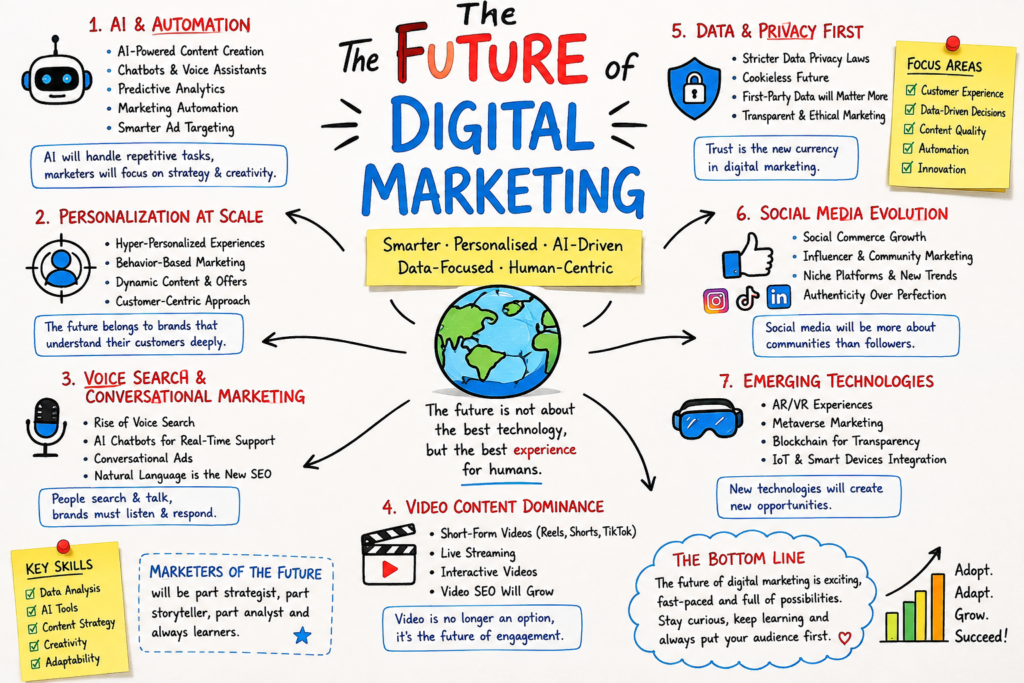
Several factors are contributing to the continued growth of digital marketing:
- Increasing internet and smartphone usage
- Growth of e-commerce and online businesses
- Rising demand for personalized customer experiences
- Expansion of AI-powered marketing tools
- Growth in video content and short-form media
- Higher investment in digital advertising
- Increased use of marketing automation
- Demand for measurable marketing results
Another reason digital marketing has a bright future is its ability to adapt to changing technology. New tools and platforms continue to emerge, giving businesses more opportunities to connect with customers. Professionals who stay updated with these changes and continue learning will be better prepared for future career opportunities.
As technology evolves, digital marketing will continue to play a central role in helping businesses grow, making it one of the most future-ready career options for students, professionals, and entrepreneurs.
Career After Digital Marketing Course: Jobs, Salary, Career Growth & Future Scope in India (2026)
Top Digital Marketing Trends That Will Shape the Future
Digital marketing is constantly evolving, and staying updated with the latest trends is essential for long-term success. Businesses that quickly adapt to new technologies and changing customer expectations are more likely to stay competitive. Understanding these trends can help marketers improve campaign performance, build stronger customer relationships, and prepare for the future of the industry.
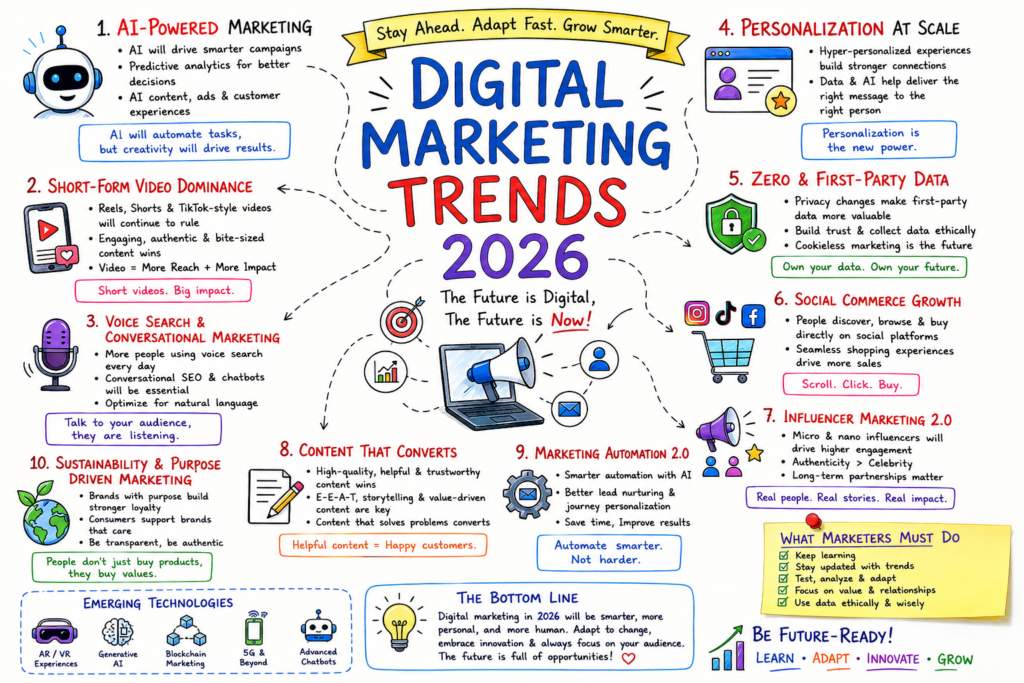
Here are some of the most important digital marketing trends expected to shape the future:
1. Artificial Intelligence (AI)
AI is helping marketers create content, analyze data, automate tasks, and personalize customer experiences more efficiently than ever before.
2. Voice Search Optimization
As voice assistants become more popular, businesses are optimizing their websites and content for conversational search queries.
3. Video Marketing
Short-form videos, live streaming, and educational content continue to attract high engagement across platforms like YouTube, Instagram, and Facebook.
4. Personalized Marketing
Customers expect personalized recommendations, emails, and advertisements based on their interests and online behaviour.
5. Marketing Automation
Automation tools help businesses manage emails, customer journeys, lead nurturing, and reporting while saving time and improving efficiency.
6. First-Party Data
As privacy regulations evolve, businesses are focusing more on collecting and using first-party customer data responsibly.
7. AI-Powered Search
Search engines are becoming smarter, making high-quality, helpful, and user-focused content more important than ever before.
These trends show that digital marketing is becoming more intelligent, customer-focused, and data-driven. Professionals who understand these technologies and continuously update their skills will be well-positioned for future career opportunities.
How AI Is Transforming the Future of Digital Marketing
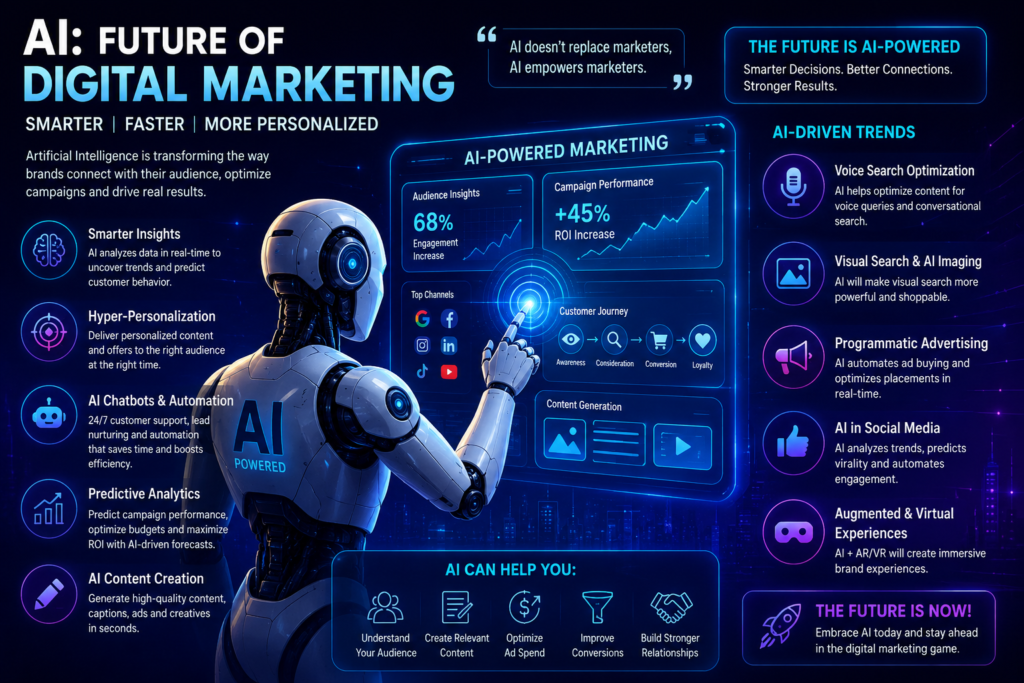
Artificial Intelligence (AI) is changing the way businesses plan, manage, and optimize their marketing campaigns. What once required hours of manual work can now be completed in minutes with the help of AI-powered tools. From content creation and keyword research to customer support and campaign analysis, AI is helping marketers work more efficiently without replacing the need for human creativity and strategic thinking.
Today, businesses use AI to understand customer behaviour, predict buying patterns, personalize marketing messages, and automate repetitive tasks. Instead of relying only on assumptions, marketers can now make data-driven decisions that improve customer engagement and increase return on investment (ROI).
Some of the most common ways AI is transforming digital marketing include:
- Creating high-quality content with AI writing assistants
- Identifying trending keywords and search opportunities
- Personalizing email marketing campaigns
- Automating customer support using AI chatbots
- Optimizing Google Ads campaigns with smart bidding
- Predicting customer behaviour using analytics
- Generating marketing reports in less time
- Improving website user experience through AI-powered recommendations
- Creating images and videos with AI tools
- Automating repetitive marketing workflows
Popular AI tools used by digital marketers include:
- ChatGPT
- Google Gemini
- Canva AI
- Adobe Firefly
- HubSpot AI
- Jasper AI
- Surfer SEO
- Notion AI
- Microsoft Copilot
While AI has made digital marketing more efficient, businesses still need professionals who can create marketing strategies, understand customer psychology, evaluate campaign performance, and make informed business decisions. AI works best when combined with human expertise rather than replacing it.
Learn more Digital Marketing course with AI
Will AI Replace Digital Marketers?
One of the biggest concerns among students and marketing professionals today is whether Artificial Intelligence will replace digital marketers. The short answer is no. AI is changing how digital marketing is done, but it is not replacing the people behind successful marketing strategies.
AI is designed to automate repetitive and time-consuming tasks such as generating reports, organizing data, writing first drafts of content, and optimizing advertising campaigns. These capabilities help marketers work faster and more efficiently, allowing them to focus on strategic planning, creativity, branding, and customer relationships.
Digital marketing involves many responsibilities that require human thinking and decision-making, including:
- Understanding customer emotions and behaviour
- Creating brand strategies
- Planning marketing campaigns
- Solving business challenges
- Developing creative ideas
- Building trust with customers
- Making ethical marketing decisions
- Managing client relationships
Rather than replacing marketers, AI is creating a new generation of professionals who know how to combine technology with creativity. Employers are increasingly looking for marketers who understand AI tools while also possessing strong communication, analytical, and problem-solving skills.
The future belongs to professionals who are willing to adapt, learn continuously, and use AI as a productivity tool rather than seeing it as a competitor. Marketers who embrace AI will have better career opportunities and remain valuable as the industry evolves.
Digital Marketing course with AI, Career After Digital Marketing Course: Jobs, Salary, Career Growth & Future Scope in India (2026)
The Future of SEO in the AI Era
Search Engine Optimization (SEO) continues to be one of the most important areas of digital marketing, but it is evolving rapidly. Search engines are becoming smarter, AI-generated search experiences are changing how users find information, and businesses must focus on creating content that genuinely helps people rather than simply targeting keywords.
Modern SEO is no longer about repeating the same keyword multiple times. Instead, success depends on creating useful, well-structured content that answers real questions, demonstrates expertise, and provides a positive user experience. Google’s search systems increasingly reward websites that publish original, trustworthy, and people-first content.
The future of SEO is expected to focus on several key areas:
- High-quality, experience-based content
- Search intent optimization
- AI-assisted content creation with human review
- Voice search optimization
- Video SEO
- Local SEO for businesses
- Mobile-first user experience
- Website speed and Core Web Vitals
- Structured data and schema markup
- Search Everywhere Optimization (SEO across search engines, social platforms, and AI tools)
Businesses that invest in technical SEO, helpful content, and a strong brand presence are more likely to achieve long-term visibility in search results. While AI tools can assist with research and content creation, human expertise remains essential for building trust, maintaining accuracy, and delivering real value to users.
For digital marketers, learning modern SEO alongside AI tools is one of the best ways to stay competitive and prepare for the future of digital marketing.
SEO Course → Search Engine Optimization (SEO)
Google Search Console Course → Google Search Console Course in Shimla
Content Marketing Course → Content Marketing Course Shimla
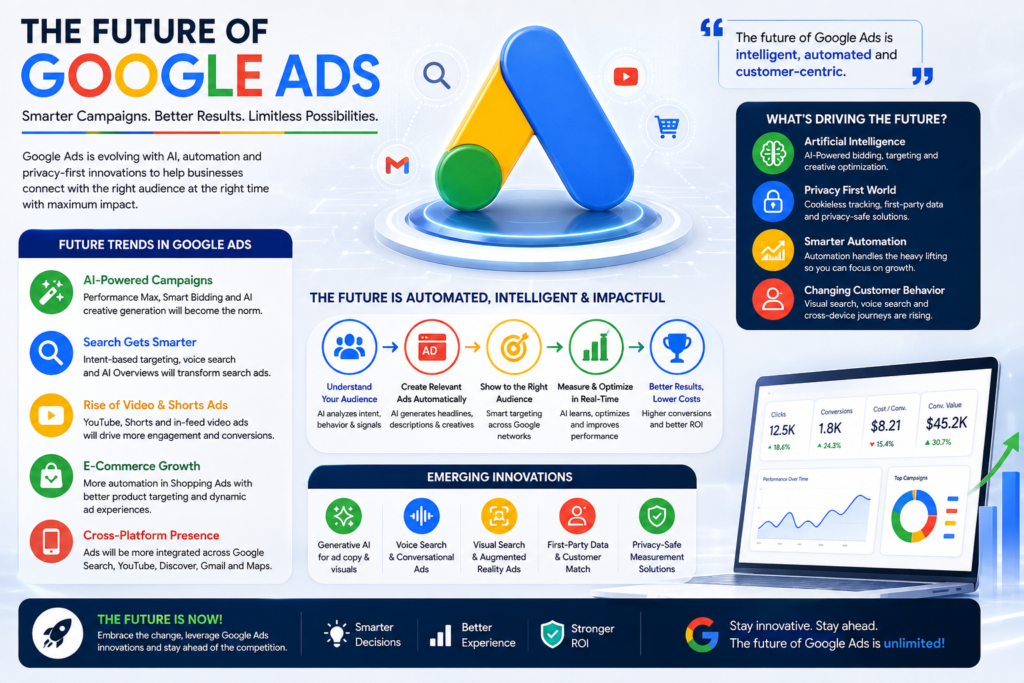
The Future of Google Ads & Performance Marketing
Paid advertising has become one of the fastest-growing areas of digital marketing, and its importance is expected to increase even further in the coming years. Businesses are investing more in Google Ads, social media advertising, and performance marketing because these channels provide measurable results and allow marketers to reach the right audience at the right time.
The future of Google Ads will be driven by artificial intelligence, automation, and data. Features such as Smart Bidding, Performance Max campaigns, audience signals, and predictive analytics are already helping businesses optimize campaigns with less manual effort. Instead of managing every bid or keyword manually, marketers can now focus more on strategy, audience targeting, creative messaging, and campaign optimization.
Performance marketing is also evolving beyond simply generating clicks. Businesses now expect marketers to improve return on investment (ROI), increase conversions, reduce acquisition costs, and deliver long-term business growth.
Key Trends Shaping Google Ads and Performance Marketing
- AI-powered campaign optimization
- Performance Max campaigns
- Smart Bidding strategies
- Better audience targeting using first-party data
- Cross-platform advertising
- Video advertising growth
- Shopping Ads for e-commerce businesses
- Privacy-focused advertising
- Conversion tracking improvements
- Data-driven campaign optimization
Although automation continues to improve, successful advertising still depends on understanding customer behaviour, writing compelling ad copy, selecting the right audience, and continuously optimizing campaigns. Digital marketers who combine technical knowledge with strategic thinking will remain highly valuable as paid advertising continues to evolve.
Future Skills Every Digital Marketer Should Learn
As digital marketing continues to evolve, employers are looking for professionals who can do much more than run advertisements or manage social media pages. The future belongs to marketers who understand technology, analyze data, create valuable content, and adapt quickly to changing consumer behaviour.
Learning the right skills today can help you stay competitive, increase your earning potential, and build a long-term career in digital marketing. Instead of depending on a single specialization, successful marketers continuously expand their knowledge and keep pace with new tools and technologies.
Essential Skills for the Future of Digital Marketing
- Search Engine Optimization (SEO)
- Google Ads & Performance Marketing
- Social Media Marketing
- Content Marketing
- Email Marketing
- Google Analytics (GA4)
- Google Tag Manager (GTM)
- Conversion Rate Optimization (CRO)
- Marketing Automation
- AI Tools & Prompt Engineering
- Data Analysis & Reporting
- Video Marketing
- Copywriting
- Personal Branding
- Communication & Presentation Skills
Technical Skills Are Important, but So Are Human Skills
While AI and automation can simplify many marketing tasks, employers continue to value professionals who can think creatively, solve problems, communicate effectively, and understand customer psychology.
Some of the most valuable human skills include:
- Critical thinking
- Creativity
- Strategic planning
- Leadership
- Team collaboration
- Problem-solving
- Adaptability
- Decision-making
The most successful digital marketers of the future will combine technical expertise with strong communication and business skills. This balance will help them stay relevant, even as technology continues to change the marketing industry.
Career Opportunities in the Future of Digital Marketing
As businesses continue to expand their online presence, the demand for skilled digital marketing professionals is expected to grow across almost every industry. Companies are no longer hiring marketers simply to manage social media or publish content—they are looking for professionals who can drive business growth, improve customer experience, and make informed decisions using data.
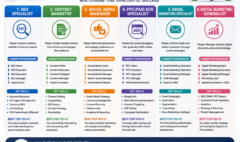
The future of digital marketing offers a wide range of career opportunities for students, graduates, working professionals, freelancers, and entrepreneurs. Whether you prefer working for a company, running your own agency, or building an online business, digital marketing provides multiple career paths with long-term growth potential.
High-Demand Career Opportunities
- SEO Specialist
- Google Ads Specialist
- Performance Marketing Specialist
- Social Media Manager
- Content Marketing Manager
- Email Marketing Specialist
- Web Analytics Expert
- Marketing Automation Specialist
- AI Marketing Specialist
- Conversion Rate Optimization (CRO) Specialist
- Digital Marketing Manager
- Growth Marketing Manager
- E-commerce Marketing Specialist
- Digital Marketing Consultant
- Agency Owner
Industries Hiring Digital Marketers
Digital marketing professionals are in demand across many sectors, including:
- Information Technology (IT)
- E-commerce
- Healthcare
- Education
- Banking & Finance
- Real Estate
- Travel & Tourism
- Media & Entertainment
- Manufacturing
- Startups
- Government Organizations
As technology continues to evolve, new job roles will continue to emerge. Professionals who continuously upgrade their skills, gain practical experience, and stay informed about AI, automation, and consumer trends will be well-positioned to build successful and rewarding careers in the years ahead.
How Businesses Should Prepare for the Future of Digital Marketing
The future of digital marketing is not only about adopting new technology—it is about understanding changing customer expectations and building meaningful online experiences. Businesses that embrace innovation while keeping their customers at the center of every marketing decision will be better positioned for long-term success.
Today’s customers expect brands to provide fast responses, personalized recommendations, valuable content, and seamless experiences across websites, social media platforms, mobile apps, and search engines. Companies that continue to rely on outdated marketing methods may struggle to compete in an increasingly digital marketplace.
To stay ahead, businesses should focus on building a flexible marketing strategy that combines technology with human creativity. Artificial Intelligence, automation, and analytics can improve efficiency, but successful marketing still depends on understanding customer needs, creating valuable content, and building trust.
Strategies Businesses Should Focus On
- Create helpful and original content that solves customer problems.
- Invest in Search Engine Optimization (SEO) and high-quality website content.
- Use AI responsibly to improve productivity without compromising quality.
- Build strong relationships through email marketing and social media.
- Improve website speed, mobile experience, and user navigation.
- Use data and analytics to make informed marketing decisions.
- Develop first-party customer data while respecting user privacy.
- Experiment with new platforms, technologies, and marketing formats.
- Continuously test and optimize advertising campaigns.
- Train marketing teams to adapt to AI and emerging technologies.
Businesses that continuously learn, innovate, and adapt to changing consumer behaviour will have a competitive advantage in the years ahead. The future of digital marketing belongs to organizations that combine technology, creativity, and customer-focused strategies.
The Future of Digital Marketing will continue to evolve as AI, automation, and data-driven strategies become more advanced.
Google Search Central https://developers.google.com/search
Frequently Asked Questions (FAQs)
1. What is the future of digital marketing?
The future of digital marketing is driven by Artificial Intelligence, automation, data analytics, personalization, and customer-focused strategies. Businesses will continue investing in digital channels, creating more career opportunities for skilled professionals.
2. Is digital marketing a good career in 2026?
Yes. Digital marketing continues to be one of the fastest-growing career fields in India and globally. As businesses expand their online presence, the demand for professionals with practical digital marketing skills is expected to increase.
3. Will AI replace digital marketers?
No. AI helps automate repetitive tasks, but businesses still need professionals who can develop marketing strategies, understand customer behaviour, create engaging campaigns, and make business decisions.
4. Which digital marketing skills will be in demand in the future?
Some of the most valuable skills include:
- Search Engine Optimization (SEO)
- Google Ads
- AI Marketing
- Marketing Automation
- Performance Marketing
- Google Analytics
- Content Marketing
- Video Marketing
- Data Analysis
- Conversion Rate Optimization (CRO)
5. Is SEO still relevant in the age of AI?
Yes. SEO continues to play an important role because search engines still prioritize high-quality, helpful, and trustworthy content. AI tools support SEO, but they do not replace the need for strong content, technical optimization, and user experience.
6. What industries hire digital marketing professionals?
Digital marketers are hired across industries, including:
- Information Technology
- E-commerce
- Healthcare
- Education
- Banking & Finance
- Real Estate
- Travel & Tourism
- Media & Entertainment
- Manufacturing
- Government Organizations
7. Can I start my own business after learning digital marketing?
Yes. Many professionals use digital marketing skills to build agencies, online stores, affiliate marketing websites, consulting businesses, and personal brands.
8. Which digital marketing specialization has the best future?
Performance Marketing, AI Marketing, SEO, Marketing Automation, Web Analytics, and Content Marketing are expected to remain among the fastest-growing specializations.
9. How long does it take to become job-ready in digital marketing?
Most learners become job-ready within 6 to 12 months, depending on practical training, live projects, certifications, and consistent practice.
10. Why should I learn digital marketing now?
Learning digital marketing today prepares you for one of the fastest-growing industries, offering opportunities in employment, freelancing, entrepreneurship, and business growth.
11. What is the role of AI in digital marketing?
AI helps marketers automate repetitive tasks, analyze customer behaviour, personalize campaigns, generate content ideas, optimize advertisements, and improve decision-making through data-driven insights.
12. How can I prepare for the future of digital marketing?
Stay updated with industry trends, learn AI-powered marketing tools, gain practical experience, earn certifications, and continuously improve your technical and communication skills.
Conclusion
The future of digital marketing is full of opportunities for businesses, professionals, students, and entrepreneurs who are ready to learn and adapt. As technology continues to evolve, marketing will become more data-driven, personalized, and AI-assisted. However, the core principles of successful marketing—understanding customers, building trust, and creating valuable experiences—will remain unchanged.
Artificial Intelligence, automation, advanced analytics, and emerging technologies will continue to transform how marketing campaigns are planned and executed. Instead of replacing marketers, these innovations will empower professionals to make better decisions, improve productivity, and deliver stronger business results.
For anyone planning a long-term career, digital marketing remains one of the most promising industries. The key to success is continuous learning, practical experience, and staying updated with new tools, platforms, and customer behaviour. Professionals who combine technical knowledge with creativity, communication, and strategic thinking will continue to be in high demand.
Whether you want to work for a company, become a freelancer, grow your own business, or build a digital marketing agency, now is the right time to invest in future-ready skills. By learning SEO, Google Ads, Analytics, AI Marketing, Content Marketing, and Performance Marketing, you can prepare yourself for a successful career in the digital economy.
Start Your Digital Marketing Journey with IICE Computer Education
If you’re ready to build a future-ready career, choosing the right training institute is one of the most important decisions you’ll make. At IICE Computer Education, our Digital Marketing Course in Shimla is designed to provide practical, industry-focused training that prepares students for real-world opportunities.
What You’ll Learn
- Search Engine Optimization (SEO)
- Google Ads (PPC)
- Social Media Marketing
- Content Marketing
- Email Marketing
- Affiliate Marketing
- Google Analytics (GA4)
- Google Tag Manager (GTM)
- WordPress Website Development
- AI Marketing & Prompt Engineering
- Marketing Automation
- Live Projects & Practical Training
- Industry-Recognized Certification
- Resume Building & Interview Preparation
- 100% Placement Assistance on Professional Courses
Whether you’re a student, graduate, working professional, or business owner, our course is designed to help you develop practical skills and prepare for the future of digital marketing.
Ready to Build Your Future in Digital Marketing?
Explore our Digital Marketing Course in Shimla, download the latest course syllabus, or contact our team for personalized career guidance. With practical learning, expert trainers, AI-focused modules, and placement assistance, you’ll be equipped with the skills needed to succeed in today’s competitive digital landscape.