Data Analysis Course in Shimla – Learn Data Analytics with Practical Training

Data Analysis Course in Shimla – Learn Data Analytics with Practical Training
Data has become an essential part of decision-making across almost every industry. Companies use data to understand customers, measure performance, identify opportunities, reduce costs, and make better business decisions. As the demand for data-driven professionals continues to grow, learning data analysis and data analytics can be a valuable career skill for students, graduates, working professionals, and people looking to move into technology and business-related careers.
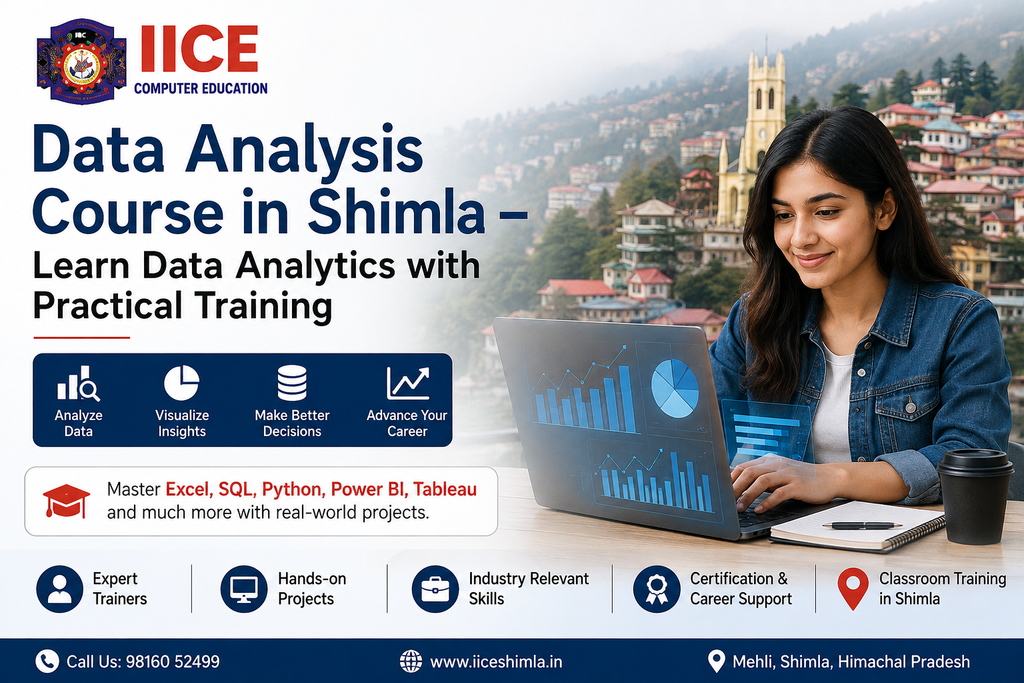
If you are looking for a Data Analysis Course in Shimla, choosing a program that combines concepts with practical training is important. A good course should help you understand how to collect, clean, analyze, visualize, and interpret data using commonly used tools such as Microsoft Excel, SQL, Python, Power BI, Tableau, and statistics.
At IICE Shimla, learners can explore data analysis concepts and develop practical skills that can be applied to real-world datasets and business problems.
What Is Data Analysis?
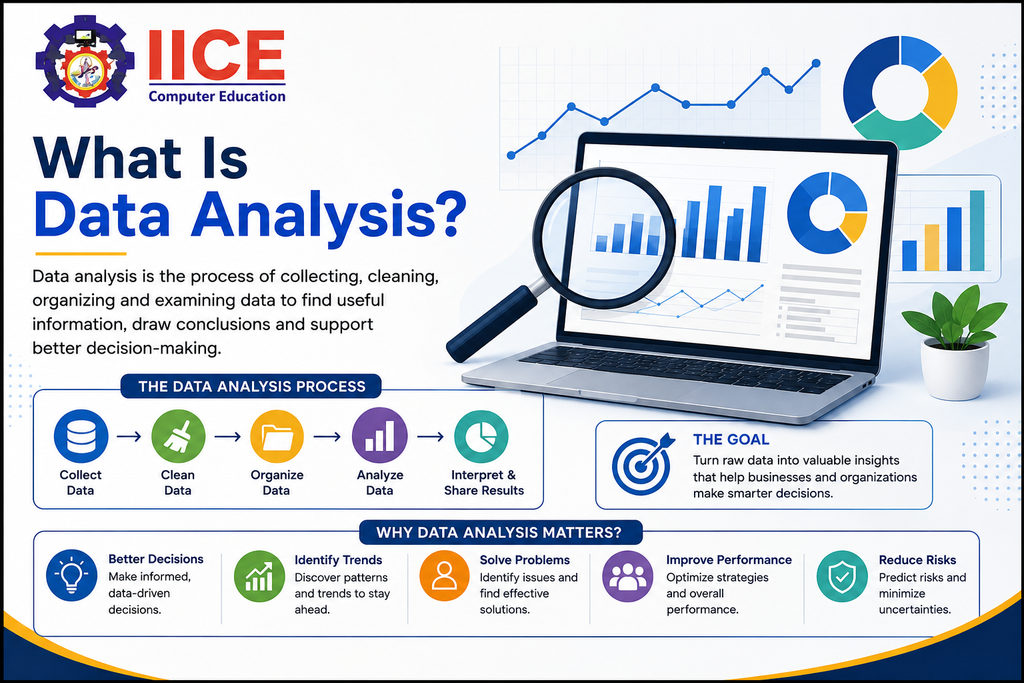
Data analysis is the process of examining raw data to discover useful information, identify patterns, answer questions, and support decision-making.
A data analyst may work with sales data, customer information, financial records, website traffic, marketing data, operational data, or other business datasets.
The typical data analysis process includes:
- Collecting data
- Cleaning and preparing data
- Exploring the data
- Analyzing patterns and trends
- Creating charts and dashboards
- Interpreting the results
- Communicating insights
For example, a company may have thousands of sales records but not know which products generate the most revenue. A data analyst can clean and analyze the data, identify important trends, and present the results through reports or dashboards.
Why Learn Data Analysis in Shimla?
Learning data analysis can be useful for students and professionals who want to develop a combination of technical, analytical, and business skills.
A structured data analytics course can help learners:
- Understand how businesses use data
- Develop analytical thinking
- Work with spreadsheets and databases
- Learn SQL for querying data
- Use Python for data analysis
- Create dashboards and visual reports
- Work with real-world datasets
- Build practical projects
- Develop skills relevant to data-related careers
For learners in Shimla, classroom-based training can also provide an opportunity to learn with instructors, ask questions directly, and work through practical exercises.
Data Analysis Course in Shimla at IICE
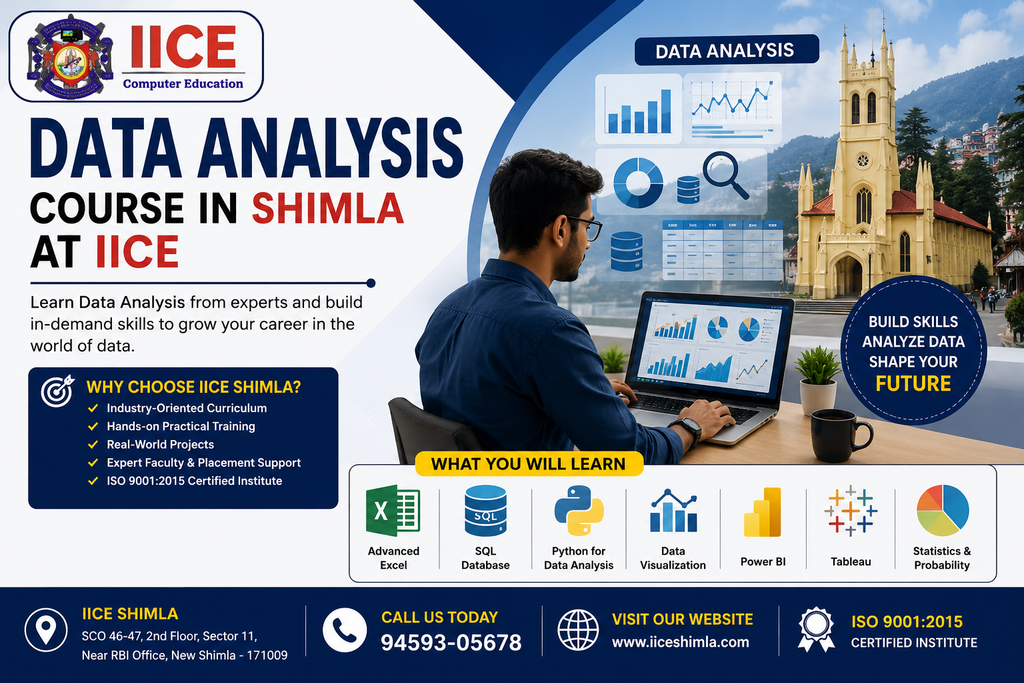
A professional data analysis course in Shimla should go beyond definitions and theoretical concepts. Learners should get opportunities to work with data and understand how analytical tools are used to solve practical problems.
At IICE, the course can be presented around the complete data analysis workflow, from preparing raw data to creating meaningful reports and dashboards.
The exact course structure, duration, fee, batch timings, and available training modes should be confirmed with IICE before enrollment.
Data Analysis Course Syllabus
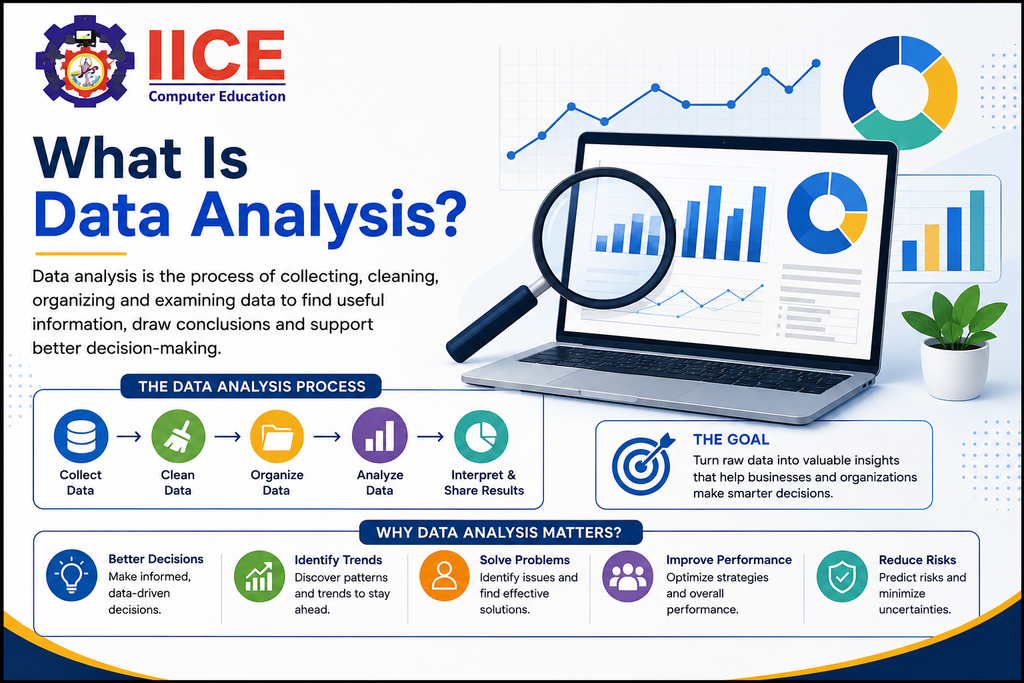
A comprehensive data analysis syllabus can include the following areas:
1. Introduction to Data Analysis
Students can begin by understanding:
- What is data?
- What is data analysis?
- Types of data
- Structured and unstructured data
- Data analysis workflow
- Role of a data analyst
- Data-driven decision-making
2. Microsoft Excel for Data Analysis
Excel remains an important tool for working with and analyzing datasets.
Topics can include:
- Excel formulas and functions
- Sorting and filtering
- Data cleaning
- Conditional formatting
- Pivot Tables
- Charts and graphs
- Lookup functions
- Data validation
- Basic statistical functions
- Excel dashboards
Practical exercises can help students understand how Excel is used to transform raw data into useful reports.
3. SQL for Data Analytics
SQL is widely used to retrieve and work with data stored in relational databases.
A SQL module can cover:
- Database fundamentals
- Tables and relationships
- SELECT statements
- WHERE conditions
- Sorting and filtering
- GROUP BY
- Aggregate functions
- JOINs
- Subqueries
- Data manipulation
- Practical SQL queries
Learning SQL can help aspiring data analysts work more effectively with large datasets.
4. Python for Data Analysis
Python is a popular programming language for data analysis and automation.
A Python-based data analysis module can introduce:
- Python fundamentals
- Variables and data types
- Lists, tuples, and dictionaries
- Conditional statements
- Loops
- Functions
- Working with files
- NumPy
- Pandas
- Data cleaning
- Data manipulation
- Exploratory data analysis
- Data visualization
Students can use Python to work with datasets and identify patterns that may be difficult to discover manually.
5. Statistics for Data Analysis
Statistics provides the foundation for understanding and interpreting data.
Important concepts can include:
- Mean
- Median
- Mode
- Range
- Variance
- Standard deviation
- Percentiles
- Probability basics
- Correlation
- Distribution
- Sampling
- Descriptive statistics
A basic understanding of statistics helps analysts interpret results more accurately.
6. Power BI for Data Visualization
Power BI can be used to transform data into interactive reports and dashboards.
Training can include:
- Importing data
- Data transformation
- Data modeling
- Creating relationships
- Charts and visualizations
- Filters and slicers
- Calculated columns
- Measures
- Dashboard design
- Publishing and sharing reports
The goal is not simply to create attractive charts but to communicate useful information clearly.
7. Tableau for Data Visualization
Tableau is another popular business intelligence and visualization platform.
Students can learn concepts such as:
- Connecting data
- Creating worksheets
- Charts
- Filters
- Dashboards
- Interactive visualizations
- Data storytelling
Working with more than one visualization tool can help students understand different approaches to presenting analytical results.
Practical Data Analysis Projects
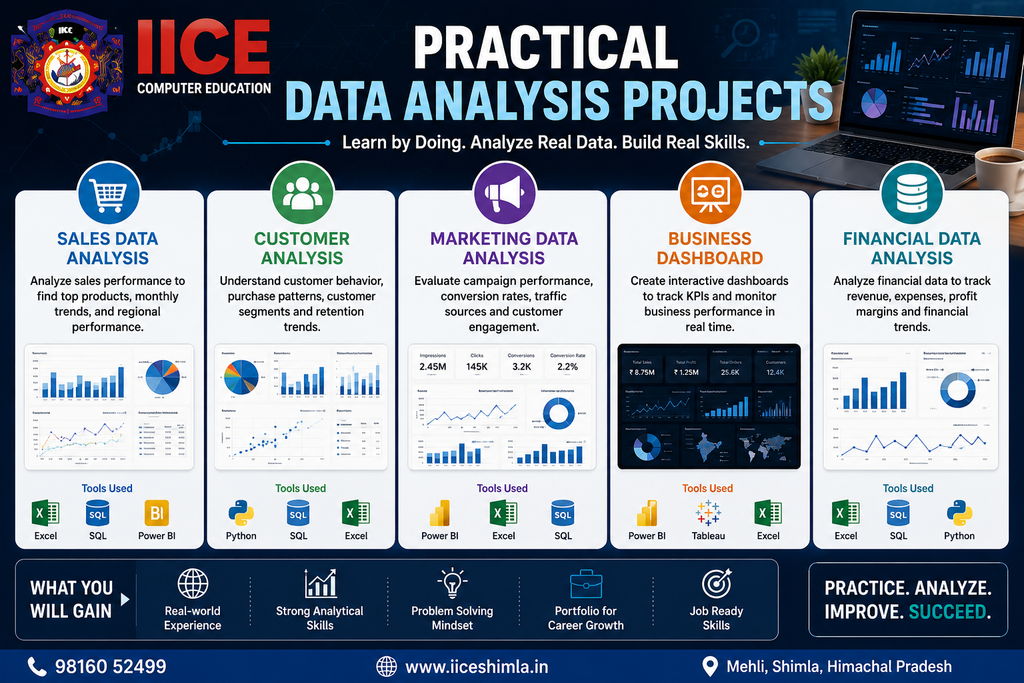
Practical projects are an important part of learning data analysis because they allow students to apply concepts to realistic situations.
Possible projects include:
Sales Data Analysis
Analyze sales records to identify:
- Best-selling products
- Monthly sales trends
- Regional performance
- Revenue patterns
- Customer segments
Customer Analysis
Use customer data to understand:
- Customer behavior
- Purchasing patterns
- Customer categories
- Retention trends
Marketing Data Analysis
Analyze marketing data to understand:
- Campaign performance
- Conversion rates
- Traffic sources
- Customer engagement
Business Dashboard
Create an interactive dashboard using a tool such as Power BI or Tableau to present important business KPIs.
Real projects can also become useful additions to a learner’s portfolio when they are documented properly.
What Skills Can You Develop?
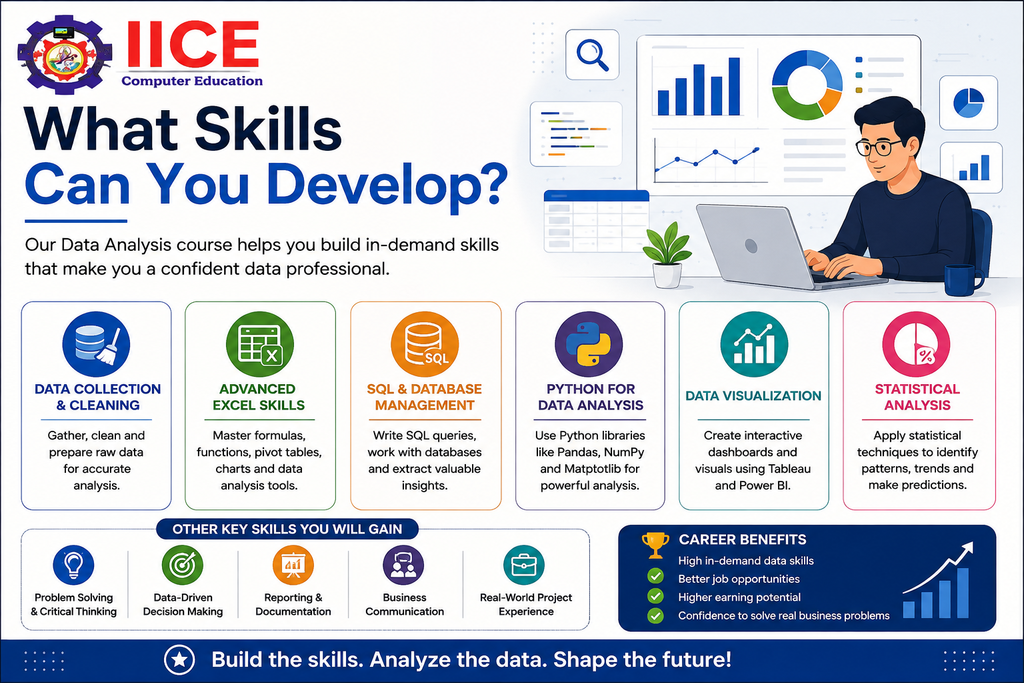
After completing practical training, learners can work toward developing skills such as:
- Data cleaning
- Data visualization
- Spreadsheet analysis
- SQL querying
- Python-based data analysis
- Statistical analysis
- Dashboard creation
- Business reporting
- Problem-solving
- Analytical thinking
- Data storytelling
The level of skill a student develops will depend on the course structure, practice time, previous knowledge, and individual effort.
Who Can Join a Data Analysis Course?
Data analysis is not limited to computer science graduates.
Depending on the course requirements, it can be suitable for:
- College students
- Graduates
- Computer science students
- Engineering students
- Business and management students
- Working professionals
- People changing careers
- Entrepreneurs
- Professionals who want to improve their data skills
Basic computer knowledge can be helpful. Students should also be prepared to practice regularly because data analysis is a skill that improves through hands-on work.
Career Opportunities After Data Analysis Training
Data analysis skills can be useful across industries such as:
- Information technology
- Banking and finance
- E-commerce
- Marketing
- Healthcare
- Education
- Retail
- Manufacturing
- Travel and tourism
- Consulting
Depending on their skills and experience, learners can explore roles such as:
- Data Analyst
- Junior Data Analyst
- Business Analyst
- Reporting Analyst
- MIS Analyst
- Business Intelligence Analyst
- Data Visualization Analyst
A course alone does not guarantee employment. Building practical skills, completing projects, developing a portfolio, and preparing for interviews are also important parts of becoming job-ready.
Why Practical Training Matters in Data Analytics
Reading about data analysis is different from actually analyzing data.
For example, knowing what a Pivot Table is does not necessarily mean that someone can analyze a large sales dataset effectively.
Practical training gives learners an opportunity to:
- Work with datasets
- Identify data-quality problems
- Clean information
- Write SQL queries
- Analyze data using Python
- Build dashboards
- Interpret results
- Present findings
This practical approach can make the learning process more useful for students who want to apply their knowledge in real-world situations.
How to Choose the Best Data Analysis Course in Shimla
Before choosing a data analysis course in Shimla, compare the following factors:
1. Course Syllabus
Check whether the program covers important tools such as Excel, SQL, Python, Power BI, statistics, and data visualization.
2. Practical Projects
Ask whether students work on real or realistic datasets and complete projects during training.
3. Trainer Experience
Find out who teaches the course and whether the instructor has relevant industry or teaching experience.
4. Training Format
Check whether the course is classroom-based, online, or available in both formats.
5. Course Duration and Timings
Choose a schedule that allows enough time for learning, practice, and project work.
6. Certification
Ask what certification is provided after successfully completing the course and what requirements must be met.
7. Career Support
If career assistance is offered, ask what it includes, such as resume preparation, interview preparation, or placement assistance.
8. Projects and Portfolio
A course that helps you build practical projects can be more useful than one focused only on theory.
Why Choose IICE Shimla for Data Analysis Training?
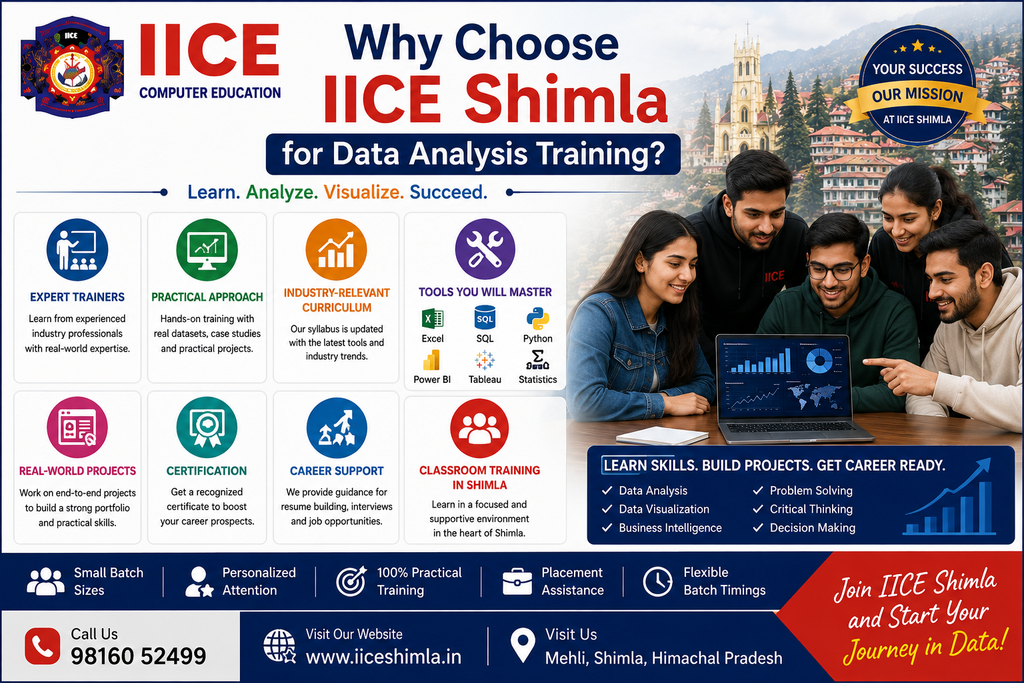
When choosing a training institute, students should look for a learning environment that combines structured instruction with practical application.
IICE can highlight its actual strengths here, such as:
- Experienced trainers
- Classroom training in Shimla
- Practical exercises
- Project-based learning
- Industry-relevant tools
- Certification
- Career guidance
- Interview preparation
- Placement assistance
Only include the points above that IICE actually provides. Specific claims should be supported by genuine information available on your website or from the institute.
Start Learning Data Analysis in Shimla
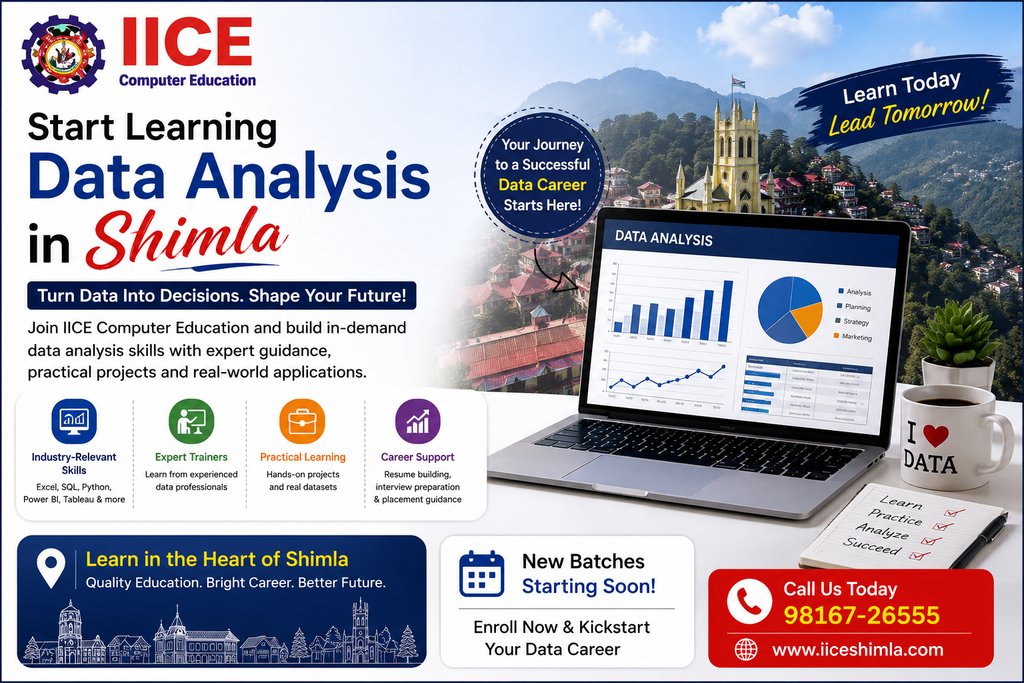
Data analysis is becoming an important skill for organizations that want to make decisions using reliable information. Learning Excel, SQL, Python, statistics, Power BI, Tableau, and data visualization can help students develop a strong foundation in this field.
If you are searching for a Data Analysis Course in Shimla, compare courses carefully and choose a program that provides a balance of concepts, practical exercises, projects, and career-oriented skills.
To learn more about the Data Analysis Course at IICE Shimla, contact the institute for the latest information about course availability, fees, duration, batches, syllabus, and enrollment.
Ready to develop your data analysis skills? Contact IICE Shimla to learn about the current Data Analysis training program.
Frequently Asked Questions
What is a data analysis course?
A data analysis course teaches learners how to collect, clean, analyze, visualize, and interpret data using analytical tools and techniques.
Which tools are used in data analysis?
Commonly used tools include Microsoft Excel, SQL, Python, Power BI, Tableau, and statistical techniques.
Is data analysis difficult for beginners?
Beginners can learn data analysis step by step. Basic computer skills, logical thinking, and regular practice can make the learning process easier.
Can non-technical students learn data analysis?
Yes. Students from different academic backgrounds can learn data analysis. The appropriate starting point depends on their existing knowledge and the requirements of the course.
Is Python necessary for data analysis?
Python is not the only tool used for data analysis, but it is a valuable skill for professionals who want to perform advanced data manipulation, automation, and analysis.
Is SQL important for a data analyst?
Yes. SQL is an important skill for working with data stored in relational databases and is commonly included in data analyst learning paths.