
Cybersecurity Course
August 25, 2026 2026-08-25 10:11Cybersecurity Course
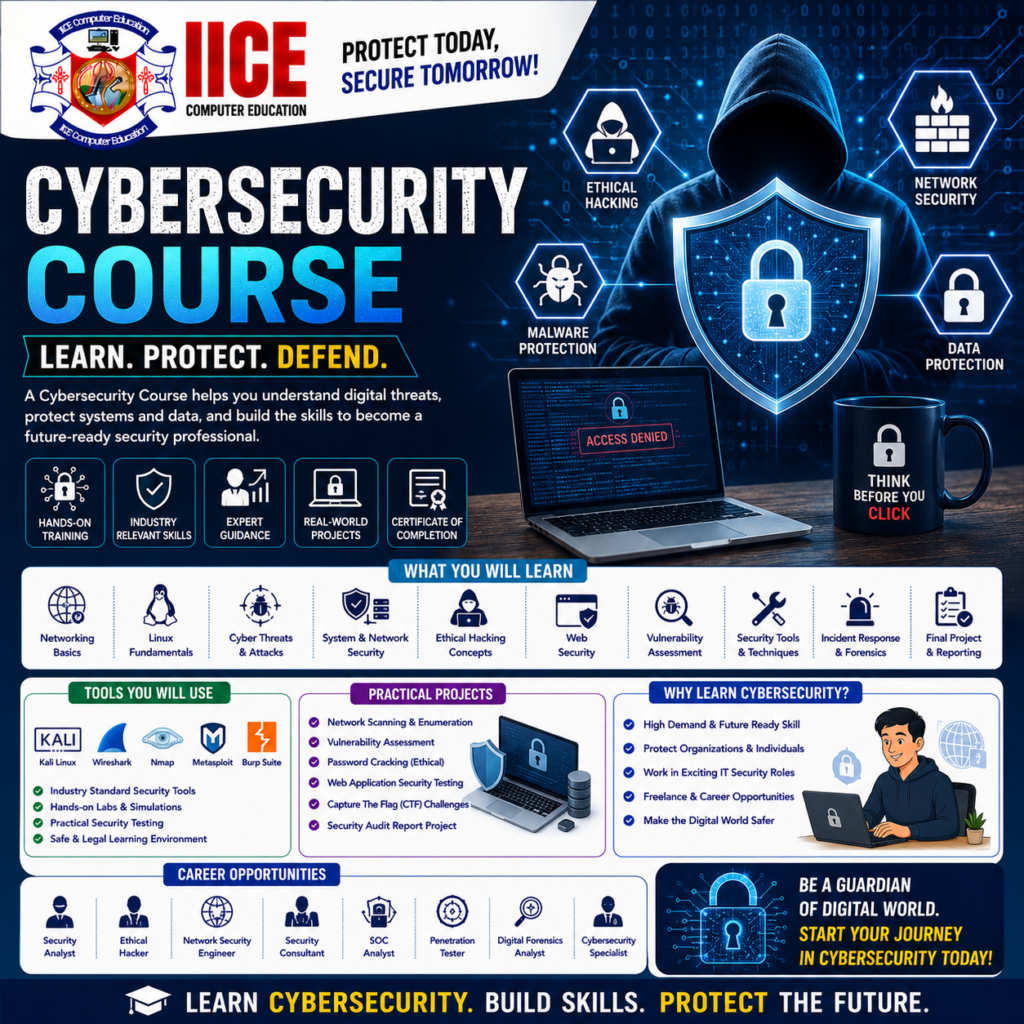
Cybersecurity Course in Shimla
Introduction
A Cybersecurity Course in Shimla helps students understand how computers, websites, networks, applications, and digital information can be protected from online threats. In simple words, cybersecurity is about keeping important information safe and making sure that only the right people can access it.
Students can learn about common cyber threats, passwords, networks, malware, data protection, and safe online practices through simple lessons and practical exercises.
At IICE Computer Education Shimla, students can learn cybersecurity step by step without needing to understand everything at once. The learning can begin with basic computer and networking concepts and gradually move toward network security, ethical hacking concepts, Linux, web security, vulnerability assessment, digital security tools, and practical cybersecurity projects.
The focus is on safe and legal learning so students understand how security professionals identify and fix weaknesses.
What Is Cybersecurity?
Cybersecurity means protecting computers, networks, applications, and data from unauthorised access, damage, or misuse.
Think of it like protecting a house:
Computer = House
Password = Lock
Firewall = Security Gate
Antivirus = Security Guard
Backup = Spare Copy
Students can learn how these different security methods work together to protect digital systems.
Why Learn Cybersecurity?
We use computers and the internet every day. Businesses, schools, banks, hospitals, and other organisations store important information digitally. This makes cybersecurity an important part of modern technology.
Key Benefits
- Learn cybersecurity basics
- Understand common cyber threats
- Learn computer and network security
- Understand passwords and authentication
- Learn Linux basics
- Understand firewalls
- Learn web security basics
- Understand vulnerabilities
- Learn ethical hacking concepts
- Practise security assessment in safe environments
- Understand data protection
- Learn security tools
- Work on practical projects
- Build a cybersecurity portfolio
Cybersecurity Course for Beginners
A Cybersecurity Course in Shimla can be suitable for school and college students, computer students, engineering students, graduates, job seekers, IT professionals, and beginners who are interested in computers and digital security.
Students do not need advanced cybersecurity knowledge before joining. Basic computer knowledge can help them understand the concepts more easily.
What Will You Learn?
Students can follow a simple learning path:
Computer Basics → Networking → Linux → Security Basics → Threats → Web Security → Ethical Hacking Concepts → Security Projects
This step-by-step approach helps beginners understand cybersecurity without making the subject unnecessarily complicated.
Cybersecurity Course Syllabus
Module 1: Cybersecurity Fundamentals & Networking
- Introduction to Cybersecurity
- Importance of Cybersecurity
- Common Cyber Threats
- Malware Basics
- Phishing Awareness
- Password Security
- Authentication Basics
- Computer Security
- Network Fundamentals
- IP Addresses
- Ports and Protocols
- TCP/IP Basics
- DNS Basics
- HTTP and HTTPS
- Firewalls
- Network Security Basics
- Safe Internet Practices
- Practical Security Exercises
Module 2: Linux & Security Tools
- Introduction to Linux
- Linux File System
- Basic Linux Commands
- Users and Permissions
- Processes
- Files and Directories
- Network Commands
- Security Configuration Basics
- Introduction to Security Tools
- Vulnerability Scanning Concepts
- Security Logs
- Basic System Monitoring
- Safe Testing Environments
- Security Tool Practice
- Practical Linux Security Project
Module 3: Ethical Hacking & Web Security
- Introduction to Ethical Hacking
- Ethical and Legal Responsibilities
- Cybersecurity Testing Process
- Information Gathering Concepts
- Vulnerability Assessment
- Web Application Security Basics
- Common Web Security Risks
- Authentication Security
- Session Security
- Input Validation
- Secure Configuration
- Security Testing Concepts
- Reporting Security Issues
- Safe Lab-Based Practice
- Web Security Project
Module 4: Security, Protection & Practical Projects
- Data Protection
- Access Control
- Network Protection
- Endpoint Security Basics
- Backup and Recovery
- Security Policies
- Incident Response Basics
- Security Monitoring
- Risk Management Basics
- Cybersecurity Awareness
- Security Assessment
- Vulnerability Report Preparation
- Practical Cybersecurity Case Study
- Final Security Project
- Portfolio Development
Learn Computer and Network Security
Before learning advanced cybersecurity concepts, students need to understand how computers and networks communicate.
Students can learn about:
- IP addresses
- Networks
- Ports
- Protocols
- Routers
- DNS
- HTTP
- HTTPS
- Firewalls
For example, when a person opens a website, many different systems work together to send the website’s information to the computer. Understanding this process helps students understand where security controls are used.
Learn Linux for Cybersecurity
Linux is widely used in many technology and security environments.
Students can learn basic Linux skills such as:
- Navigating folders
- Creating files
- Managing directories
- Using commands
- Managing users
- Understanding permissions
- Checking processes
- Working with networks
- Viewing basic logs
The goal is to help beginners become comfortable working with a command-line environment.
Learn Ethical Hacking
Ethical hacking means testing a computer system or application with proper permission to find security weaknesses.
Students can learn the basic process:
Understand the System → Identify Weaknesses → Test Safely → Document Findings → Recommend Fixes
The course should use controlled labs, practice machines, or systems where testing is authorised. Students should never test someone else’s website, computer, network, or account without permission.
Learn Web Security
Websites and web applications need protection because they often handle user accounts and important information.
Students can learn basic concepts related to:
- Login security
- Password protection
- Session security
- Input validation
- Access control
- Secure configuration
- Common web vulnerabilities
- Security testing
- Security reporting
Students can practise these concepts in safe learning environments.
Learn Vulnerability Assessment
A vulnerability is a weakness that could create a security problem.
Students can learn how security professionals:
- Understand a system
- Identify possible weaknesses
- Assess the risk
- Document findings
- Recommend improvements
- Verify the fixes
This teaches students that cybersecurity is not only about finding problems. It is also about helping organisations make their systems safer.
Learn Cybersecurity Awareness
Good cybersecurity starts with simple habits.
Students can learn why it is important to:
- Use strong passwords
- Avoid suspicious links
- Enable multi-factor authentication
- Keep software updated
- Protect personal information
- Use secure networks
- Create backups
- Be careful with unknown files
- Check website security
- Report suspicious activity
These habits are useful for both personal and professional digital safety.
Practical Cybersecurity Projects
Practical projects help students apply what they learn.
1. Network Security Project
Students can study a sample network and identify basic security risks.
Final Output: Network security assessment report.
2. Linux Security Project
Students can configure a practice Linux environment and learn about users, permissions, processes, and basic security settings.
Final Output: Linux security configuration project.
3. Web Security Project
Students can examine a safe practice website or training application and identify common security weaknesses in a controlled environment.
Final Output: Web security assessment report.
4. Cybersecurity Assessment Project
Students can combine networking, Linux, security concepts, vulnerability assessment, and reporting skills.
Final Output: Complete cybersecurity assessment and security improvement report.
Who Can Join a Cybersecurity Course?
A Cybersecurity Course in Shimla can be suitable for:
- School students
- College students
- Engineering students
- Computer students
- IT students
- Graduates
- Job seekers
- Working professionals
- Beginners
- Technology enthusiasts
Students can start with basic computer knowledge and gradually develop cybersecurity skills.
Do I Need Coding Knowledge?
No advanced programming knowledge is required to begin learning basic cybersecurity.
Students can first understand computers, networks, Linux, and security concepts. Programming and scripting can then be introduced gradually when they become useful for security-related tasks.
Is Cybersecurity Difficult for Beginners?
Cybersecurity has many different areas, so it may look complicated at first. Learning it step by step can make it easier.
A simple learning path is:
Computer Basics → Networking → Linux → Security → Ethical Hacking → Web Security → Practical Projects
Regular practice in safe environments can help students become more confident.
Cybersecurity Training in Shimla
Students searching for Cybersecurity Training in Shimla should look for practical training that covers computer security, networking, Linux, ethical hacking concepts, web security, vulnerability assessment, security tools, and practical projects.
A useful program should allow students to practise in controlled and authorised environments rather than only learning cybersecurity theory.
Before joining, students should confirm the latest course duration, fees, batch timings, syllabus, software/tools, certification, and project structure with the institute.
Career Opportunities After Cybersecurity
Cybersecurity skills can be useful in IT companies, businesses, banks, technology organisations, government organisations, and other sectors that need digital security.
Depending on their education, skills, and experience, students can explore roles such as:
- Cybersecurity Analyst
- Junior Security Analyst
- Security Operations Centre (SOC) Analyst
- Information Security Assistant
- Security Support Executive
- Vulnerability Assessment Analyst
- Network Security Assistant
- Cybersecurity Intern
- IT Security Executive
- Security Operations Intern
Students can also combine cybersecurity with networking, Linux, cloud computing, programming, ethical hacking, web development, or data security.
Why Choose IICE Computer Education Shimla?
Cybersecurity becomes easier when students can practise concepts in controlled environments instead of only reading about them. Practical exercises can help learners understand how computers, networks, applications, and security controls work together.
IICE Computer Education Shimla provides computer and technology training with a practical learning approach. Students choosing a Cybersecurity Course in Shimla can learn through structured lessons, security exercises, controlled labs, trainer guidance, and practical cybersecurity projects.
Key Reasons to Choose IICE
- ISO 9001:2015 Certified
- Government Registered
- MSME/Udyam Registered
- Practical cybersecurity training
- Beginner-friendly learning
- Networking fundamentals
- Linux basics
- Cybersecurity concepts
- Ethical hacking concepts
- Web security
- Vulnerability assessment
- Security tools
- Safe lab-based practice
- Practical security projects
- Trainer guidance
- Portfolio development
- Career-focused learning
- Classroom training in Shimla