
Ethical Hacking Course
August 19, 2026 2026-08-19 4:54Ethical Hacking Course
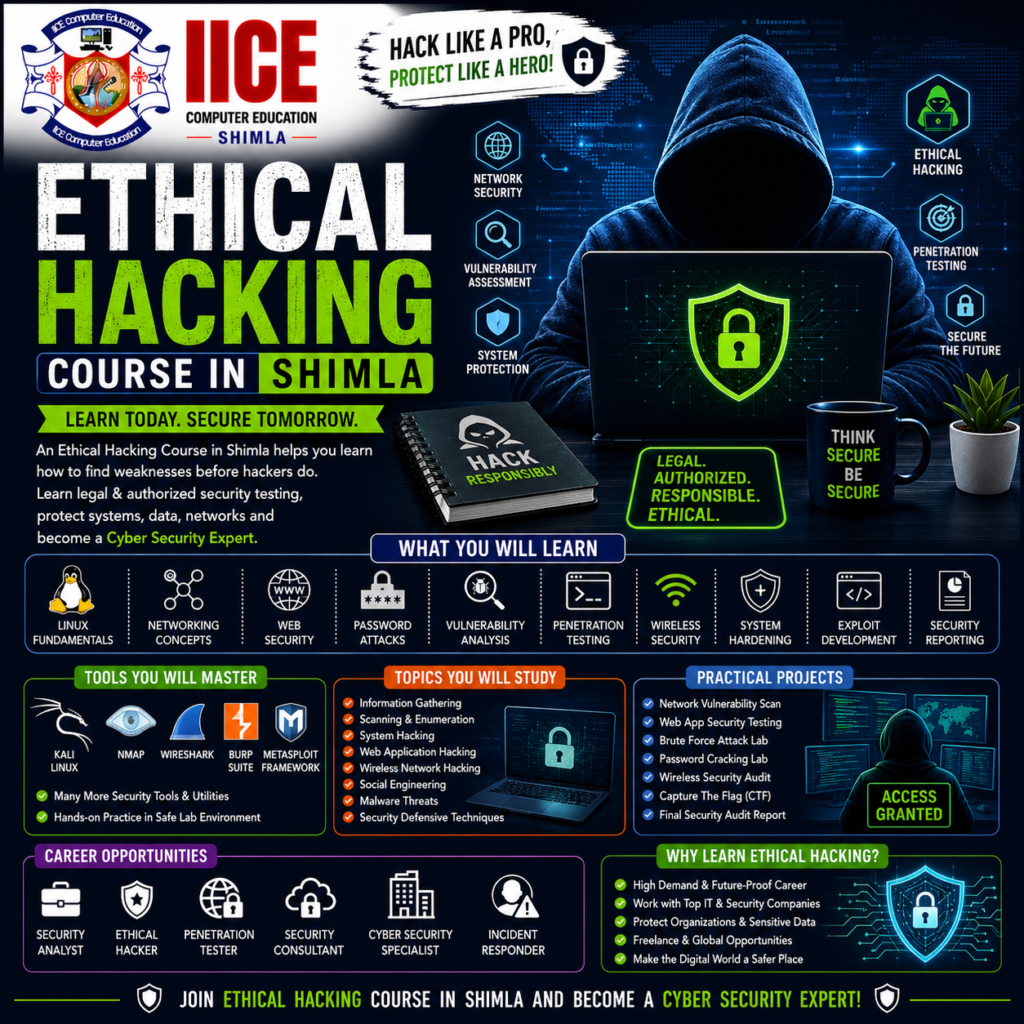
Ethical Hacking Course in Shimla
Introduction
An Ethical Hacking Course in Shimla helps students understand how computers, websites, networks, and applications can be protected from security problems. Ethical hackers learn to find weaknesses in a system with proper permission so that those weaknesses can be fixed before someone misuses them.
At IICE Computer Education Shimla, students can learn cyber security step by step through simple explanations, practical exercises, security tools, safe lab practice, and real-world security projects.
Ethical hacking may sound complicated, but students can start with basic computer and networking concepts. They can gradually learn about Linux, networks, web security, passwords, vulnerabilities, security testing, and defensive techniques in a controlled learning environment. The focus is on legal and authorized security testing, not on breaking into systems without permission.
What Is Ethical Hacking?
Ethical hacking means checking a computer system, website, network, or application for security weaknesses with the owner’s permission.
For example, a company may ask a security professional to test its website and find out whether attackers could misuse a weakness. The ethical hacker reports the problem so the company can fix it.
In simple words:
Find Weakness → Test Safely → Report Problem → Fix Security
Why Learn Ethical Hacking?
As businesses use websites, mobile applications, cloud services, and computer networks, protecting digital information has become important.
Learning ethical hacking can help students understand how security problems happen and how organizations can reduce security risks.
Key Benefits
- Learn cyber security fundamentals
- Understand computer networks
- Learn Linux basics
- Understand common security weaknesses
- Learn web security concepts
- Understand authentication and access control
- Learn vulnerability assessment
- Understand security testing
- Practise in controlled labs
- Learn security tools
- Understand security reports
- Learn basic incident response
- Work on practical security projects
- Build a cyber security portfolio
Ethical Hacking Course for Beginners
An Ethical Hacking Course in Shimla can be suitable for school and college students, graduates, job seekers, IT learners, network learners, web developers, and beginners interested in cyber security.
Students do not need to be expert hackers before joining. Basic computer knowledge and an interest in technology can help them begin.
What Will You Learn?
Students can learn ethical hacking gradually instead of trying to understand every security concept at once.
The learning journey can include:
Computer Basics → Networking → Linux → Security Fundamentals → Vulnerability Assessment → Web Security → Security Testing → Reporting → Projects
All practical testing should be performed only on systems, applications, and lab environments where the student has explicit permission.
Ethical Hacking Course Syllabus
Module 1: Cyber Security & Networking Fundamentals
- Introduction to Cyber Security
- What Is Ethical Hacking?
- Ethical Hacking vs Malicious Hacking
- Cyber Security Basics
- Computer Security
- Network Security Basics
- Internet Fundamentals
- IP Addresses
- Ports and Protocols
- TCP/IP Basics
- DNS Basics
- HTTP and HTTPS
- Firewalls
- Routers and Network Devices
- Common Security Risks
- Password Security
- Authentication Basics
- Safe Security Lab Setup
Module 2: Linux & Security Tools
- Introduction to Linux
- Linux File System
- Basic Linux Commands
- Users and Permissions
- Processes
- Files and Directories
- Networking Commands
- System Administration Basics
- Introduction to Security Tools
- Vulnerability Scanning Concepts
- Network Analysis Basics
- Log Analysis
- Security Tool Selection
- Safe Lab Practice
- Linux Security Project
Module 3: Web & Application Security
- Introduction to Web Security
- How Websites Work
- Web Requests and Responses
- HTTP Methods
- Cookies and Sessions
- Authentication
- Access Control
- Input Validation
- Common Web Security Risks
- SQL Injection Concepts
- Cross-Site Scripting Concepts
- Security Misconfiguration
- File Upload Risks
- API Security Basics
- Vulnerability Assessment
- Secure Coding Basics
- Web Security Lab Project
Module 4: Security Testing, Reporting & Projects
- Ethical Security Testing Process
- Reconnaissance Concepts
- Vulnerability Identification
- Risk Assessment
- Security Testing Methodology
- Password Security Awareness
- Network Security Testing Basics
- Web Application Testing
- Security Logs
- Incident Response Basics
- Security Documentation
- Vulnerability Reports
- Remediation Recommendations
- Security Best Practices
- Final Cyber Security Project
- Project Presentation
- Portfolio Development
Why Choose IICE Computer Education Shimla?
Cyber security is easier to understand when students can practise concepts in a controlled environment. Instead of learning only definitions, students can work with safe labs, security exercises, vulnerability examples, and practical projects.
IICE Computer Education Shimla provides computer and technology training with a practical learning approach. Students choosing an Ethical Hacking Course in Shimla can learn through structured lessons, security exercises, controlled lab practice, trainer guidance, and practical projects.
Key Reasons to Choose IICE
- ISO 9001:2015 Certified
- Government Registered
- MSME/Udyam Registered
- Practical computer training
- Beginner-friendly learning
- Cyber security fundamentals
- Networking basics
- Linux training
- Web security concepts
- Vulnerability assessment
- Security testing
- Safe lab practice
- Security reporting
- Practical cyber security projects
- Trainer guidance
- Portfolio development
- Career-focused learning
- Classroom training in Shimla
IICE can be considered by students who want to learn ethical hacking and cyber security through structured, legal, and practical training.