Full Stack Web Development Course
August 14, 2026 2026-08-14 7:25Full Stack Web Development Course
Full Stack Web Development Course in Shimla
Introduction
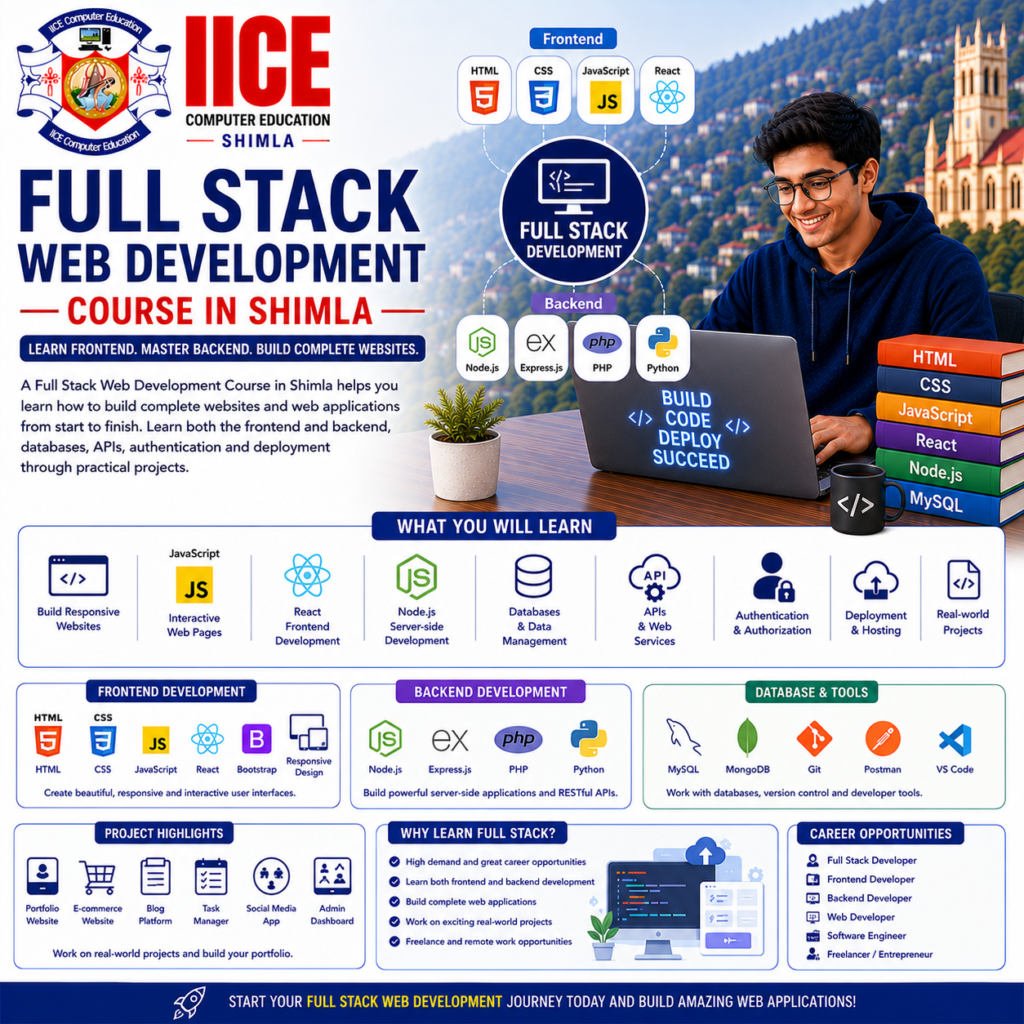
A Full Stack Web Development Course in Shimla helps students learn how to create complete websites and web applications from start to finish. Students can learn both the frontend that users see and the backend that works behind the website, along with databases, APIs, authentication, and deployment.
At IICE Computer Education Shimla, students can learn through simple explanations, coding practice, practical exercises, and real-world projects.
Full Stack Development may sound difficult at first, but students can learn it one step at a time. They can begin with HTML and CSS, move to JavaScript and frontend development, and then learn backend programming, databases, APIs, and complete web applications.
What Is Full Stack Web Development?
Full Stack Web Development means working with different parts of a web application.
A complete application can be understood like this:
Frontend → Backend → Database → API → User
For example, when you log in to a website, the frontend shows the login form, the backend checks the information, and the database stores or retrieves the user’s details.
A Full Stack Developer learns how these different parts connect and work together.
Why Learn Full Stack Web Development?
Almost every modern business needs an online presence. Many websites also require more than simple pages and need features such as user accounts, forms, dashboards, databases, payments, search, and APIs.
Learning Full Stack Development can help students understand the complete development process and create websites and applications independently.
Key Benefits
- Learn frontend development
- Learn backend development
- Understand databases
- Learn JavaScript
- Learn server-side programming
- Understand APIs
- Create responsive websites
- Build dynamic web applications
- Learn authentication basics
- Understand deployment
- Work on complete projects
- Build a professional portfolio
Full Stack Web Development Course for Beginners
A Full Stack Web Development Course in Shimla can be suitable for school and college students, graduates, job seekers, freelancers, computer learners, and beginners interested in coding.
Students do not need advanced programming knowledge before joining. They can begin with HTML and CSS and gradually move toward JavaScript, frontend frameworks, backend programming, databases, APIs, and deployment.
What Will You Learn?
Students can learn the complete process of developing a web application.
The learning path can include:
HTML → CSS → JavaScript → Frontend → Backend → Database → API → Deployment
Students can also learn how to test websites, identify coding errors, connect frontend and backend systems, and improve their applications through practical work.
Full Stack Web Development Course Syllabus
The syllabus is divided into 4 major modules to make learning easier for beginners.
Module 1: HTML, CSS & Frontend Fundamentals
- Introduction to Web Development
- How Websites Work
- HTML Fundamentals
- HTML5
- Web Page Structure
- Links and Images
- Lists and Tables
- Forms
- CSS Fundamentals
- Selectors
- Colours and Fonts
- Margins and Padding
- Flexbox
- CSS Grid
- Responsive Web Design
- Mobile-Friendly Websites
- Basic Website Project
Module 2: JavaScript & Modern Frontend Development
- Introduction to JavaScript
- Variables and Data Types
- Operators
- Conditions
- Loops
- Functions
- Arrays and Objects
- Events
- DOM Manipulation
- Form Validation
- Interactive Web Pages
- JSON Basics
- Fetch API
- Frontend Application Structure
- Introduction to React
- Components and Props
- State Basics
- Frontend Project
Module 3: Backend, Database & Server-Side Development
- Introduction to Backend Development
- Server and Client Concepts
- Node.js Basics
- Express.js Basics
- Routes
- Request and Response
- Middleware Basics
- REST APIs
- MySQL Basics
- Database Tables
- SQL Queries
- CRUD Operations
- Database Connection
- Authentication Basics
- Sessions and Tokens
- Backend Project
Module 4: Full Stack Applications, APIs & Deployment
- Frontend and Backend Connection
- API Integration
- JSON Data
- User Authentication
- Database Integration
- Full Stack Application Structure
- Error Handling
- Form Validation
- Basic Web Security
- Website Testing
- Git and GitHub Basics
- Domain and Hosting
- Deployment Basics
- Performance Basics
- Final Full Stack Project
- Project Testing
- Project Presentation
Learn Frontend Development
Frontend development is the part of a website that users can see and interact with.
Students can learn:
- HTML
- CSS
- JavaScript
- Responsive design
- Forms
- Buttons
- Navigation
- Interactive elements
- Frontend components
They can practise by creating websites that work on computers, tablets, and mobile phones.
Learn JavaScript
JavaScript helps make websites interactive.
Students can learn how JavaScript can be used to create:
- Interactive buttons
- Forms
- Calculators
- Menus
- Dynamic content
- Search features
- Form validation
- Interactive web applications
They can gradually move from basic JavaScript to modern frontend development concepts.
Learn React
React is a popular technology for creating interactive user interfaces.
Students can learn basic concepts such as components, props, state, events, and reusable interface elements.
The goal is to help students understand how larger frontend applications can be organized into smaller and manageable parts.
Learn Backend Development
Backend development handles many processes that happen behind the website.
For example, when a user creates an account, the backend can receive the information, validate it, and store it in the database.
Students can learn backend programming, routes, requests, responses, APIs, authentication, and database connections.
Learn Databases
Web applications often need to store information.
Students can learn how databases can store:
- User accounts
- Products
- Orders
- Student records
- Enquiries
- Blog posts
They can also learn basic SQL operations such as adding, finding, updating, and deleting information.
Learn APIs
An API allows different applications to communicate with each other.
For example:
Frontend → API Request → Backend → Database → API Response → Frontend
Students can learn how APIs are created and how frontend applications can communicate with backend systems.
Learn Authentication
Many web applications need users to log in securely.
Students can learn the basic concepts behind:
- Registration
- Login
- Password handling
- Sessions
- Authentication
- Authorization
- Protected pages
The focus is on understanding how user access works in a web application.
Learn Git and GitHub
Students can learn the basics of version control and how developers manage their code.
They can understand concepts such as:
- Repositories
- Commits
- Branches
- Push and Pull
- Project collaboration
This can help students organize their development projects and build a coding portfolio.
Practical Full Stack Web Development Projects
Projects allow students to combine frontend, backend, database, and API skills.
1. Student Management System
Students create an application where student information can be added, viewed, updated, and deleted.
Final Output: Full-stack student management application.
2. Online Shopping Website
Students create a basic shopping application with products, categories, user interaction, and database functionality.
Final Output: Functional e-commerce-style web application.
3. Job Portal Website
Students create a platform where users can view jobs and interact with job-related information.
Final Output: Full-stack job portal application.
4. Full Stack Business Application
Students combine frontend, backend, database, authentication, and APIs to create a complete business-focused application.
Final Output: Complete full-stack web application.
Who Can Join a Full Stack Web Development Course?
A Full Stack Web Development Course in Shimla can be suitable for:
- School students
- College students
- Graduates
- Job seekers
- Beginners
- Freelancers
- Web development learners
- Computer students
- Technology enthusiasts
Students can start with basic computer knowledge and gradually build their programming skills.
Do I Need Coding Knowledge?
No advanced coding experience is required to start.
Students can first learn HTML and CSS and then move toward JavaScript, React, backend programming, databases, APIs, and deployment.
Regular practice is important because Full Stack Development involves several connected technologies.
Is Full Stack Development Difficult?
Full Stack Development has many parts, so it can seem challenging at first.
The learning becomes easier when students follow a clear sequence:
HTML/CSS → JavaScript → Frontend → Backend → Database → APIs → Full Stack Project
Instead of trying to learn everything at once, students can master one area and then move to the next.
Full Stack Web Development Training in Shimla
Students searching for Full Stack Web Development Training in Shimla should look for practical training that covers both frontend and backend development.
A useful program should include coding practice, databases, APIs, authentication, testing, deployment, and complete projects. Students should also get opportunities to build applications rather than only study theoretical concepts.
Before joining, students should confirm the latest course duration, fees, batch timings, syllabus, technologies, certification, and project structure with the institute.
Career Opportunities After Full Stack Development
Full Stack Development can provide a foundation for different web and software development roles.
Depending on education, experience, and additional skills, students can explore roles such as:
- Full Stack Developer
- Web Developer
- Frontend Developer
- Backend Developer
- JavaScript Developer
- React Developer
- Node.js Developer
- Software Developer
- Web Application Developer
- Full Stack Development Intern
Students can further improve their skills by learning technologies such as React, Node.js, Express.js, PHP, Laravel, Python, cloud platforms, and modern databases.
Why Choose IICE Computer Education Shimla?
Full Stack Development is best learned through regular coding and project work. Students need opportunities to create frontend pages, connect databases, develop APIs, fix errors, and build complete applications.
IICE Computer Education Shimla provides computer and technology training with a practical learning approach. Students choosing a Full Stack Web Development Course in Shimla can learn through structured lessons, coding exercises, practical assignments, trainer guidance, and real-world projects.
Key Reasons to Choose IICE
- ISO 9001:2015 Certified
- Government Registered
- MSME/Udyam Registered
- Practical computer training
- Beginner-friendly learning
- Frontend development training
- Backend development training
- Database learning
- API integration
- Modern web technologies
- Project-based learning
- Trainer guidance
- Career-focused learning
- Classroom training in Shimla
IICE can be considered by students who want to learn complete web development through practical coding and application building.