Software Engineering Course
November 6, 2026 2026-11-06 6:19Software Engineering Course
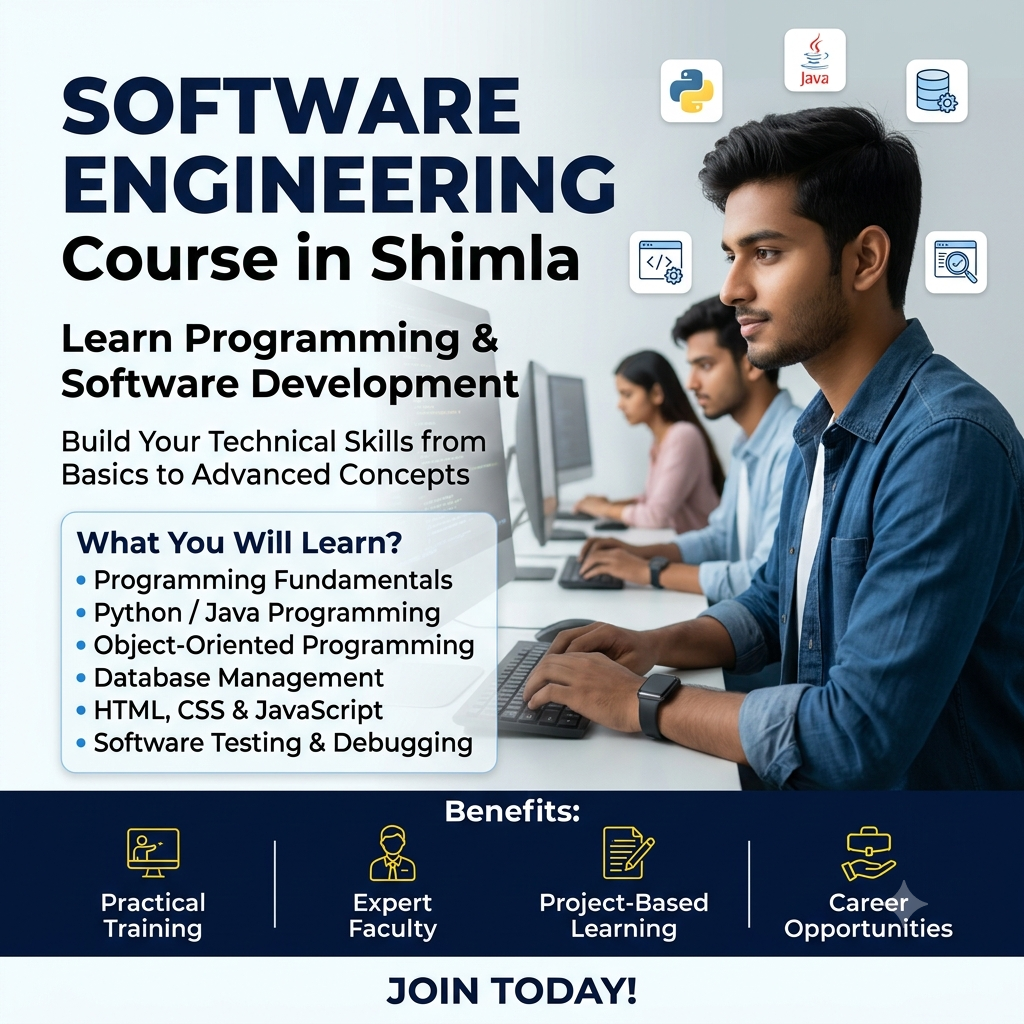
Software Engineering Course in Shimla
Introduction
Are you interested in learning how software, websites, and computer applications are developed? The Software Engineering Course in Shimla can be a good choice for students who want to understand programming, software development, and modern technology.
Software engineering is the process of designing, developing, testing, and maintaining software applications. It combines programming skills, logical thinking, problem-solving, and technical knowledge to create useful software.
At IICE Computer Education Shimla, students can develop their technical knowledge through structured learning and practical exercises. The course can help beginners understand programming concepts and explore different areas of software development.
Whether you are a school student, college student, graduate, or someone interested in starting a career in IT, learning software engineering can help you build a foundation for further technical studies and development work.
What Is Software Engineering?
Software engineering is a field of computer science that focuses on creating and maintaining software applications.
It involves different stages, such as understanding user requirements, planning a project, writing code, testing software, fixing errors, and improving applications.
Software engineers use programming languages, development tools, databases, and testing methods to build software for businesses, websites, mobile devices, and other digital platforms.
Why Learn Software Engineering?
Software is used in almost every industry, including education, banking, healthcare, business, communication, and entertainment.
Learning software engineering can help you:
Understand how software applications are developed.
Learn programming and coding concepts.
Improve logical thinking and problem-solving skills.
Understand databases and data management.
Explore website and application development.
Learn software testing and debugging.
Develop practical projects.
Prepare for further learning in the IT field.
Who Can Join a Software Engineering Course in Shimla?
This course may be suitable for:
School students interested in computers and technology.
College students who want to develop programming skills.
Graduates interested in the IT industry.
Beginners who want to understand software development.
Aspiring programmers and developers.
Students planning to learn web or application development.
Basic computer knowledge can be helpful. The required educational qualifications may depend on the course level and training programme.
Software Engineering Course Syllabus
The following is a suggested syllabus structure covering important software development concepts. The actual modules and programming languages should be adjusted according to IICE’s confirmed course curriculum.
1. Computer Fundamentals
Introduction to computers
Hardware and software concepts
Operating systems
Computer memory and storage
Introduction to programming
Basic computer operations
2. Programming Fundamentals
Introduction to programming languages
Variables and data types
Operators and expressions
Conditional statements
Loops and functions
Arrays and basic data structures
Problem-solving techniques
Writing and executing programs
3. Object-Oriented Programming (OOP)
Introduction to OOP
Classes and objects
Inheritance
Polymorphism
Encapsulation
Abstraction
Practical programming exercises
4. Database Management System (DBMS)
Introduction to databases
Database concepts
Tables, records, and fields
SQL fundamentals
Creating and managing databases
Inserting, updating, and deleting records
Database queries
Data organisation
5. Web Development Fundamentals
Introduction to web development
HTML fundamentals
CSS styling
JavaScript basics
Website structure and layouts
Forms and user interaction
Responsive web design concepts
Practical website development
6. Software Development Life Cycle (SDLC)
Introduction to SDLC
Understanding project requirements
Software planning and design
Software development process
Software testing
Software maintenance
Introduction to Agile methodology
7. Software Testing and Debugging
Introduction to software testing
Types of software testing
Finding and fixing errors
Debugging techniques
Test cases and test planning
Basic software quality concepts
8. Version Control and Development Tools
Introduction to development tools
Working with code editors
Introduction to Git
Basic version control
Managing project files
Understanding code repositories
9. Practical Projects
Students can apply their learning through practical development exercises, such as:
Creating a basic website.
Developing a simple calculator.
Building a registration form.
Creating a database-based application.
Developing a small software project.
Practical Skills You Can Develop
Software engineering is not only about learning programming languages. It also involves understanding how to plan, develop, test, and improve applications.
During training, students can work towards developing skills such as:
Writing and understanding code.
Designing basic software applications.
Creating websites and web pages.
Working with databases.
Identifying and fixing programming errors.
Understanding software development methods.
Working on individual and team projects.
Career Opportunities After Software Engineering Training
After developing the required programming knowledge and practical skills, students can explore different career paths in the IT industry.
Some possible job roles include:
Junior Software Developer
Software Engineer
Web Developer
Front-End Developer
Back-End Developer
Junior Programmer
Software Tester
Application Developer
Database Assistant
The eligibility for these roles depends on the employer, educational qualifications, technical knowledge, and practical experience. Completing a training course alone does not guarantee a job.
Why Choose IICE Computer Education Shimla?
Choosing the right training institute is an important step when learning technical skills.
At IICE Computer Education Shimla, our focus is on helping students understand computer concepts and develop practical knowledge through guided learning.
Practical computer training
Guidance from experienced faculty
Step-by-step learning approach
Programming and development exercises
Project-based learning opportunities
Support during practical work
Placement assistance as applicable to the programme
Our aim is to help students improve their technical knowledge and prepare for further learning and opportunities in the computer and IT field.
Frequently Asked Questions About Software Engineering Course in Shimla
1. What is a Software Engineering Course?
A Software Engineering Course teaches students how software applications are planned, developed, tested, and maintained using programming languages and development tools.
2. Who can join a Software Engineering Course in Shimla?
Students, graduates, and beginners interested in programming and software development can explore this course. Eligibility depends on the specific training programme.
3. Do I need coding knowledge before joining?
Not necessarily. Beginners can start by learning programming fundamentals and gradually move towards more advanced concepts.
4. Which programming languages are taught in software engineering?
Programming languages depend on the course curriculum. Common examples include Python, Java, C, C++, and JavaScript. Contact IICE to confirm the languages included in its current programme.
5. Does the course include practical training?
Software engineering learning generally involves practical coding exercises, development tasks, and projects. Contact IICE for details about the current practical training structure.
6. What topics are covered in software engineering?
Topics may include programming fundamentals, object-oriented programming, databases, web development, software testing, debugging, and software development methods.
7. Can beginners learn software engineering?
Yes. Beginners can start with basic computer concepts and programming fundamentals before moving towards software development topics.
8. What projects can students develop?
Depending on the syllabus, students may work on websites, calculators, registration forms, database applications, and other small software projects.
9. What career opportunities are available after software engineering training?
Students with the required qualifications and technical skills can explore roles such as Junior Software Developer, Web Developer, Programmer, Application Developer, and Software Tester.
10. Where can I join a Software Engineering Course in Shimla?
You can contact IICE Computer Education Shimla to enquire about software engineering training, course modules, eligibility, and admission details.