
Financial Management Course
August 19, 2026 2026-08-19 5:44Financial Management Course
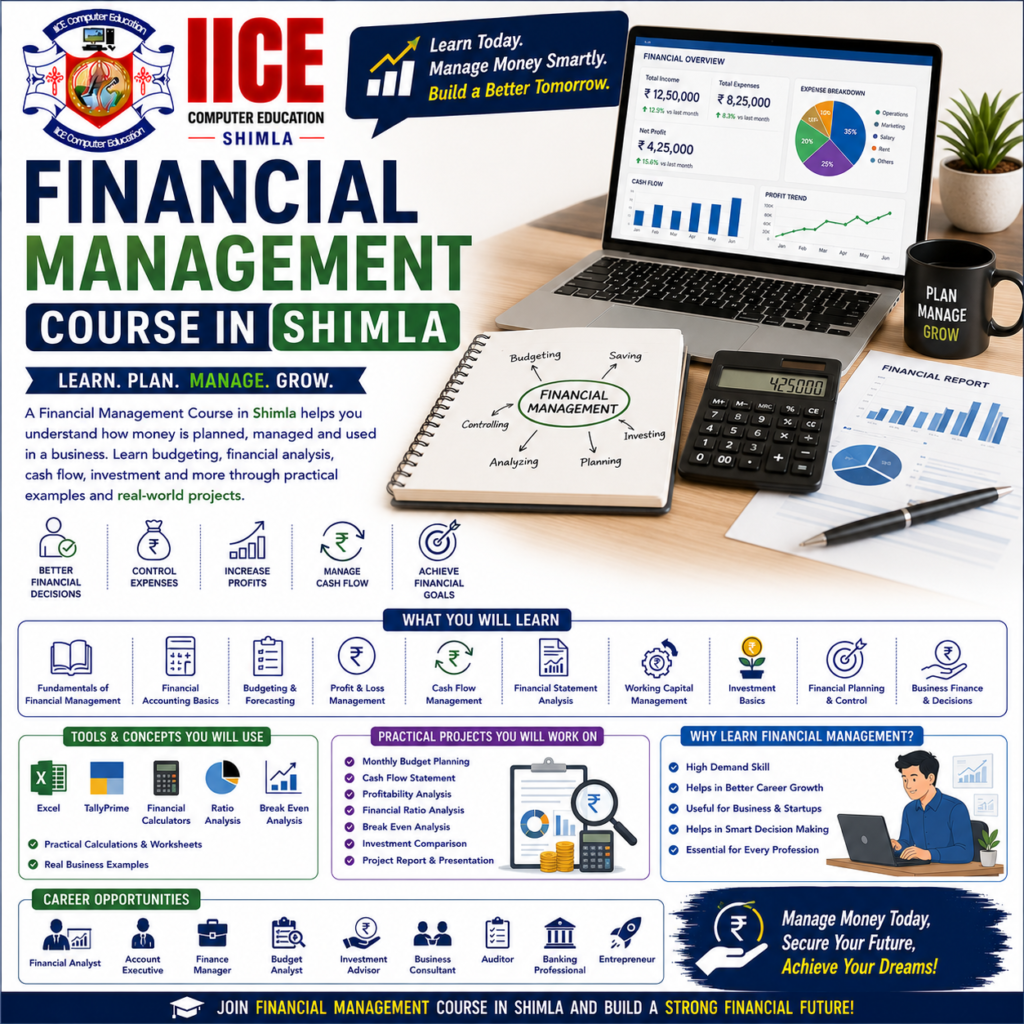
Financial Management Course in Shimla
Introduction
A Financial Management Course in Shimla helps students understand how money is planned, managed, saved, and used in a business. Students can learn simple concepts such as income, expenses, budgeting, profit, loss, cash flow, financial statements, and investment basics.
At IICE Computer Education Shimla, students can learn financial management step by step through simple explanations, practical examples, calculations, exercises, and business-related projects.
Financial management may sound difficult, but students can understand it by starting with everyday examples. For example, a business needs to know how much money it earns, how much it spends, and how much is left. Students can gradually learn how businesses prepare budgets, control expenses, understand financial reports, manage cash, and make better financial decisions.
What Is Financial Management?
Financial management means planning and managing money in a proper way.
For a business, financial management helps answer questions such as:
- How much money is coming into the business?
- How much money is being spent?
- Is the business making a profit?
- Can the business afford a new expense?
- How much money should be saved?
- How can expenses be controlled?
In simple words:
Plan Money → Track Money → Control Expenses → Understand Profit → Make Better Decisions
Why Learn Financial Management?
Every business needs to manage its money carefully. Even a profitable business can face problems if it does not manage cash, expenses, or budgets properly.
Learning financial management can help students understand how businesses make financial decisions.
Key Benefits
- Learn financial management basics
- Understand income and expenses
- Learn budgeting
- Understand profit and loss
- Learn cash flow management
- Understand financial statements
- Learn financial planning
- Understand business costs
- Learn basic investment concepts
- Understand financial ratios
- Improve financial decision-making
- Work on practical financial projects
- Develop business skills
Financial Management Course for Beginners
A Financial Management Course in Shimla can be suitable for school and college students, graduates, commerce students, management students, job seekers, business owners, and beginners who want to understand business finance.
Students do not need advanced financial knowledge before joining. Basic mathematics and an interest in business and money management can help them start learning.
What Will You Learn?
Students can learn financial management gradually through simple business examples.
The learning journey can include:
Finance Basics → Budgeting → Accounting Concepts → Financial Statements → Cash Flow → Financial Analysis → Investment Basics → Projects
Financial Management Course Syllabus
Module 1: Financial Management Fundamentals
- Introduction to Financial Management
- Importance of Financial Management
- Personal Finance vs Business Finance
- Income and Expenses
- Fixed and Variable Costs
- Revenue and Profit
- Profit and Loss Basics
- Financial Goals
- Budgeting Fundamentals
- Business Budget Preparation
- Cost Control
- Break-Even Point
- Basic Financial Calculations
- Practical Finance Exercises
Module 2: Accounting & Financial Statements
- Introduction to Accounting
- Basic Accounting Concepts
- Assets and Liabilities
- Capital and Equity
- Revenue and Expenses
- Basic Bookkeeping
- Profit and Loss Statement
- Balance Sheet
- Cash Flow Statement
- Understanding Financial Reports
- Accounts Receivable
- Accounts Payable
- Inventory Basics
- Financial Statement Exercises
- Practical Financial Reporting Project
Module 3: Financial Analysis & Planning
- Introduction to Financial Analysis
- Financial Ratios
- Profitability Analysis
- Liquidity Analysis
- Business Performance Analysis
- Cash Flow Analysis
- Working Capital Management
- Financial Forecasting Basics
- Budget Planning
- Cost Analysis
- Business Financial Planning
- Risk Management Basics
- Comparing Business Performance
- Financial Analysis Project
Module 4: Investment, Business Decisions & Projects
- Introduction to Investment
- Saving and Investment Basics
- Risk and Return
- Investment Planning
- Time Value of Money Basics
- Simple and Compound Interest
- Investment Decision Basics
- Business Financing Basics
- Loans and Interest
- Financial Decision-Making
- Practical Financial Case Studies
- Business Finance Project
- Financial Report Preparation
- Final Project Presentation
- Portfolio Development
Why Choose IICE Computer Education Shimla?
Financial concepts become easier when students practise them using simple business examples and real-looking financial data. Practical exercises can help learners understand budgets, financial statements, cash flow, profit, and financial analysis.
IICE Computer Education Shimla provides computer and technology-related training with a practical learning approach. Students choosing a Financial Management Course in Shimla can learn through structured lessons, financial exercises, business examples, trainer guidance, and practical projects.
Key Reasons to Choose IICE
- ISO 9001:2015 Certified
- Government Registered
- MSME/Udyam Registered
- Practical learning approach
- Beginner-friendly training
- Financial management fundamentals
- Budgeting and financial planning
- Profit and loss analysis
- Financial statements
- Cash flow concepts
- Financial analysis
- Investment basics
- Business finance projects
- Trainer guidance
- Portfolio development
- Career-focused learning
- Classroom training in Shimla