
Deep Learning Course
August 12, 2026 2026-08-12 8:36Deep Learning Course
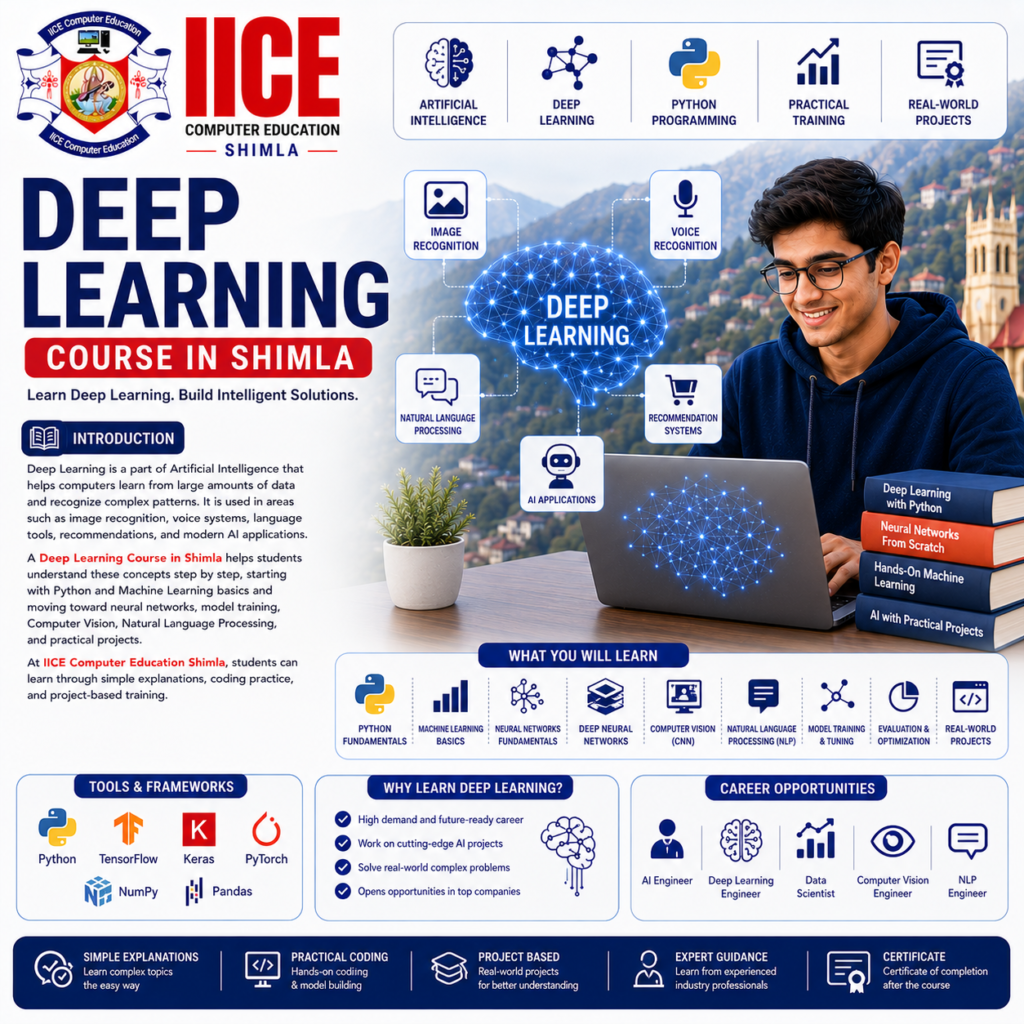
Deep Learning Course in Shimla
Introduction
Deep Learning is a part of Artificial Intelligence that helps computers learn from large amounts of data and recognize complex patterns. It is used in areas such as image recognition, voice systems, language tools, recommendations, and modern AI applications.
A Deep Learning Course in Shimla helps students understand these concepts step by step, starting with Python and Machine Learning basics and moving toward neural networks, model training, Computer Vision, Natural Language Processing, and practical projects. At IICE Computer Education Shimla, students can learn through simple explanations, coding practice, and project-based training.
What Is Deep Learning?
Deep Learning is a method of Machine Learning that uses neural networks to learn patterns from data. These networks are inspired by the basic idea of how the human brain processes information.
For example, when a computer needs to recognize whether an image contains a cat or a dog, a Deep Learning model can learn visual patterns from many example images. With enough suitable data and training, the model can learn to identify similar patterns in new images.
In simple terms:
Data → Neural Network → Training → Pattern Learning → Prediction
Why Learn Deep Learning?
Deep Learning is behind many modern AI applications. It is used for image recognition, speech systems, language applications, recommendation systems, autonomous technologies, and Generative AI.
Learning Deep Learning can help students move beyond basic Machine Learning and understand how more advanced AI models are developed.
Key Benefits
- Understand advanced Artificial Intelligence concepts
- Learn how neural networks work
- Build models using Python
- Understand image and text-based AI
- Learn model training and evaluation
- Explore Computer Vision
- Learn Natural Language Processing basics
- Work with Deep Learning frameworks
- Build practical AI projects
- Create a foundation for advanced AI learning
Deep Learning Course for Beginners
A Deep Learning Course in Shimla can be suitable for students who already have basic Python or Machine Learning knowledge. Beginners can also start if they are willing to learn programming and data concepts step by step.
Students can first understand Python, data, and Machine Learning fundamentals before moving toward neural networks and Deep Learning models. This gradual approach makes advanced topics easier to understand.
What Will You Learn?
Students can learn how neural networks process information, how models are trained, how data is prepared, and how model performance is checked.
The learning path can include Python, NumPy, Pandas, Machine Learning basics, neural networks, activation functions, loss functions, backpropagation, optimization, CNNs, RNN concepts, Computer Vision, NLP, model evaluation, and practical projects.
Deep Learning Course Syllabus
The syllabus is divided into 4 major modules to provide a structured learning path.
Module 1: Python, Data & Deep Learning Fundamentals
- Introduction to Deep Learning
- AI, Machine Learning and Deep Learning
- Applications of Deep Learning
- Python Fundamentals
- NumPy Basics
- Pandas Basics
- Working with Datasets
- Data Cleaning
- Data Preprocessing
- Data Visualization
- Introduction to Neural Networks
- Neural Network Components
- Neurons and Layers
- Activation Functions
- Training Data and Testing Data
- Basic Deep Learning Exercise
Module 2: Neural Networks & Model Training
- Artificial Neural Networks
- Input, Hidden and Output Layers
- Weights and Biases
- Activation Functions
- Loss Functions
- Optimizers
- Gradient Descent
- Backpropagation
- Forward Propagation
- Model Training
- Batch Processing
- Epochs and Iterations
- Learning Rate
- Overfitting
- Underfitting
- Regularization Basics
- Model Evaluation
- Neural Network Project
Module 3: Computer Vision, CNN & NLP
- Introduction to Computer Vision
- Image Data
- Image Preprocessing
- Convolutional Neural Networks
- Convolution Layers
- Pooling Layers
- Image Classification
- Object Detection Basics
- Introduction to Natural Language Processing
- Text Data Processing
- Word Representation Basics
- Sequence Data
- Recurrent Neural Network Concepts
- Text Classification
- Sentiment Analysis
- Computer Vision Project
- NLP Project
Module 4: Advanced Deep Learning & Projects
- Transfer Learning
- Pre-Trained Models
- Model Fine-Tuning
- Deep Learning Frameworks
- TensorFlow Basics
- Keras Basics
- PyTorch Introduction
- Model Optimization
- Model Performance Analysis
- AI Application Development
- Deep Learning Applications
- Real-World AI Projects
- Final Deep Learning Capstone Project
- Project Presentation
Why Choose IICE Computer Education Shimla?
Choosing an institute for an advanced technical subject requires attention to practical training, trainer support, projects, and the learning environment. Deep Learning involves coding and model experimentation, so students benefit from regular practice instead of learning only theoretical definitions.
IICE Computer Education Shimla provides computer and technology training with a practical learning approach. Students looking for a Deep Learning Course in Shimla can learn through structured lessons, coding exercises, assignments, and project work.
Key Reasons to Choose IICE
- ISO 9001:2015 Certified
- Government Registered
- MSME/Udyam Registered
- Practical computer training
- Beginner-friendly guidance
- Python-based learning
- Project-based training
- Trainer support
- Modern AI topics
- Career-focused skills
- Classroom learning in Shimla
IICE can be considered by students who want to develop practical skills and gradually move from Python and Machine Learning toward advanced Artificial Intelligence concepts.