Digital Marketing for Beginners: Complete Guide to Start in 2026

Digital marketing has become an important part of how businesses reach customers, build their brands, and sell products or services. Whether you are a student, job seeker, business owner, freelancer, or someone thinking about a new career, learning the basics of digital marketing can help you understand how businesses grow online.
If you are completely new to this field, you may have questions like: What is digital marketing? How does it work? Which skills should I learn first? Do I need coding knowledge? Can I build a career in digital marketing? And how long does it take to learn?
This Digital Marketing for Beginners guide is designed to answer these questions in simple language. You will learn the basic concepts of digital marketing, the major types of digital marketing, important tools, useful skills, AI applications, practical projects, and career opportunities.
The goal is not just to explain digital marketing but to give you a clear starting point so you know what to learn, in what order, and how to practice your skills.
In simple words: Digital marketing is the process of using the internet and digital channels to promote a business, product, service, or brand and connect with potential customers.
Digital Marketing course with AI
What Is Digital Marketing? A Beginner’s Guide
Digital marketing is the promotion of products, services, businesses, or brands through digital channels such as search engines, websites, social media platforms, email, online advertising, and other internet-based channels.
For example, imagine that a student searches Google for “best computer institute in Shimla.” A computer training institute may appear in the search results because it has optimized its website for search engines. The student visits the website, reads about the courses, checks the details, and may eventually contact the institute.
That entire journey can involve digital marketing.
Similarly, a business can use Instagram to introduce its products, Google Ads to reach people who are actively searching, email marketing to communicate with existing customers, and content marketing to answer questions and build trust. For anyone starting digital marketing for beginners, understanding these basic concepts is the first step.
This is why digital marketing is much more than simply posting on social media.
A Simple Example of Digital Marketing
Suppose a local bakery in Shimla wants to attract more customers.
It could use several digital marketing methods:
- Create a website with its products and contact details.
- Optimize the website for searches such as “best bakery in Shimla.”
- Post photographs and videos on Instagram.
- Run Google Ads for people searching for cakes nearby.
- Publish useful content about choosing cakes for different occasions.
- Collect customer email addresses and send offers or updates.
- Maintain its Google Business Profile so local customers can discover the bakery.
Each activity serves a different purpose, but together they form part of a digital marketing strategy.
Digital Marketing vs Traditional Marketing
Traditional marketing includes methods such as newspapers, television, radio, billboards, brochures, and other offline advertising channels.
Digital marketing uses online channels such as:
- Search engines
- Websites
- Social media
- Google Ads
- Online video
- Mobile platforms
One major advantage of digital marketing is that businesses can measure many aspects of their campaigns. They can see how many people visited a website, which pages they viewed, how many clicked an advertisement, where leads came from, and which campaigns generated results.
However, digital marketing is not automatically successful just because a business is online. Good results depend on understanding the target audience, creating useful content, choosing suitable channels, testing different approaches, and analyzing the results.
That is why learning digital marketing basics is important before jumping into advanced tools or advertising campaigns.
SEO Course in Shimla | IICE Computer Education Shimla
As you continue through this guide, you will see that digital marketing is made up of several connected areas. You do not need to master everything at once. A beginner can start with the fundamentals, learn one skill at a time, practice with real projects, and gradually choose an area in which to specialize.
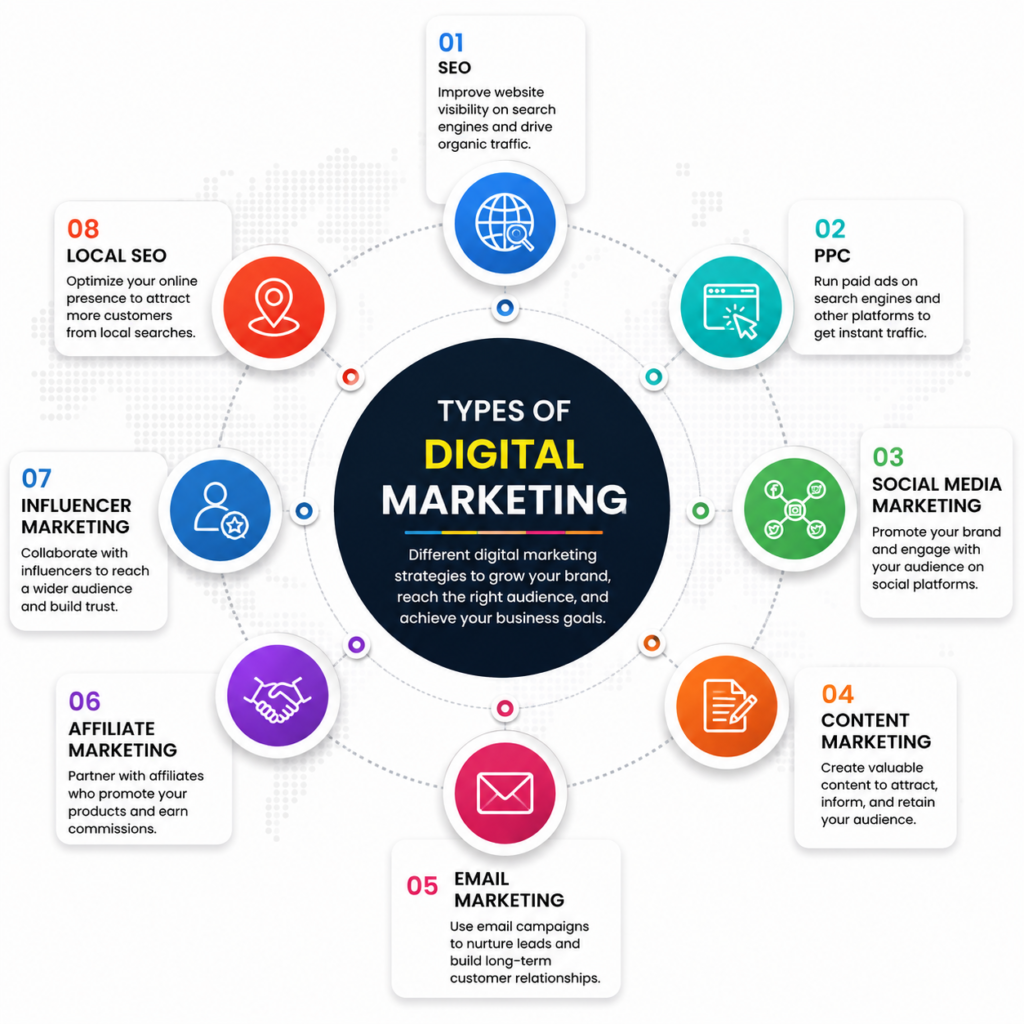
Types of Digital Marketing
Digital marketing includes several different channels, and each one has a different purpose. Some channels help businesses attract new visitors, while others focus on building relationships, generating leads, increasing sales, or retaining existing customers.
As a beginner, you do not need to master every area immediately. Understanding the major types of digital marketing will help you decide which skills you want to learn first.
For anyone following a Digital Marketing for Beginners learning path, understanding these channels is an important starting point
1. Search Engine Optimization (SEO)
Search Engine Optimization, or SEO, is the process of improving a website and its content so that it can appear in relevant search engine results.
For example, when someone searches for “digital marketing course in Shimla,” relevant institutes may appear in the search results. A business can use SEO to improve its chances of being discovered by people who are actively looking for its products or services.
SEO is one of the most important areas to understand when starting Digital Marketing for Beginners, because it connects search behavior, content, websites, and business visibility.
SEO includes several areas, such as:
- Keyword research
- Search intent
- On-page SEO
- Technical SEO
- Off-page SEO
- Local SEO
- Content optimization
- Internal linking
- Website performance
SEO is particularly valuable because it can help businesses attract organic traffic over time without paying for every individual visit.
2. Search Engine Marketing and Paid Advertising
Paid advertising allows businesses to reach potential customers through platforms such as Google Ads and social media advertising networks.
For example, a coaching institute can create an advertisement that appears when someone searches for a relevant course. Similarly, an online store can show product advertisements to people who may be interested in its products.
Social media is another important part of Digital Marketing for Beginners, particularly for students who enjoy content creation and audience engagement.
Paid advertising can be used to generate:
- Website traffic
- Leads
- Phone calls
- Product sales
- Course registrations
- App downloads
- Brand awareness
Unlike SEO, paid advertising can provide visibility quickly, but successful campaigns require careful planning, targeting, budgeting, ad creation, landing pages, and conversion tracking.
3. Social Media Marketing
Social Media Marketing involves using social media platforms to communicate with an audience and promote a business or brand.
Businesses can use platforms such as Instagram, Facebook, LinkedIn, YouTube, Pinterest, and other relevant networks.
Social media marketing can include:
- Creating posts
- Publishing short-form videos
- Creating educational content
- Responding to comments
- Building communities
- Running paid advertisements
- Collaborating with creators
- Analyzing engagement
For example, a computer education institute can share student projects, course information, career tips, educational videos, and success stories on social media.
The goal should not simply be to gain followers. A successful social media strategy should connect content with a specific business objective.
4. Content Marketing
Content marketing involves creating useful and relevant content to attract, educate, and engage a target audience.
Common types of content include:
- Blog posts
- Guides
- Videos
- Infographics
- Case studies
- E-books
- Social media content
- Webinars
- Podcasts
For example, a digital marketing institute can publish a beginner-friendly guide explaining SEO, Google Ads, social media marketing, and career opportunities. Someone searching for this information may discover the website through Google and later become interested in the institute’s training programs.
Good content should provide genuine value rather than simply trying to promote a business.
5. Email Marketing
Email marketing involves using email to communicate with potential and existing customers.
Businesses can use email marketing for newsletters, offers, product announcements, educational content, customer follow-ups, and promotional campaigns.
For example, someone may download a free digital marketing guide and provide their email address. The business can then send useful information and relevant updates over time.
Effective email marketing depends on delivering the right message to the right audience at the right time.
6. Affiliate Marketing
Affiliate marketing is a performance-based marketing method in which an individual or business promotes another company’s products or services and earns a commission when a qualifying action takes place.
For example, a blogger may review a digital marketing tool and provide an affiliate link. If a reader purchases the tool through that link, the blogger may receive a commission.
Affiliate marketing can be useful for bloggers, content creators, influencers, and website owners with a relevant audience.
7. Influencer Marketing
Influencer marketing involves collaborating with people who have an established audience in a particular niche.
Businesses may work with influencers to promote products, services, courses, applications, events, or brands.
However, having a large number of followers does not automatically make an influencer effective. Audience relevance, engagement, trust, content quality, and the connection between the influencer and the product are also important.
8. Local SEO
Local SEO focuses on helping businesses become visible to customers searching within a particular geographical area.
Examples include searches such as:
- Digital marketing course in Shimla
- Computer institute in Shimla
- Best coaching institute near me
- Restaurants in Shimla
Local SEO can involve website optimization, Google Business Profile optimization, customer reviews, local citations, location pages, and other local search signals.
For businesses that serve customers in a specific city or region, local SEO can be an important part of their digital marketing strategy.
How Does Digital Marketing Work?
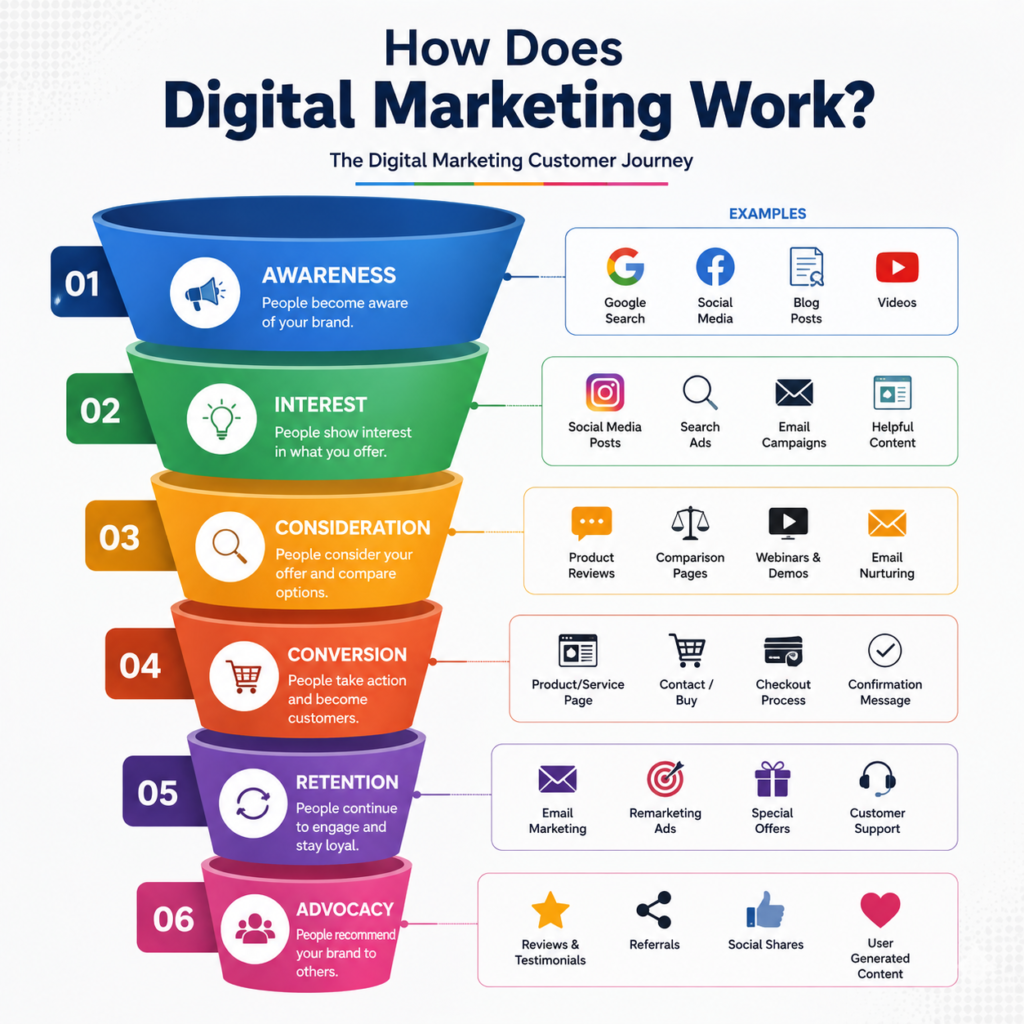
Digital marketing usually works through a combination of different channels rather than a single activity.
A potential customer may first discover a business through Google, social media, an advertisement, a video, or a recommendation. They may then visit the website, read content, compare options, contact the business, and eventually make a purchase.
This process can be understood through the customer journey.
Awareness
The customer first becomes aware of the business or product.
Interest
The customer starts exploring the business and wants more information.
Consideration
The customer compares products, services, prices, reviews, features, or alternatives.
Conversion
The customer completes a desired action, such as making a purchase, filling out a form, calling a business, or registering for a service.
Retention
After conversion, the business continues communicating with the customer through email, social media, useful content, offers, and customer service.
Advocacy
Satisfied customers may recommend the business, leave reviews, share content, or make repeat purchases.
This is why digital marketing should be viewed as a complete customer journey rather than simply advertising products online.
Important Digital Marketing Skills for Beginners
A successful digital marketer needs a combination of creative, analytical, technical, and communication skills.
SEO Skills
Learn keyword research, search intent, on-page optimization, technical SEO basics, local SEO, content optimization, and link-building fundamentals.
Content Writing
Learn how to write useful blogs, website content, social media posts, advertisements, emails, and other marketing materials.
Social Media Skills
Understand content planning, platform-specific content, audience engagement, social media analytics, and basic paid campaigns.
Advertising Skills
Learn the fundamentals of Google Ads and social media advertising, including targeting, budgeting, ad copy, creatives, landing pages, and conversion tracking.
Analytics Skills
Digital marketers need to understand data. Important metrics include traffic, impressions, clicks, engagement, conversions, conversion rate, cost per lead, and return on advertising spend.
Basic Website Knowledge
Advanced programming is not required for most digital marketing roles. However, understanding WordPress, HTML basics, website structure, links, headings, images, URLs, and page performance can be extremely useful.
Communication Skills
Digital marketers often work with clients, business owners, designers, developers, sales teams, and content creators. Good communication helps them explain strategies, understand requirements, and present results.
Do You Need Coding Knowledge for Digital Marketing?
No, you do not need advanced coding knowledge to start a career in digital marketing.
You can learn SEO, content marketing, social media marketing, email marketing, paid advertising, and analytics without becoming a professional programmer.
However, basic HTML and CSS knowledge can give you an advantage. It can help you understand website structure, headings, links, images, landing pages, and some technical SEO concepts.
If you later choose technical SEO, marketing automation, analytics, or web development as a specialization, you may benefit from learning more technical skills.
Digital Marketing Tools Beginners Should Learn
Digital marketers use different tools for research, content creation, advertising, analytics, design, and optimization.
Some commonly used tools include:
| Digital Marketing Area | Example Tools |
|---|---|
| SEO | Google Search Console, Semrush, Ahrefs |
| Analytics | Google Analytics |
| Advertising | Google Ads, Meta Ads Manager |
| Design | Canva |
| Website Management | WordPress |
| Email Marketing | Mailchimp, Brevo |
| Keyword Research | Google Keyword Planner, Semrush |
| Website Performance | PageSpeed Insights, Lighthouse |
| AI | ChatGPT and other AI tools |
You do not need to learn all these tools at once.
First understand the marketing concept and then learn the tools used to implement and measure it. For example, learn what keyword research is before trying to master an SEO platform.
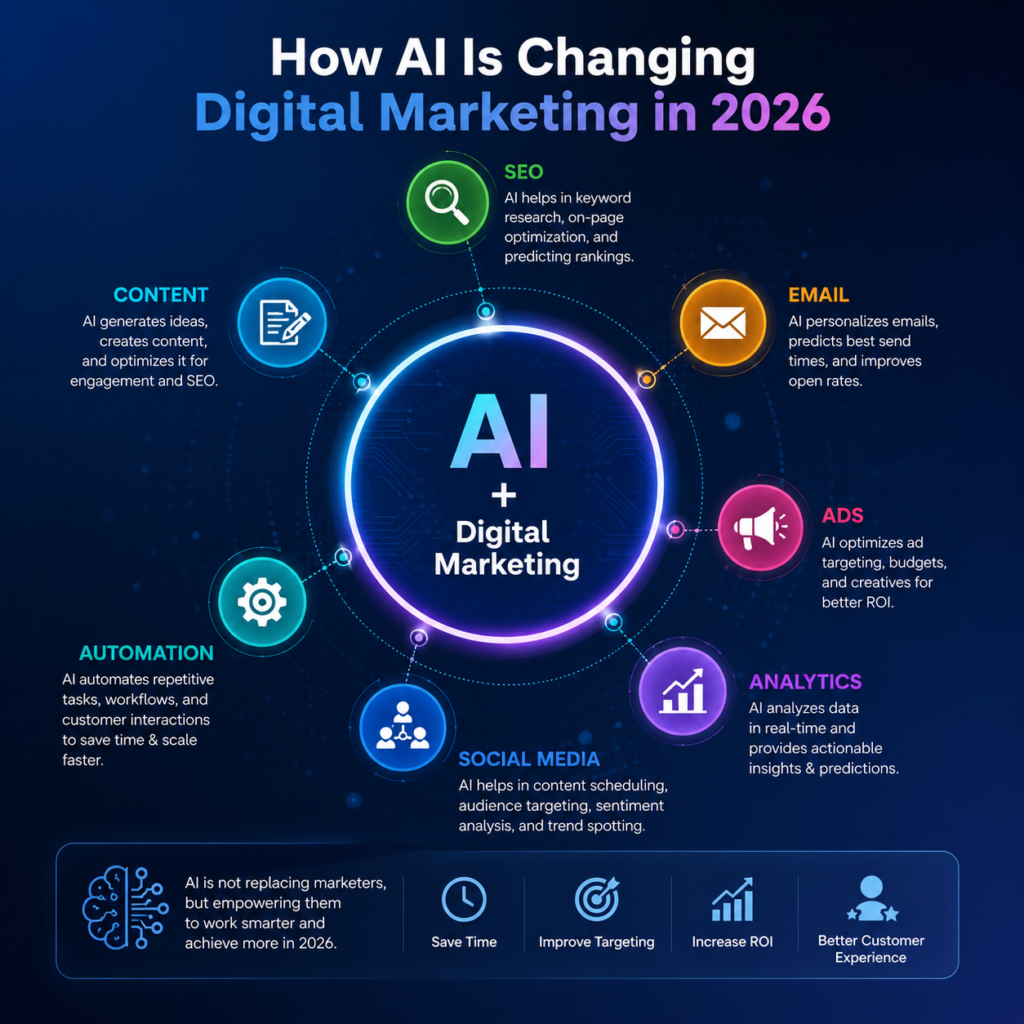
How AI Is Changing Digital Marketing in 2026
Artificial intelligence has become an important part of modern digital marketing.
AI tools can help marketers with tasks such as:
- Generating content ideas
- Creating content outlines
- Analyzing data
- Writing initial drafts
- Creating advertising variations
- Developing email ideas
- Generating images
- Brainstorming social media content
- Personalizing marketing messages
- Automating repetitive tasks
However, AI does not remove the need for human marketing skills.
A marketer still needs to understand the target audience, evaluate information, check accuracy, develop strategy, understand customer psychology, and make decisions based on business objectives.
The best approach for beginners is therefore to learn digital marketing fundamentals first and then use AI to improve productivity and efficiency.
Digital Marketing Course Digital Marketing course with AI
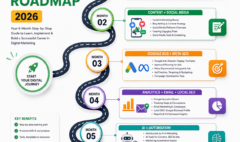
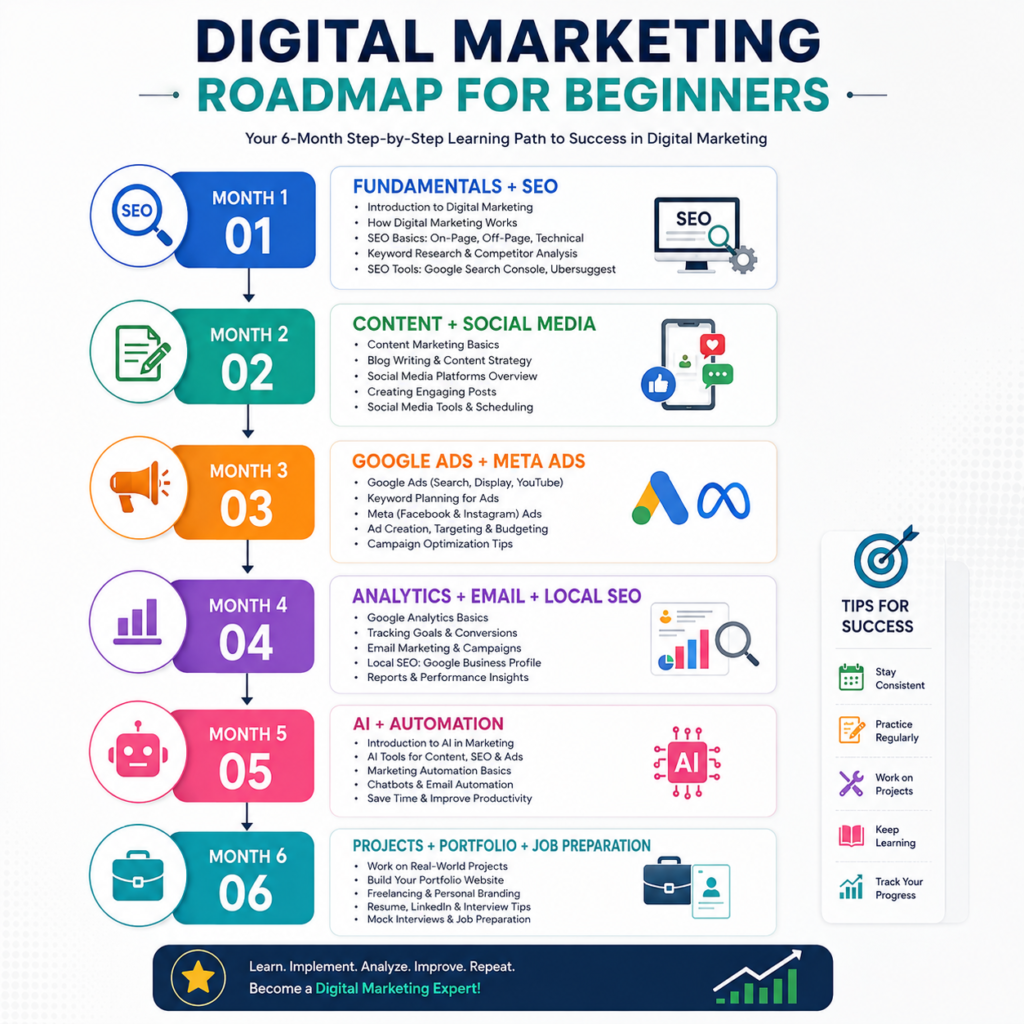
Digital Marketing for Beginners: Learning Roadmap
If you are starting from zero, learning digital marketing in the correct order can make the process easier.
Step 1: Learn Marketing Fundamentals
Start by understanding target audiences, customer needs, marketing funnels, customer journeys, branding, leads, conversions, and basic marketing terminology.
Step 2: Learn SEO
Begin with keyword research and search intent. Then move to on-page SEO, technical SEO basics, local SEO, content optimization, and off-page SEO.
Step 3: Learn Content Creation
Practice writing blog posts, website pages, social media captions, advertisements, and emails.
Step 4: Learn Social Media Marketing
Understand how different platforms work and create a simple content calendar for a business.
Step 5: Learn Paid Advertising
Study Google Ads and social media advertising. Start with theory and campaign planning before using real money.
Step 6: Learn Analytics
Understand how to measure traffic, engagement, leads, conversions, and campaign performance.
Step 7: Learn AI Tools
Use AI for brainstorming, research assistance, content workflows, analysis, and repetitive tasks while reviewing its output carefully.
Step 8: Work on Practical Projects
Create your own projects instead of only watching tutorials.
Step 9: Build a Portfolio
Document your projects, strategies, tools, screenshots, results, and lessons learned.
Step 10: Choose a Specialization
Once you understand the fundamentals, you can specialize in areas such as SEO, paid advertising, social media, content marketing, email marketing, analytics, affiliate marketing, or AI-powered marketing.
SEO Course in Shimla | IICE Computer Education Shimla
Why Learn Digital Marketing in 2026?
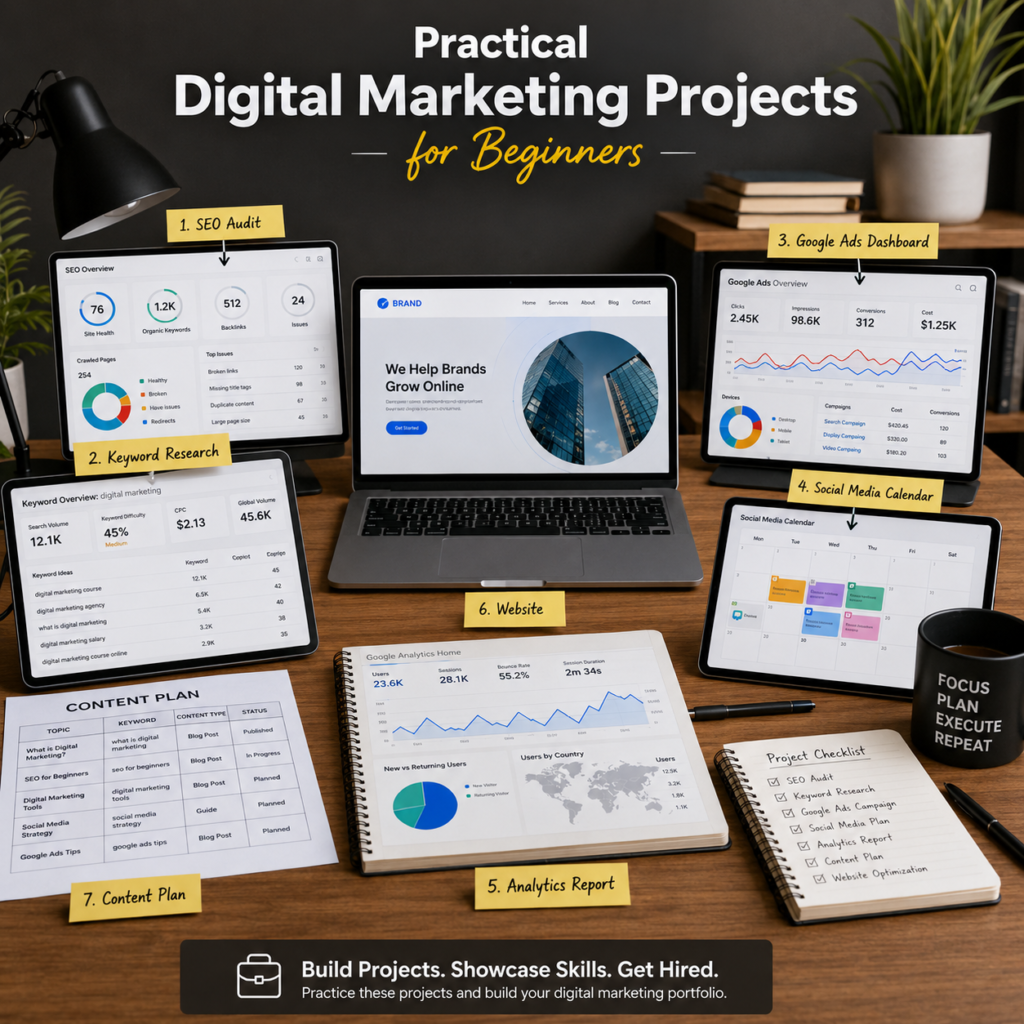
Practical Digital Marketing Projects for Beginners
Practical experience can make learning much more effective.
You can create a simple website for a fictional or real business and optimize it for search engines. You can also conduct keyword research and create a content plan based on search intent.
Other useful projects include:
- Creating an SEO blog
- Building a keyword research report
- Creating a social media calendar
- Designing a Google Ads campaign plan
- Creating a Meta Ads campaign
- Developing an email marketing sequence
- Optimizing a Google Business Profile
- Creating a monthly analytics report
- Developing an AI-assisted content workflow
The objective is not simply to complete projects. You should understand why you selected a particular strategy and how you would measure its performance.
Career Opportunities in Digital Marketing
Digital marketing offers several career paths because businesses across different industries need online marketing skills.
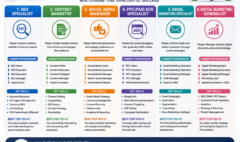
Beginners can explore roles such as:
- SEO Executive
- Digital Marketing Executive
- Social Media Executive
- Content Writer
- PPC Executive
- Email Marketing Executive
- Digital Marketing Analyst
- Content Marketing Executive
- SEO Specialist
- Performance Marketing Specialist
With experience, professionals can move into roles such as Digital Marketing Manager, SEO Manager, Performance Marketing Manager, Content Strategist, Marketing Analyst, or Digital Marketing Consultant.
Digital marketing can also provide opportunities for freelancing and entrepreneurship. Freelancers can offer services such as SEO, content writing, social media management, website optimization, advertising, and email marketing to businesses and clients.
Common Mistakes Digital Marketing Beginners Should Avoid
Many beginners make the mistake of trying to learn everything at the same time.
Avoid these common mistakes:
Trying to Master Every Tool
Tools change frequently. Focus on understanding the underlying marketing concepts first.
Focusing Only on Certificates
Certificates can demonstrate learning, but practical skills and projects are important when applying for jobs or working with clients.
Copying Competitors
Research competitors for ideas, but do not simply copy their content or strategy.
Ignoring Analytics
Without measuring results, you cannot determine whether a campaign is working.
Using AI Without Reviewing the Output
AI-generated content can contain errors, generic information, or unsuitable recommendations. Always review and improve AI-assisted work.
Expecting Instant Results
SEO, content marketing, social media growth, and brand building can take time. Consistency and continuous optimization are important.
Learning Without Practicing
Watching courses and tutorials is only one part of learning. Create projects and solve realistic marketing problems to develop practical skills.
Frequently Asked Questions About Digital Marketing for Beginners
Is digital marketing difficult for beginners?
Digital marketing is not necessarily difficult, but it includes many different concepts and tools. Starting with the fundamentals and learning one skill at a time can make it easier.
Can I learn digital marketing without a technical background?
Yes. Many digital marketing activities do not require programming knowledge. Basic website and HTML knowledge can still be helpful.
How long does it take to learn digital marketing?
The learning time depends on your goals and consistency. You can learn the fundamentals within a few weeks, but becoming job-ready generally requires several months of structured learning and practical experience.
Is digital marketing a good career in 2026?
Digital marketing continues to be relevant because businesses need to attract customers through online channels. However, employers increasingly value practical skills, analytical thinking, AI awareness, and the ability to demonstrate results.
Can I get a digital marketing job without experience?
Yes, but you need to demonstrate your skills. Personal projects, freelance work, internships, volunteer projects, and a strong portfolio can help compensate for limited professional experience.
Can I freelance as a digital marketer?
Yes. Freelancers can provide services such as SEO, content writing, social media management, paid advertising, email marketing, and website optimization.
Is AI going to replace digital marketers?
AI is likely to automate many repetitive marketing tasks, but it does not eliminate the need for strategy, creativity, communication, customer understanding, and decision-making. Learning how to work effectively with AI can therefore be an important advantage.
Which digital marketing skill should a beginner learn first?
SEO, content creation, and marketing fundamentals are good starting points because they help you understand audiences, search behavior, content, and online visibility. After that, you can explore paid advertising, social media, analytics, email marketing, and other areas.
Start Your Digital Marketing Journey in 2026
Digital marketing can initially seem overwhelming because it includes SEO, social media, paid advertising, content, email, analytics, websites, AI, and many other areas.
You do not need to learn everything in one day.
Start with the fundamentals, choose one skill, practice it through a real project, measure your results, and gradually expand your knowledge. As your experience grows, you can choose a specialization that matches your interests and career goals.
If you want structured, practical training, IICE Computer Education Shimla offers digital marketing education covering important areas of modern digital marketing, including SEO, social media marketing, Google Ads, analytics, content marketing, and AI-powered marketing tools.
The most important step is simply to start learning and practicing.
Learn the fundamentals. Build projects. Develop your portfolio. Use AI intelligently. Keep improving.